Manasulu Circuit, Nepa with Mike Howarth (UK).
After 10 days rounding Manaslu I ended up continuing over Thorung Pass on the Annapurna Circuit, another 5 days.

Trip reports coming SOON.

Best hikes, treks, tramps in the world.
Manasulu Circuit, Nepa with Mike Howarth (UK).
After 10 days rounding Manaslu I ended up continuing over Thorung Pass on the Annapurna Circuit, another 5 days.

Trip reports coming SOON.
by site editor Rick McCharles
The Manaslu Trek (or Manaslu Circuit Trek) is a 14-day tea-house trek which circumnavigates the 8th highest peak in the world (8,156m).
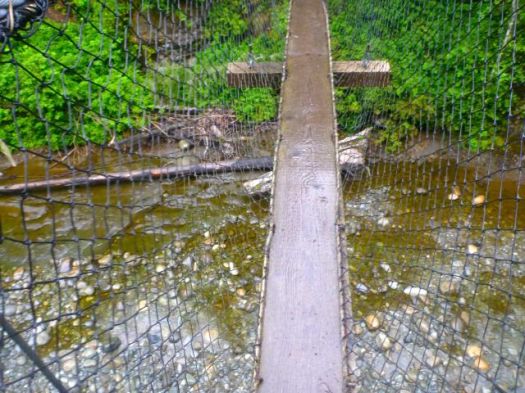
The trek has all the elements of other treks in Nepal including both Hindu and Buddhist culture, protected wildlife, rhododendrons and wild flowers, raging rivers, precarious bridges and stunning mountain scenery.
The trek is much easier than it used to be with greatly improved trails along the Budi Gandaki river gorge. In terms of difficulty, it is comparable with the Annapurna Circuit Trek or Everest Base Camp trek. Its highlight is undoubtedly the spectacular unhindered views of Manaslu. …
Two of us plan to try this high altitude trek starting Nov. 7th. It’s touted the NEW Annapurna Circuit, the old Annapurna having been degraded by road construction. 😦
Guy Shachar posted the best almost independent (hired guide/porter, carried their own packs) trip report (2011) I’ve seen:
Manaslu Circuit Trek- Around Manaslu Trek – detailed itinerary and trail description
More of Guy’s photos
… Until recently the trek used require camping, but building of tea-houses means the trek can be completed using local accommodation. …
When trekking through the Manaslu region, ten peaks of over 6,500 metres (21,300 ft) in height are visible, including peaks of over 7,000 metres (23,000 ft) elevation. …
We plan to go very lightweight. Quite fast. Perhaps 11 days.
We carry our own packs. Have no fixed itinerary. Our guide carries his own gear. We pay his costs — including insurance. Rate is $25 / day.
A private car to the trailhead costs at least $120. We’ll take the bus both ways.
Altitude acclimatization is easy on this trip. You start at Arughat 600m and work slowly and steadily up to crossing Larkya La 5135m. Of course if anyone suffers altitude sickness signs, it’s easy to quickly backtrack.
We’re not likely to make many sidetrips.
Wish us luck. 🙂
by site editor Rick McCharles
day 0 | day 1 | day 2 | day 3 | day 4 | day 5 | day 6
We arose at first light last morning, the coldest yet.


Our adopted dog was quick to the fire.


I’d have to rate the day before and the two days after Kuari as about as good as hiking gets.


Our guide was happy to get back to mobile phone service. He confirmed out pick-up time.


We wandered lazily down through huge alpine meadows. Please that the trek had been a success.

Reaching this Hindu Temple having connection to great epic Ramayana means you’ve almost completed the Kuari.

We finished at the Auli Ski Resort, India’s finest. (Ski Jan-March.) Asia’s longest Cable Car (4km) is a must. The road to get there is deadly. This was one of the hosts of the 1st South Asian Winter Games in 2011.


Our driver was waiting just outside the gates. 🙂

It was 10hrs back to Rishikesh with a hotel stop en route.
The most dangerous aspect of Himalaya trekking by far is the drive to and from the trailheads. Washouts and landslides are frequent.


OK. The giant spider we found awaiting us at our (Le Meadows) Hotel room might look even scarier. 🙂

Before the trek I knew about the June flooding, but not exactly how bad it had been. More than 5700 dead. 😦
One of the 4 Holy Hindu mountain temples, nearby Kedarnath, was inundated with water, mud and boulders from landslide. Several died from drowning or being crushed by stampeding pilgrims.
Yet the roads were back to “normal” by October.
See all high resolution photos from this day.
End.
If you might be interested in trekking Kuari yourself, start with our Kuari Trek information page. 🙂
by site editor Rick McCharles
day 0 | day 1 | day 2 | day 3 | day 4 | day 5 | day 6
We rose early, keen to get up to the Kuari Pass 3640m (12,000ft) in early light.


WOW!
I left a Summit Stone and a 2 Rupee coin at the Alter, thanking Shiva for a safe crossing.

Actually, the Trail climbs a fair bit after the famous Pass.

Here’s the highest point we achieved on the Trek.

Plus perhaps 50cm. 🙂
Anil had just had his fancy boots resoled. But the sole was coming loose. 😦

Our mules caught us here.


Note how mule drivers use stones to balance the load.

Several times I saw the scat of small carnivores. Perhaps Pine Martin. But we never spotted any rodents or rodent eaters.

This handsome bridge had been obliterated just this previous monsoon.

The best section of the trip was from here to the finish. LOVE the ridges.

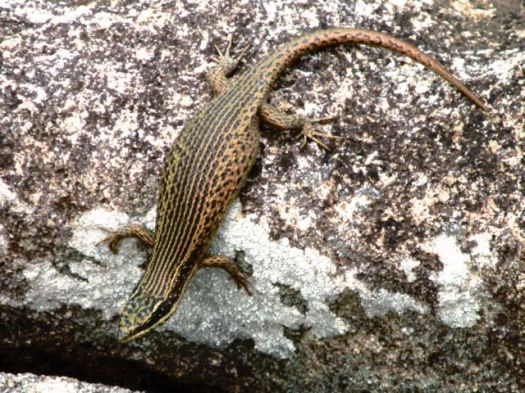
Several times we saw a small lizard that moves like a snake.

Aside from ants, the most common insect was this cricket (?).

After 6 days, we finally encountered another trekking group doing a 2 day Kuari.

One of the Indian men had worked a year in Alaska!

A dog following them reversed directions and joined us for an evening. It’s not unusual to have dogs follow you in the Himalaya. One once climbed up to perhaps 6500m with us on Everest north.
The fantastic view from my tent included the elusive & mysterious Nanda Devi, highest mountain entirely in India.
From here you can gain the Rishi Gorge, a deep canyon, almost impossible to follow. It wasn’t until 1934 that Eric Shipton and H.W. Tilman, with three Sherpa companions, Angtharkay, Pasang, and Kusang, finally discovered a way through into the Sanctuary. Any other route involves difficult passes, the lowest of which is 5180m (16,990 ft).
Tilman and Noel Odell made the first ascent of 7,816 metres (25,643 ft) Nandi Devi in 1936, the highest summit climbed by man until 1950. On a shoe-string budget. Only seven climbers, no fixed ropes, nor any Sherpa support above 6,200 m (20,300 ft).
Tenzing Norgay stated that his most difficult peak was Nanda Devi East, the lower summit.
For religious significance and protection of the its fragile ecosystem, Nanda Devi National Park was declared a UNESCO World Heritage Site in 1988. All access had been banned 1982.
On the Trail we learned that the Park has been partially opened recently for restricted number of tourists.
Tempting …
Our cook outdid himself for out last meal on the Trail.

Pizza. Spring Rolls. French fries …
And for dessert …

See all high resolution photos from this day.
by site editor Rick McCharles
day 0 | day 1 | day 2 | day 3 | day 4 | day 5 | day 6
Another beautiful morning.

Another fantastic breakfast.

Omelette. Toast. Muesli. Corn flakes. And much more.
Alf and I are both coffee addicts. We’d have 2-3 mugs to start each day.
We shared this camp with hundreds of these smelly, entertaining characters.

Climbing over the first ridge we saw our titular destination, Kuari Pass.

On both sides of Kuari we saw no people. The herds were already gone south for the season.

Seasonal herders huts were empty.

This was the biggest waterfall en route.

It dropped hundreds of metres in stages.
I doubt this bridge will EVER be taken out by flood.

I once had a backpack damaged on a pack animal. Straps rubbed a hole in it.


Happily, our mule drivers were very careful. Sleeping mats were wrapped around our gear.
There are butterflies everywhere in the Himalaya.

Alf and I thought we might DASH up to the pass for sunset.

Distances are deceptive. That climb takes 90min!
Instead we used the afternoon for reading and writing. There’s plenty of time for both on a guided trek. I carried two iPods. And began Games of Thrones.

Alpenglow was amazing this evening.


That afternoon I’d tried to get close to an insanely colourful Himalayan Monal.

And we were spied upon by a sentinel on the ridge.

Our cook was sure it was a bharal (Himalayan blue sheep). Our guide wasn’t so sure. Compare with another photo of bharal from nearby Nanda Devi National Park.
Alpine Ibex? Serow? Goral?
Leave a comment if you can identify by that profile.
It was Blue Sheep being pursued by George Schaller and Peter Matthiessen in Nepal 1973. Their adventures documented in one of my favourite books, The Snow Leopard.
BEST of all, just before dark Alf spotted “Baloo“. A Momma Asian black bear and 3 cubs.

That photo was taken at 18 times zoom. The zoom was sufficient, but light was fading fast.
Those are the first bears Alf has seen in the wild. And the first our Guide had seen on this particular trek. A rare sighting.
See all high resolution photos from this day.
by site editor Rick McCharles
day 0 | day 1 | day 2 | day 3 | day 4 | day 5 | day 6
A highlight of this guided trip was the food. Here’s our chef, Kumar, who cooks inside with headlamp.

He’s from Nepal. But has cooked all over the Himalaya, including Ladahk.
One of the mule drivers cooked up Chapattis in the fire, fluffing them right in the ash.

Another treat was our hot water wash-up every morning.

We began to get glimpses of snowy peaks.

Some of the most prosperous villages use slate roofing.

This woman was separating seeds from chaff.

Another was separating beans.

Chilli peppers grow well here. As does seemingly everything.


Quality of bridge and road construction seems superior to that of Nepal and Tibet.


That bridge is maybe 200m high.

The scale of everything in the Himalayas is deceptive.

People here want roads and electricity. The power lines are often out-of-service, however.
To this point, we’d seen less wildlife than I hoped.

The trees are grand, however.


And we did see one troop of Gray Langur monkeys in the wild. We’d seen hundreds in Rishikesh, of course.

Here’s a rarer sighting. A house cat.

We mostly spent time with farm animals.


My favourite of the crops was this gorgeous red grain, just ready for harvest.


We again had some rain late afternoon.

Nights were always clear. Stars and Milky Way super sharp until moon rise.

See all high resolution photos from this day.
by site editor Rick McCharles
day 0 | day 1 | day 2 | day 3 | day 4 | day 5 | day 6
Packing up next morning I was surprised to find that we’d added 2 more pack animals. They carried feed for our 4 mules.


So two helpless “Sahibs” needed an Expedition Team of 4 men (guide, cook, 2 mule drivers). A minimum of 4 beasts. This morning, 6 beasts.
To walk.
Dogs hang about Camps waiting on the compost.

Seems they’ll eat anything except citrus peel and onions.
Up and up.

We passed many villages. All seemingly prosperous and well maintained.

Grazing is critical. Stone fences seem to demarcate who grazes where. But I’m not sure those boundaries are often contested.

We saw a number of the great birds of India.
The Bearded Vulture (Lammergeier) soared above and below us for much of the trip.

Our guide urged us to drink as much water as possible as we acclimatized to altitude.

On arrival at our night’s Camp we were surprised by a freak hail storm.


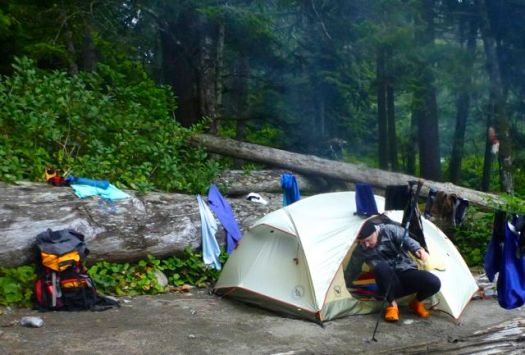
The larger 2-man, 4-season tent was provided by Red Chilli.
But I used my own 1-man tent instead. Alf got the Tent Mahal for himself. 🙂

We Sahibs read in our tents while our Team got a fire started with wet wood.

You’ve got to be ready for anything in the Himalaya.

See all high resolution photos from this day.
by site editor Rick McCharles
day 0 | day 1 | day 2 | day 3 | day 4 | day 5 | day 6
Excited to get started, the day broke clear as it did every day. October through December are normally the clearest skies for hiking.

Rivers are major obstacles in the Himalaya. Many bridges are being “improved”.

We stopped for Chai at a lovely village, friends of our guide.


Women work hard in the mountains. It’s almost impossible to find one resting at any given moment.


Foreigners are regular visitors at this home. The ladies tried to convince this little one that we were friendly.

We chatted with two young women home for the Soy bean harvest. One had a Bachelor of Arts. The other was in first year University.
Our guide, Anil Panwar, insisted that the men of the Himalaya work hard, as well. But I wasn’t convinced.

We set Camp next to a school.

A Saturday, exams had just finished. The kids had Dhal Bhat for lunch. Then most ran off home.
Several hung around to play. Anil led them in some Yoga.


There are many things the mountain people don’t understand about foreigners.

For example, why do white men need a “toilet tent”?

Embarrassed at the extravagance, that was the only campsite we used it.
See all high resolution photos from this day.
by site editor Rick McCharles
day 0 | day 1 | day 2 | day 3 | day 4 | day 5 | day 6
The trek over the Kuari (“doorway“) Pass in the Indian Himalaya was the route followed by Shipton and Tilman and other early mountaineers en route to the peaks on the Indo-Tibetan border.
It is also called the Curzon Trail as the famous former Viceroy of India traveled this route in 1905. (Some say Curzon abandoned that adventure after being attacked by wild bees.)
Frank Smythe:
“We breasted the slope and halted, silent on the path. No words would express our delight. The Himalayas were arrayed before us in a stupendous arc“. (1931)
The tag line for Kuari is “best mountain vista in the Himalayas“.
Click over to kuaripass.co.uk to see the entire panorama, the best I’ve seen online. 7000m peaks are lined up like soldiers for your inspection.
Kuari, as well, is one of the best two treks for those, like me, who want to see famed, mysterious Nandi Devi. Not quite visible from the Pass.
This is Arnaldur Indridason from Norway.

Call him Alf.
Alf and I both signed on separately for the Kuari Trek with Red Chilli Adventure out of Rishikesh. (trip details PDF)
Red Chilli’s Vipin Sharma returned our emails. Gave us clear answers and specific prices. That’s a very professional company.
Cost $600 each for 2 hikers. (Price drops up to a maximum of 10 hikers.)
• 82km over 6 days of hiking
• 8 days all inclusive (Oct 18-25, 2013)
• 34,000 rupees + 3.1% because I paid with credit card
• tips to 2 drivers, 2 mule drivers, cook and guide
Animal trackers, gun bearers and skinners are extra. 😦
Note: Lonely Planet recommends this hike in the opposite direction. LP got that WRONG. There’s not one single reason to start in Joshimath. Especially if you are not acclimatized to altitude.
We wisely started at Ghat 1330m, slowly and steadily working our way up to over 3500m.
Alf and I did not meet until the morning of departure. Always a gamble, it turned out that Alf and I had many common interests. We were both travellers. Both hikers. We’d both done Milford Track in New Zealand and Huayhuash in Peru, for example.
Red Chili provided an excellent vehicle and a safe driver for the 8hr trip up into the Himalayan foothills.
I stayed awake for almost all of that. There are many interesting sites en route.
Well past monsoon, the roads were in good repair. We had no delay longer than a few minutes.
It’s rare to find a valley in the Indian Himalayas without people. During the trip we bought last minute provisions at roadside villages.
It began to rain as we arrived at our trailhead campsite.

First order of business in all things India is … Chai.

This fellow needed to climb to turn on the Village electricity for the evening.

Road repair and animal grazing. Those seem to be the two main industries in roadside Himalayan villages.

The youngest babies rode along on mules.

So far, so good … 🙂
See all high resolution photos from this day.
I’m just back online after 8 days away on the Kuari Pass in the Indian Himalaya.
Detail trip report coming soon. In the meantime, here’s a glimpse of our adventure.