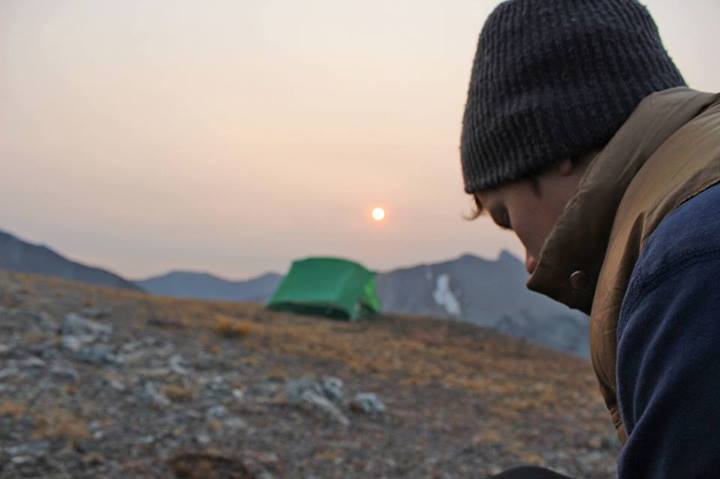
Greg and Helen are hiking the East Coast Trail.
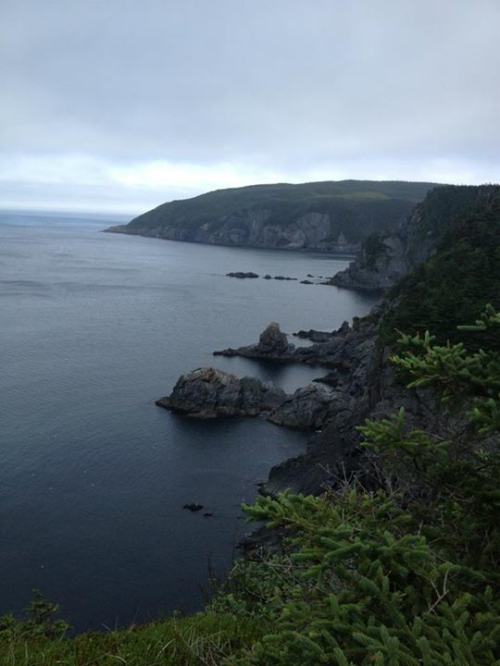

more photos on Facebook

Best hikes, treks, tramps in the world.
by site editor Rick McCharles
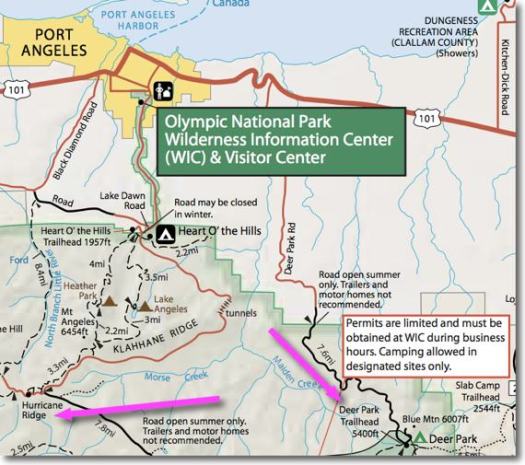
I’ll likely start at Hurricane Ridge, in the direction of Deer Park.
That could change when I get local advice while collecting my Wilderness (Backpacking) Permit.
Maximum 4 nights.
I’m most interested in the eastern (higher) side of the Park. The rain shadow.
Leave a comment if you have advice.
Our 10 episode video series – Lightweight & Ultralight Backpacking Foundations – and our Gear Recommendations eBook are the complete learning package for any backpacker interested in lightweight backpacking, thru-hiking, or simply carrying a more comfortable pack.
$24.95
details
Click PLAY or watch an introduction YouTube.
Disappointed with the other day hikes I’d checked close to NY City, I made a special trip to the best of the best.
Breakneck Ridge is a mountain along the Hudson River … Its distinctive rocky cliffs are visible for a long distance …
… Lying within Hudson Highlands State Park, it offers many stunning views of the river and region and is quite popular with hikers, to the point that a rail flag stop has been established on the Metro North line which runs right by the base of the ridge along NY 9D.
While several routes exist, most hikers take the white-blazed route up the mountain’s west face that begins on the West (Southbound) side of Route 9D near the tunnel.

After circling around to cross above the tunnels, it begins a steep, rocky and challenging climb up to the first bump of the mountain, about 720 feet (219 m) above the river, where there are sweeping views of the river and Highlands. …
Here’s that first “bump”, this flagpole.
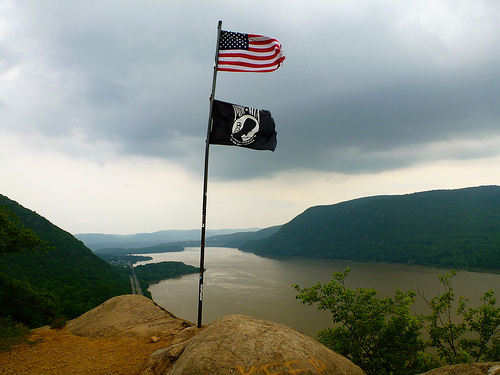
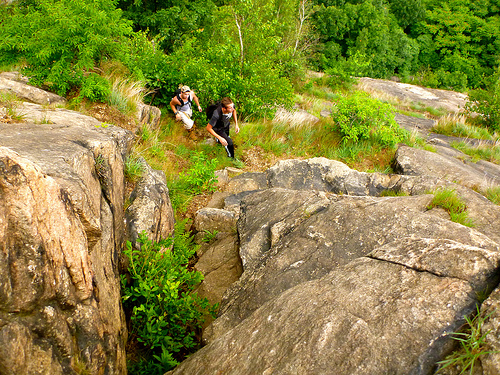
As a former gymnast, I loved it. Using my hands as much as possible.
The only time my heart rate jumped above 180 beats / minute was when I nearly stepped on this BIG BLACK (possibly deadly, I assumed) Western rat snake.
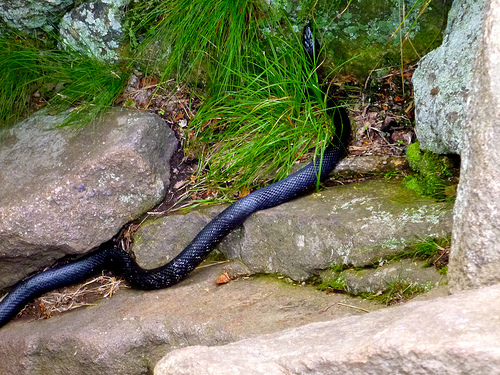
(Or is it a northern black racer?)
I left a Summit Stone atop the highest point I could find.
Trip report by Big City girl Amy Cao:
With its close proximity to New York City (only an eighty-minute train ride from Grand Central), stunning vistas of the Hudson, Storm King Mountain, Mount Taurus and West Point Academy, it’s no wonder why Breakneck Ridge is an immensely popular hiking destination for those seeking to escape the frenetic city pace, if just for a day.
Repeatedly voted as one of the best trails in the country, Breakneck Ridge offers 5.5 miles of challenging rock climbs and rugged hikes for even the most seasoned Eagle Scout. You’ll need all four limbs to scramble up the first mile when suddenly the vertical ascent will have you scrunching your brow at how you managed to get stuck—and without safety equipment—between a rock and a hard place, with no way to go but up. The adrenaline is pumping at this point. …
I scrambled up and down. But you could opt for the Breakneck Ridge Loop.
MAP (PDF)
yet more photos – Breakneck Ridge & Sugarloaf Mountain Hike
I rented a car. Tented at Beaver Pond Campground – Harriman State Park. Quiet mid-week, party central on summer weekends.
The Long Path is a 347.4-mile (559.1 km) long-distance hiking trail beginning at the George Washington Bridge in Fort Lee, New Jersey and ending at Altamont, New York, in the Albany area.
While not yet a continuous trail, relying on road walks in some areas, it nevertheless takes in many of the popular hiking attractions west of the Hudson River, such as the New Jersey Palisades, Harriman State Park, the Shawangunk Ridge and the Catskill Mountains. …
Plans call for it to be extended through the Adirondacks to the Canadian border.
Unlike the Appalachian Trail, I actually set out to day hike the Long Path.
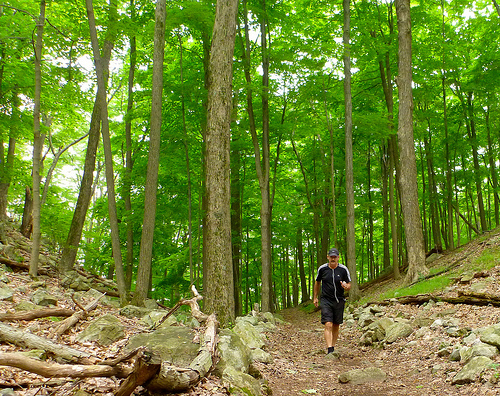
But didn’t go far.
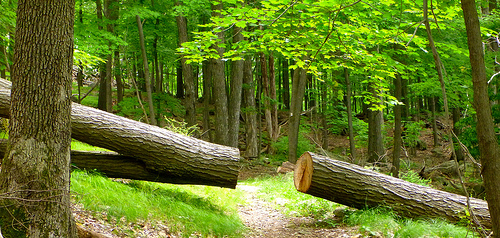
The tree locked trails of the eastern USA simply don’t engage a guy from the Rockies. It’s mostly a green tunnel out here.
I left a Summit Stone with this caterpillar, … and turned back.
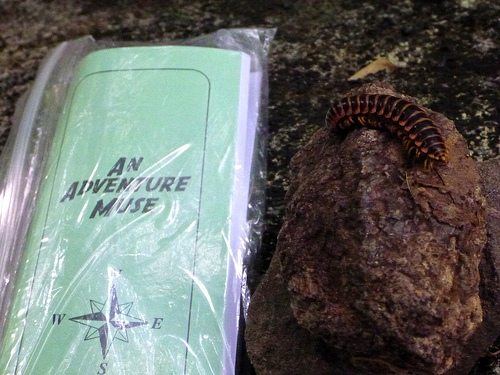
No Long Path for me.
Here’s a glimpse of the kind of terrain we’re talking about.
Click PLAY or watch it on YouTube.
via NJ Hiking
Gone Hiking posted an excellent write-up of an 8 mile off-season section hike of the Appalachian Trail, climbing to Perkins Tower.
Bear Mountain State Park, NY – Appalachian Trail to Hessian Lake
That’s a great hiking site. I’ve subscribed. 🙂

Me?
I drove up to Perkins. Posed for a photo op on the Appalachian Trail, my first encounter with the AT.

This was the first section of the AT opened, October 7, 1923.
Recommended mid-week and off season. It’s a madhouse party camp during summer weekends.
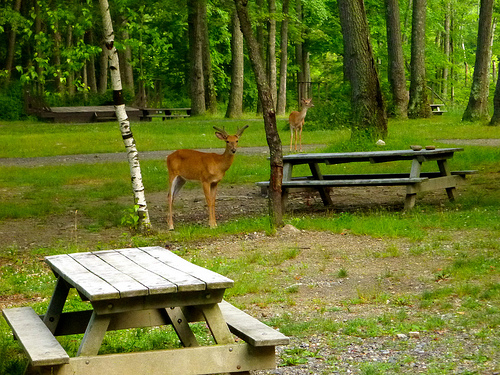
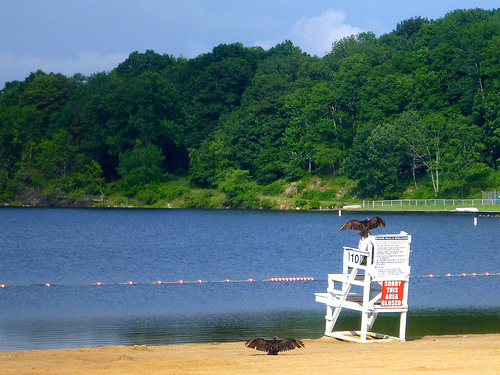
Trip reports from Harriman State Park, New York and surrounds being DRAFTED.
If you (like me) had been using Google Reader, it’s being retired by Google on July 1, 2013.
I recommend you switch to Feedly, a similar free service which most former Google Reader users have adopted.
From Feedly, click the blue button to import your RSS feeds from Google Reader.
There are more RSS reader alternatives listed here.
The new Digg Reader is also free. And garnering some praise.
Easier still would be to subscribe to our posts via once-a-day email. Check the right hand navigation to that.
😦
The mountaineering community continues to be stunned by the events that took place in Base Camp on Nanga Parbat this past weekend. Late Saturday evening or early Sunday morning a group of armed militants stormed the camp, grabbed several foreign climbers, tied them up and shot them in the back of the head, execution style. This left 11 dead, including a Pakistani guide and a cook. The names of the fallen are as follows.
Ukrainian Victims:
Igor Svergun
Kashaev Magomedovich Badawi
Konyaev Dmitry SergeyevichChinese Victims:
Rao Jianfeng
Yang Chunfeng
Honglu Chen (held dual US/China citizenship)Lithuanian Victim:
Ernestas Marksaitis (ExWeb says he was the only member of his team in BC, the rest were in Camp 1)Slovakian Victims:
Anton Dobes
Peter SperkaNepali Victim:
Sona Sherpa