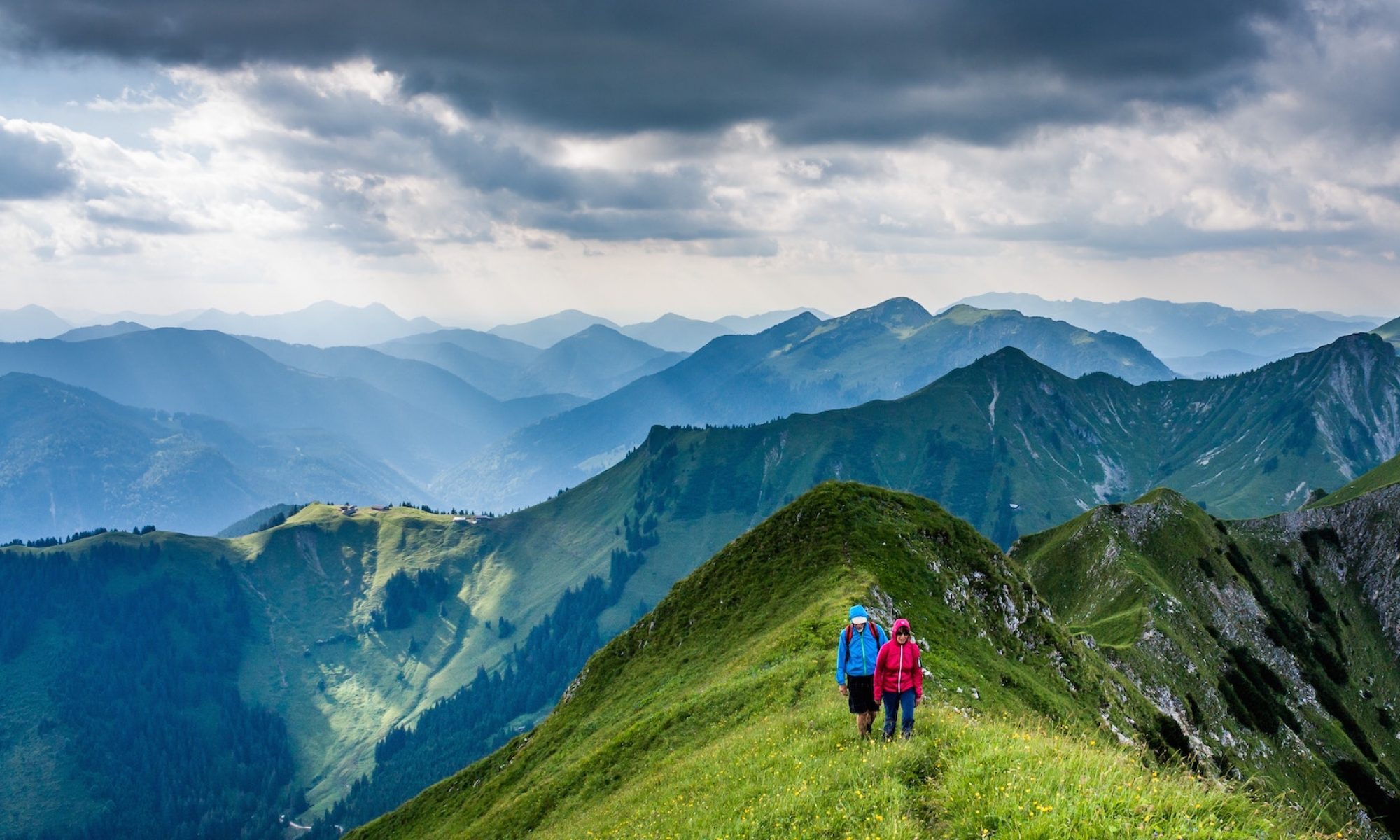

“Walking and Hiking in Europe”

“annie en hans” from the Netherlands contacted us about an excellent site called “Walking and Hiking in Europe”.

It seems to be an archive of walks completed over the years with brief summaries and a few small photos each.

Not all the links work in all browsers, but “Walking and Hiking in Europe” will be of interest to avid European hikers. It’s also posted in Dutch.

oranginas.jpg

looking for a new hiking jacket

My Marmot PreCip jacket is getting old. I should replace it soon.

The editor of Wilderness Trailcraft switched from a PreCip to the O2 Rainwear Jacket by RainShield.

“This jacket is nearly perfect for me because it is extremely light (5.7 oz), a bit fragile and very cheap. I bought mine on Amazon for just under $30! Fragile is no problem when you don’t wear it very often.”

Rain Shield O2 Breathable Rain Jackets

Rain Shield O2 Breathable Rain Jackets

Looks interesting.

Lightweight raingear on the cheap – Wilderness Trailcraft

Also being tested is the (slightly heavier) Zealot Jacket by Outdoor Research. I’ll be watching that blog to hear which jacket they like best.

Zealot Jacket - Men\'s by Outdoor Research

Grey Owl Trail, Saskatchewan

DSD of the wonderful Summit Stones & Adventure Musings blog recommended we add the Grey Owl Trail to our list of the best hikes in the world.

And we have.

You might think this a surprising addition. It’s a relatively easy 40km (25mi) walk along Kingsmere lake in Prince Albert National Park, Saskatchewan. (This is the rugged, rocky “Canadian Shield” — not the flat prairies.)

More information on Trailpeak.com – Grey Owl Trail

One of the criteria for inclusion on besthike is historical significance. The destination — pilgrimage you might even say — is Grey Owl’s cabin.

His is one of the greatest stories of wilderness lore. A British white man born Archibald Belaney (1888) who took on a First Nations identity. Grey Owl wrote books eventually becoming a spokesperson for conservation and the traditional lifestyle of indigenous peoples.

Our contributors from Saskatoon have hiked the Grey Owl Trail many times. Their favourite itinerary is to hike one way, paddle a canoe the other. Half of your hiking group walks, half paddles. (Packs are transported by canoe.)

The Mystery of Archie Belaney

Grey Owl: The Mystery of Archie Belaney

where’s the best hike?

besthike.jpgThe main purpose of this website is to:

list the best, most memorable hikes, long & short, in the world. Hikes that can change your life.

Most are challenging, multi-day adventures. But we also include the very best day hikes: the Tongariro Crossing (New Zealand) & Zion Narrows (USA), for example. We do not (yet) include off-trail scrambles or climbs.

This site helps you get started organizing the trek of a lifetime. The best guidebooks are listed to help you plan. (Be sure to get the most recent edition.)

Currently we are researching the best hikes on Earth adding an information page overview for each.

This is a work in progress. Can you help? Do you know of a fantastic hike that is not yet listed on this site? Did you notice any errors? If so, please e-mail us through contact links on every page.

This page is in the blog section. Here we post what’s new in the hiking world. Updates to our database of the world’s best hikes. And issues facing hikers.

fly to Huaraz, Peru

A shout out to Clara Luz Bravo Diaz of Casa de Clara Guest House in Trujillo, Peru. (Great tourist town, by the way. The north coast of Peru is wonderful.)

They emailed to let us know of a regional airline now flying to Huaraz, Peru, one of the best hiking towns in the world. If you are planning a future trekking holiday to Peru — and who isn’t — stop researching the Inca Trail and start looking at the wonderful walks out of Huaraz:

Alpamayo

Santa Cruz

Huayhuash Circuit

You can now fly into Lima and connect to Huaraz via LC Busre airlines. Air service to Huaraz had been almost nonexistent over the past few years. This really helps.

huayhuash-jake.jpg
photo – solo trekking the Huayhuash Circuit – Jake G – flickr

not having a camera is a GOOD thing

Another great post from the surprising, thoughtful As The Crow Flies blog:

Ten years ago my camera was stolen and until this winter, I didn’t replace it. A camera is nice to have for blogging but for traveling and on the trail I find it too heavy and I think it encourages a person to objectify their experiences. Without a camera, when great sunsets are happening, you don’t think, “this will make a good picture,” you just sit back and enjoy it thoroughly.

On a trek in a jungle in Sumatra, a mother orangutan came down a tree with her baby wrapped around her, the guide gave me a banana as I was the only one without a camera in my hands, I handed the orangutan the banana, looked into her eyes and touched her hand. Over and over, I see people missing experiences by trying to capture them.

Five years ago, when I sold my house, I needed to get rid of all of my stuff. I looked through all the pictures I had, took out the ones of my son, sent them to him, and threw away the rest. Life is about now and you can never be in the now if you have to cart the past around with you.

My travels and hikes are not diminished by not having pictures; I think they are enhanced because not having a camera frees me up for experiencing the moment instead of trying to preserve it. In addition, my life is enhanced by not having to store bunches of pictures of the past.

As The Crow Flies» Blog Archive » Pictures.

(She actually does have a camera now.)

South Coast Track, Tasmania

Rick McCharles

Most serious hikers who travel to Tasmania hike the Overland Track as training for the far more rigorous South Coast Track.

That adventure on the southern most shore of Tasmania takes even fast hikers 7 days, 6 nights after flying into the Melaleuca airstrip trailhead. It’s 83km (51mi) to exit at Cockle Creek through the world’s largest temperate wilderness.

Me – I ran out of time.

Instead of doing the entire South Coast Track, I spent only 4 days, 3 nights enjoying the southern beaches out of Cockle Creek.

400425643_70821a52e8
South Cape Rivulet campsite

I’ve seen tea stained water before, but never as dark as the water of south coast Tasmania. (It’s quite safe to drink.)

400426342_dba7499bf3

The only hassles on this section were biting flies and the odd very deep mud pool. (I almost lost my shoe knee deep at one point.)

400447486_d06fdb9497

I enjoyed the beach sunsets best of all.

Though it looks lovely, be aware that “there are no huts or people living along the track so you will need a tent. There are no fires allowed along most of the coast. You will need to carry your own fuel stove. Lastly and most important – there are no food resupply points between the two ends of the track. You must carry all your own food for the entire trip and also carry out your rubbish. There are no hut wardens …”

John Chapman – guidebook author on the South Coast Track

400448243_6b345cf443
whale statue at Cockle Creek

More annotated photos of the South Coast Track out of Cockle Creek

Final word. One veteran hiker told me that the similar Kokoda Trail in Papua New Guinea was “more difficult by half” than the South Coast Track. On the other hand, in PNG you can have porters carry your pack.

seen a Tasmanian tiger?

Of all sad extinction stories, one of the saddest is that of the Tasmanian tiger.

The Thylacine (Tasmanian tiger) … is the largest known carnivorous marsupial of modern times. …

The Thylacine became extinct on the Australian mainland thousands of years before European settlement of the continent, but survived on the island of Tasmania along with a number of other endemic species such as the Tasmanian Devil. Intensive hunting encouraged by bounties is generally blamed for its extinction, but other contributory factors may have been disease, the introduction of dogs, and human encroachment into its habitat. Despite being officially classified as extinct, sightings are still reported.

The last Thylacine … was captured in 1933 and sent to the Hobart Zoo where it lived for three years. It died on 7 September 1936

Official protection of the species by the Tasmanian government was introduced on 14 July 1936, 59 days before the last known specimen died in captivity.

Thylacine – Wikipedia

To see the last Tasmanian tiger (1933) click PLAY or watch the video clip from 1933 on YouTube.

amazing photos – Marc Shandro

Looking for inspiration today?

I particularly like some of those featuring his son Aaron, here atop Mt. Eiffel in the Canadian Rockies.

.flickr-photo { border: solid 2px #000000; }
.flickr-yourcomment { }
.flickr-frame { text-align: left; padding: 3px; }
.flickr-caption { font-size: 0.8em; margin-top: 0px; }


Aaron Climbs Mt. Eiffel, originally uploaded by Marc Shandro.

A wilderness expert already at his young age.

371435981_9c70ea0cee.jpg
larger original

“favourite” photos of Marc Shandro – flickr