I did not enjoy my one and only true mountaineering adventure, guided to the top of 6000m (20,000ft) Huayna Potosi in Bolivia. Being connected by rope was tedious. Having no input into the speed of the climb, annoying.
Where I come from, the guidebook Scrambles in the Canadian Rockies, 3rd edition by Alan Kane is essential. Increasingly my hiking friends prefer hard, fun one day adventures over multi-day walk hauling a pack.
I love this book. And curse it, alternately. Needless to say, route finding on scrambles are not without their challenges. (We’re still arguing about the actual summit of Storm Mountain.)
I’m happy to announce the sequel, by a new author: Andrew Nagura.
Looks great. New routes for those of us who like to climb high, but don’t want to gear up for climbing.
Guests at the biggest UK festival include Sir Chris Bonington, Doug Scott, Sir Ranulph Fiennes, Greg Child, Joe Simpson, Simon Yates, Canadian Will Gadd and many, many others.
“Since 1980, the very best showcase for mountain sports, culture & environment”
First we have news of a film coup on the opening Friday night: Far North
Only shown at the Venice and London Film Festivals, this is a dark epic tale set in the harsh beauty of the Arctic starring Sean Bean, Michelle Yeoh and Michelle Krusiec. A powerful film that combines action, love and survival in the frozen wastes. Shot in Svalbard and Northern Norway in by Asif Kapardia, director of Warrior.
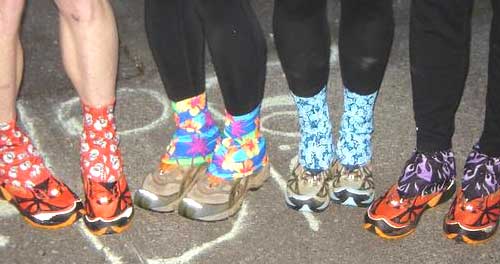
My hiking buddy Mark Glaser invented “InstaGaiters” years ago. He wears modified women’s nylon stockings.
Looks like he should have patented the idea. This is similar:
From the Happy Feet blog:
Gaiters are an important for trail runners, and for that matter, hikers, adventure racers, and even walkers. They cover the top of the shoe and prevent debris from going inside the shoe. It is this debris, between the shoe and sock, which leads to hot spots and blisters. A simple pair of gaiters can help prevent problems.
For my money, I like the gaiters made by Chrissy Weiss, called Dirty Girl Gaiters. Chrissy has a lock on gaiters that make a statement. They are bold and colorful. They are in-your-face patterns that inspire. Most of the runners yesterday wore Chrissy’s gaiters. They are made from soft, comfortable four-way stretch spandex unisex with gaiter hooks under the front shoe lace and secures to the back of the shoe with a self-adhesive Velcro strip. They are dirt-cheap for $13 per pair, including postage.
And, yes, guys are wearing them too. A lot of guys.
Compared with the many other reviews you’ve read, I have little to add:
excellent movie
a little too lengthy
excellent acting
Academy Award consideration, perhaps for Emile Hirsch who played Christopher McCandless. Perhaps for Hal Holbrook and several others.
Hirsch was great too in Lords of Dogtown. He’s got a career ahead of him.
I went to the movie with a hiking buddy, Rocco Cioncio, who had just reread the superb book by Jon Krakauer. Rocco was impressed how little the film was Hollywoodized. Director Sean Penn loves the book and obviously went to pains to stay true to the story.
I want to thank the McCandless family for letting the film go forward. That must have been very painful. I trust it was something of a cathartic resolution.
And I want to thank Jon Krakauer for having the vision to follow-up this, one of many run-a-way tragedy stories.
Krakauer has done more than anyone else over the past 10 years to bring main stream attention to the outdoor lifestyle. Yet he’s lightning rod for criticism, most of it unfair.
One new angle, to me, is the possibility that Chris and Alexander (his alter ego) was a manifestation of mental illness.
This story was published in the Anchorage Daily News recently and it was sent to me by Azzfan. The gist of the story is that the writer, Craig Medred, believes that Into The Wild, both the book and the movie, fail to tell Chris McCandless’ story because they ignore the fact that he may have been a schizophrenic. …
At the Banff Mountain Festival I bumped in Chris Hopkins, a friend I hadn’t seen for 17-years.
Turns out he and his wife are managing beautiful Simpson’s Num-Ti-Jah Lodge, 40km north of Lake Louise on the Banff – Jasper highway.
Unlike many of the tourist highlights of the Canadian Rockies, winter is their favourite season. When I told Chris I was a hiker, he spoke of great trails out of the lodge. But that the cross country and backcountry skiing was even better.
I’d love to tour of all the Rocky Mountain lodges. This would be high on my list.
Stop summer or winter. The red roof, the blue lake, the green trees. This would be a terrific place to film your movie.
“The filmmaker creates a rich and beautiful canvas on which this story is told,†says jury member Julie Tait. “This is a sensual film with an experimental treatment, a story of life, love and loss.†“It’s sex mixed up with climbing,†adds jury member Pat Morrow.
“Director Sharon Colman has given us a refreshing look at the resilience of the natural world in the face of human impact. She’s creatively delivered a serious subject in a light-hearted and humorous way,†says jury member Rob Frost.
“He has everything,†says jury member Kerrie Long. “He’s young, talented, beautiful and articulate. And yet, this is a gritty story of persistence and determination — he’s always reaching for the route he might not be able to do.â€
“It’s very difficult to deal with the philosophical approach to life in the mountains, and do it visually, not just with words,†says jury member Pat Morrow. “This film does that, with its strong synergy among visuals, narration and dialogue.â€
“We get to know the central character over time, and the film combines precipitous physical locations with insight into the deepest recesses of this athlete’s mind,†says jury member Pat Morrow.
“Mountain culture is not just about folkloric traditions,†says jury member Charlie Buffet. “It’s the way people live and dream their mountain experience. There was a sense of surprise, of playful curiosity, that carried me through this film.â€
“Rarely does Hollywood treat a delicate story with this level of integrity,†says jury member Rob Frost. “We hope that Penn’s work will lead the way for other Hollywood directors, and develop a taste for truth in their audience.â€
“For the Grand Prize, we looked to a film that transcends category,†says jury member Julie Tait. “In giving us fresh insight into a historic event and the cult of hero, Death on Nanga Parbat offers the viewer a depth of experience that underlines the power of the medium. It’s a triumph of substance over style.â€
You and I can catch these videos on the World Tour, starting today. Check the Schedule to see when it’s coming close to you.
One awesome trailer as reward for getting to the end of this post:
King Lines follows Chris Sharma on his search for the planet’s greatest climbs. From South American fantasy boulders to uncharted deep water soloing in Greece to the future of sport climbing at Mt. Clark, Sharma and friends find and climb the most spectacular routes in the world.
The last movie I watched at the Banff Mountain Film Festival was a fitting finale: The Beckoning Silence.
Joe Simpson gives his perspective on the 1936 disaster on the North Face of the Eiger when four young climbers died in public view of Eiger Bird tourists below.
The last, Kurz, perished after hanging on the end of a rope all night with 2 dead partners. Died within metres of the rescue party next morning. A tragedy in every respect.
Simpson’s Touching the Void is my favourite documentary of all time — so I kept my expectations as … realistic as possible.
But The Beckoning Silence is no sequel to Touching the Void. Though it explores similar themes, and is a remarkably parallel story, this is a made-for-TV presentation, not a feature film release.
My review …
The Beckoning Silence is excellent. It’s a must see for anyone interested in the history of mountaineering.
Joe Simpson is the best possible narrator. Articulate, compelling, flawed. He is the highlight.
Joe cannot understand why he lived, and these young men died.
Germany, 2007, 60 minutes
Directed by Jens Hoffmann
“I don’t want to die, I want to live. I’m pretty good at running away, and this is my escape!†This is how Karina Hollekim describes her dedication to BASE jumping. Documentary filmmaker Jens Hoffman first met the now 30-year-old Norwegian in 2002. He immediately started to film, accompanying her through many stages of her BASE-jumping career, until it comes to a sudden stop, changing all aspects of her life.
Karina was mad for BASE jumping the first moment she saw it. This movie documents her addiction to extreme sport and the many costs of that addiction.
It explains why extreme athletes are driven step-by-step to more dangerous stunts. She was one of the first 3 women to fly the new wing suits allowing more daring manoeuvres.
In the film she makes one mistake. And walks away. Later she crashes through equipment failure — and miraculously survives.
BASE jumping to most of us is tiny YouTube video highlight clips. This movie is essential if you really want to understand the sport.
Over 110 BASE jumpers have been killed to date. Pro jumpers last an average of 6 years.
I don’t want to do it. But this film makes me much more understanding of those that do.
BASE jumping is a sport involving the use of a parachute to jump from fixed objects. “BASE” is an acronym that stands for the four categories of fixed objects from which one can jump:
* Building
* Antenna (an uninhabited tower such as an aerial mast)
* Span (a bridge or arch)
* Earth (a cliff or other natural formation)
All of these books are great and recommended. But I have a gut feeling this was not one of the best years ever for outdoor adventure books. Most of the winners are predictable.
The best bet at being a new “classic” is this extensively researched investigation into the 1967 Mt. McKinley expedition. Only five of the 12-man team survived.



 Turns out he and his wife are managing beautiful Simpson’s Num-Ti-Jah Lodge, 40km north of Lake Louise on the Banff – Jasper highway.


 besthike.com