In Calgary the past few weeks we’ve had some amazing hoarfrost and ice fog. Very pretty!
Either on bike or on foot, I’ve been out often with Sasha in the winter wonderland.

Yesterday a hungry coyote tried to lure Sasha away from me, into the trees.


Best hikes, treks, tramps in the world.
In Calgary the past few weeks we’ve had some amazing hoarfrost and ice fog. Very pretty!
Either on bike or on foot, I’ve been out often with Sasha in the winter wonderland.
Yesterday a hungry coyote tried to lure Sasha away from me, into the trees.
Stuart at TrailSpotting.com is doing something interesting and innovative.
He’s built a Gallery on Flickr, adding some of his favourite photos from different photographers.
For example, click through to Yosemite Trailspotters Gallery.
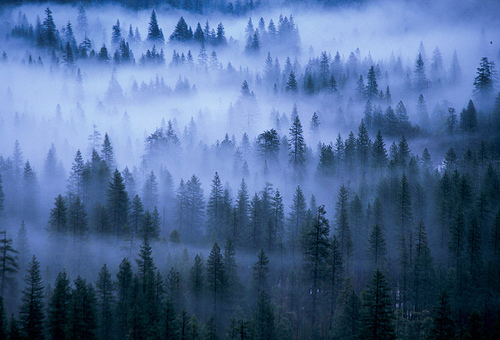
Here’s one of those beautiful pics, Valley Winter Fog From Inspiration Point, by gorman jones.
Next, he’s added some annotation to that photo:
Inspiration Point is a short hike up from Tunnel View where you can admire the splendors of Yosemite Valley. It’s difficult to find an original image from this oft-photographed spot, which makes Gorman Jones’ image all the more impressive.
And, finally, linked to his hiking trip report on that location:
TrailSpotting – Yosemite Inspiration Point
Very elegant, Stuart.
Kudos.
Last trekking day. Namche to Lukla.
by site editor Rick McCharles
It was a long but comparatively easy descent from Namche to the airport at Lukla.
The highlight was the series of suspension bridges.
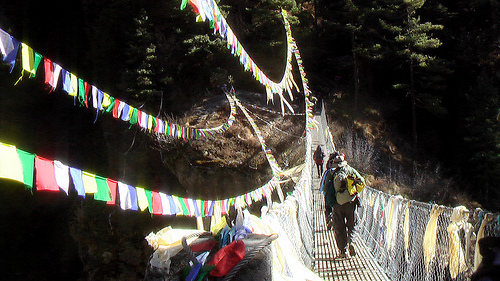
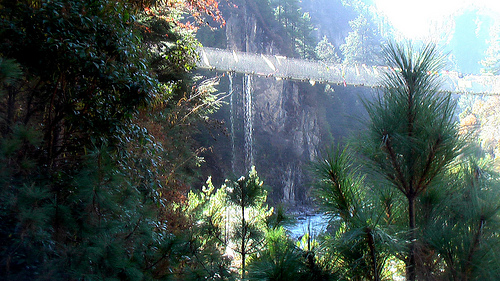
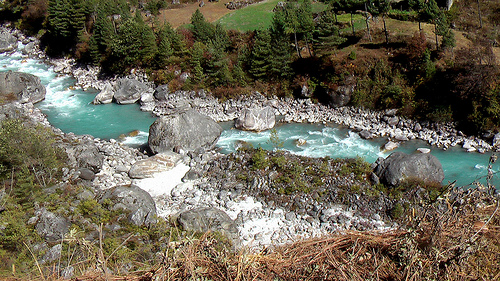
I’ll miss the Buddhist culture and monuments.
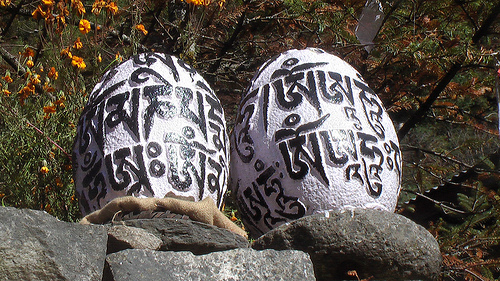
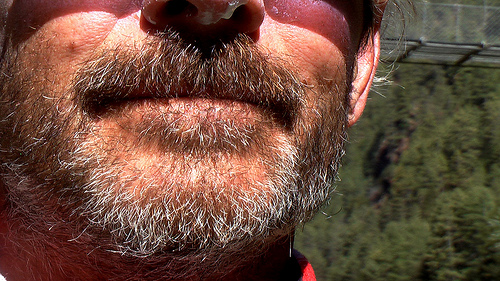
But I was looking forward to a barber shave, “one of the best travel bargains in Asia”.
Are you interested in doing an independent Everest trek? … Some advice:
- you need a minimum of 14 days. More is better.
- acclimatization to altitude is the most serious danger
- Oct-Dec weather is cold and clear
- Mar-May the weather is warmer, but skies may be overcast
- best hike is the 3 Passes, next best Everest Base Camp, third best Gokyo
- if you fly, buy your flights Kathmandu-Lukla return in Kathmandu. You can change the date of your return, if necessary.
- no need to bring camping gear, but warm clothing and sleeping bag are essential
Step 1 would be getting a book for planning. Both the Trailblazer and Cicerone guidebooks are excellent.
Farewell Lukla. The Everest region has the finest mountain scenery I’ve ever seen.
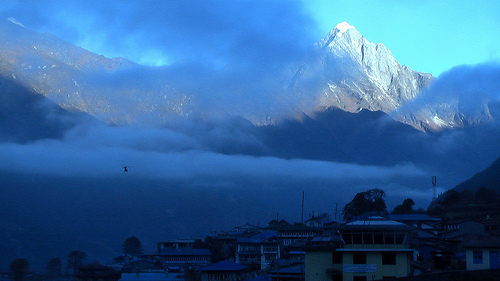
see all photos from day 17
by site editor Rick McCharles
Gokyo to Namche
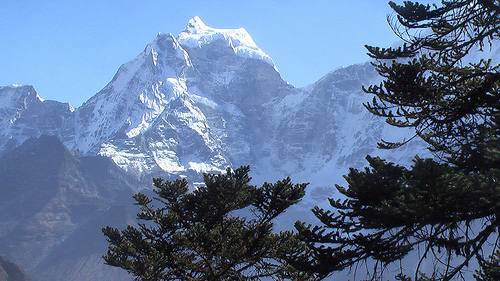
Renjo La should have been the last high alpine crossing on my Three Passes of Everest trek. … It starts with a steep climb from Gokyo over the ridge (5345m) at the top right corner of this photo:
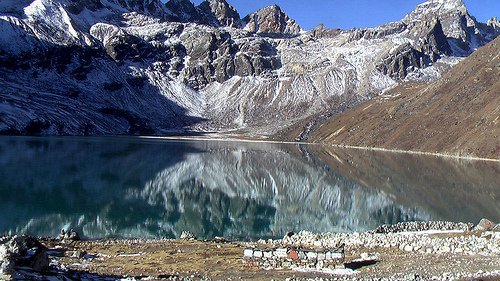
A particularly grueling 10hr trek to Thame.
… Instead I turned south, deciding to end my trek as quickly as possible. I could make it to Namche from here in a long but easy walking day.
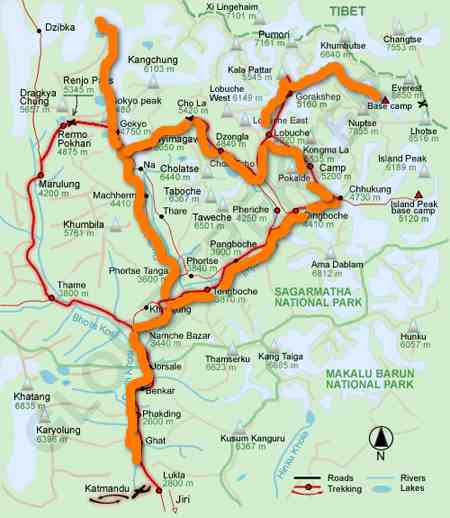
My 3 Passes route became a 2 Passes route. In the end, I did the lollypop loop in orange, skipping the Renja Pass in red.
Highlights of this day included 2nd Lake, Taujung Tsho …
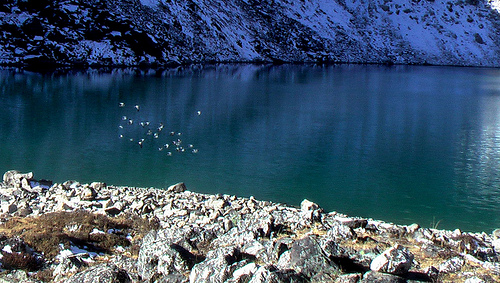
… and the Brahminy ducks on Longponga Tsho, 1st Lake.
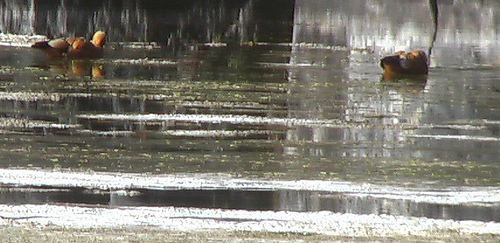
Nobody knows why these birds decided to make their home at such high altitude.
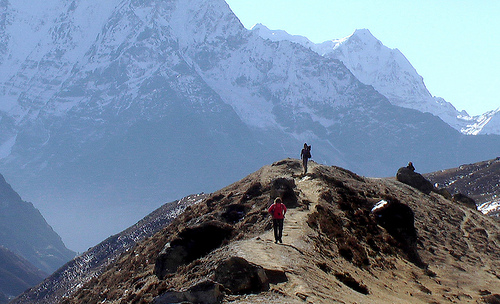
Very quickly I left the snow behind.
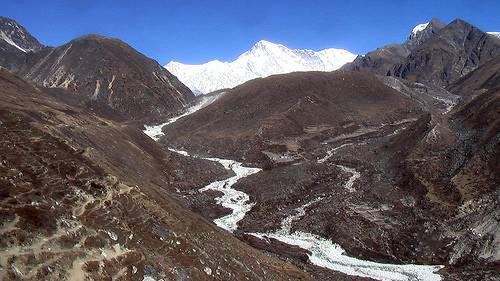
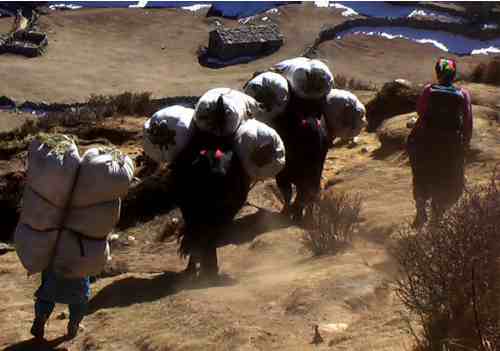
The trail got busier and dustier as I descended.
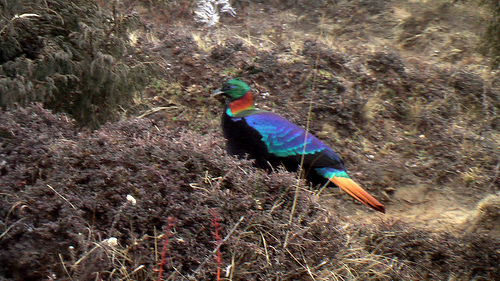
I spotted a colourful male Himalayan Monal (Impeyan Pheasant), much less common than the female, it seemed to me.
Finally, large trees started providing some shade.
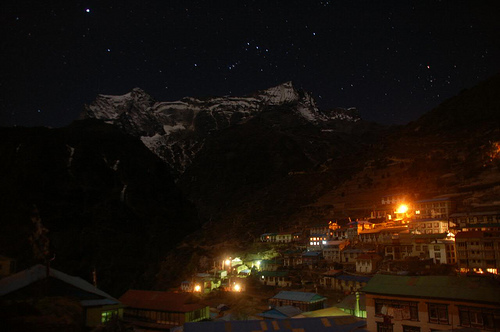
That night in Namche I enjoyed “civilization”, staying (I think) in the same room slept in by Jimmy and Rosalyn Carter in 1985.
It felt great to be finishing such a long hike.
see all photos from day 16
by site editor Rick McCharles
I awoke to this gorgeous view from Gokyo village 4790m (15,715ft).

The brown hill off to the right (in shadow) is Gokyo Ri (5360m). Famed for its view of four 8000m peaks, including Everest.
Here’s the world’s highest mountain from the top:
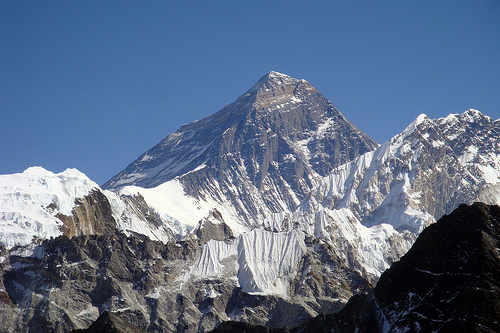
That’s not my photo. Actually I did not make the ascent because a guide had told me that the view en route to Renjo La, was identical. Renjo La would be the last alpine crossing on my Three Passes of Everest trek.
Instead I waited for the sun to come out while chatting with guests at Gokyo Resort.
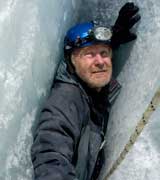 The most interesting and entertaining was Doug Benn, Professor of Glaciology, teaching at University of St Andrews, UK and The University Centre in Svalbard, Norway.
This was Doug’s 6th trip to Gokyo. He and a number of researchers were taking measurements on the Ngozumpa Glacier, the largest in Nepal.

Diplomatically, Doug answered my questions about “Climate Change”. Al Gore is not measuring glacial retreat, Doug is.
Doug confirmed that all glaciers are retreating aside from 4 areas of the world. Climate is changing, as it has been changing since the beginning of the Earth. He wouldn’t speculate as to why. Or what could be done about it.
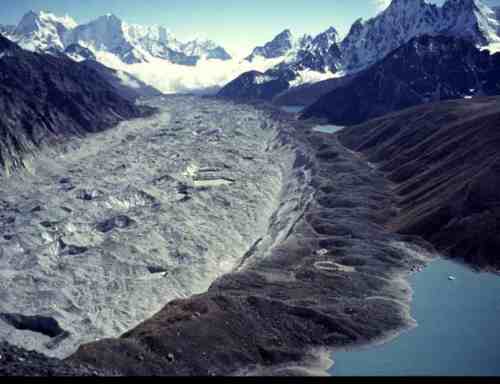
Later I found Doug’s Ngozumpa Glacier Project page online:
… Glaciers in many parts of the Himalayas have undergone significant shrinkage in the last century in response to climatic warming, which in some areas is occurring faster than the global average. Some of this warming is part of a natural climatic cycle, although over the last 50 years or so probably about half of the warming is attributable to human sources (greenhouse gases) …
Doug’s research was to get hard data on what is happening. His goal was to help people and nations better prepare for that change. He said that in every climate shift some species in some regions are winners, some are losers.
I took a leisurely off-trail hike along the crumbling moraine ridge north towards Tibet. Up to Thonak Tscho 4870m.

This one way side trip is called The Sacred Lakes of Gokyo. Six lakes are sacred to both Hindus and Buddhists.
The next, Ngozumpa Tscho, was groaning and moaning like some distressed beast. Weird. I tried to capture the sound on video, but it didn’t work. It was the sound of ice freezing.

The highlight of the day wasn’t the lakes, but rather my old friend Cho Oyu, the friendliest 8000+m peak. I got as close as I could.

Eleven years ago we did the same thing, walking towards Cho Oyu from the Tibet side. The summit is on the border. For me it was déjà vu all over again.
Two hikers from the U.K. and I walked as far as possible up the glacier, hoping we might even reach Cho Oyu base camp. That turned out to be impossible. Late in the afternoon, the Brits departed with haste, trying to get back to Gokyo before dark.

I stayed to climb this boulder, the obvious viewpoint at the very end of the normal trail. This was as close as you can get to Tibet without descending down to the glacier.

I left a Summit Stone on top. The next hiker to scramble up would find it.
… All day I’d had a feeling I should end this adventure soon. This seemed a suitable finale.
It was night by the time I got back to Gokyo. But by now I was getting used to stumbling into my lodge in the dark.
see all photos from day 15
… on to day 16
Trip report by site editor Rick McCharles.
Over the Cho La 5420m (17,782ft)
There are no tea houses. No restaurants. The Cho La is seriously dangerous. Often a guide, ice axes and ropes are needed. Yaks can only rarely cross.
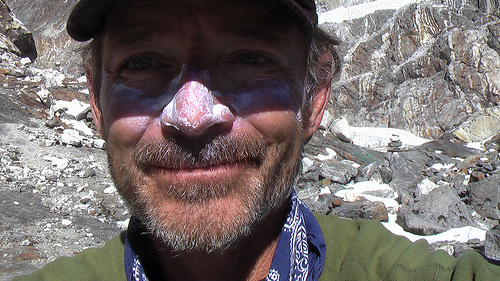
I may not have been looking better, but I was feeling better after headache and some diarrhea the day before. (All I could stomach was Pringles, the first time I’d ever bought them.)
Actually, I awoke with a very stiff neck, a condition (cause unknown) that lingered for 2wks!
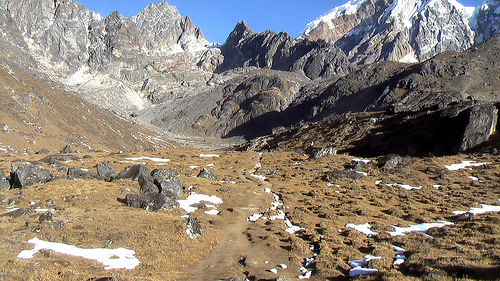
Departing Dzonghla the mountains look impassible.
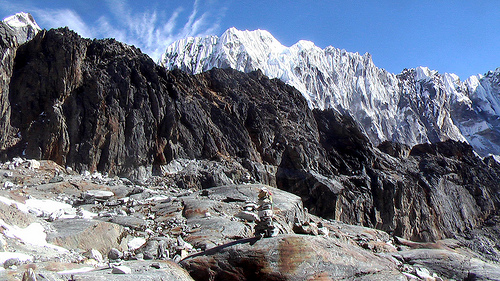
High, steep and intensely glaciated.

Here’s the crux. Crossing the Cho La Glacier.
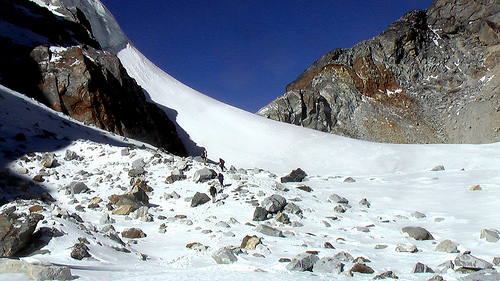

I waltzed across like it was a sidewalk.

The astonishing weather had encouraged many guides to bring their groups to cross the Pass today. There must have been 50 people eating lunch at the Cho La.

The descent is a crappy scree scramble.
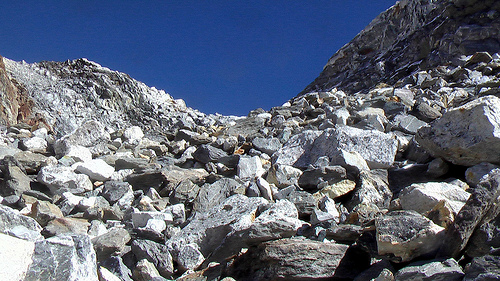
Everyone but me stopped in the next village, Tagnag (Dragnag). A charming, clean and well-organized stop.

Having lost a day to illness, I thought I’d push on to Gokyo on the other side of the Ngozumpa Glacier.
… How far could it be?
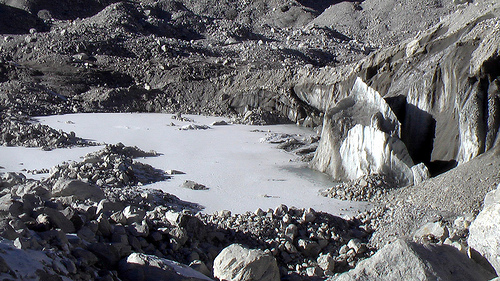
The torturous and exhausting traverse seemed to take forever. Crossing glaciers is by far the most difficult and dangerous thing hikers do in this region.
It was well after dark when I finally rolled into famed Gokyo 4790m (15,715ft).
see all photos from day 14
… on to day 15
Trip report by site editor Rick McCharles.
After a long, cold night in the tent, I awoke with “mountaineer’s lassitude“:
… reluctance to put one foot in front of the other …
I’d first read of the condition in the mountaineering parody, The Ascent of Rum Doodle (1956), one of my favourite books.
I was sick again. The same stomach ailment I had on the first 2 days of the trek.
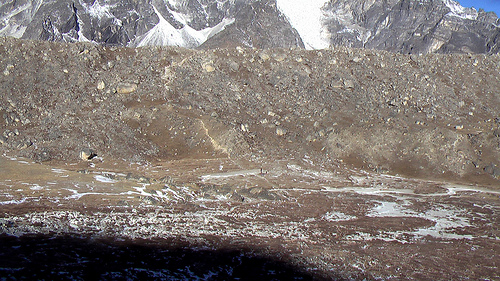
That’s the lateral moraine of the Khumbu Glacier. I first needed to trudge down. Then find a safe way across. Others had advised that it was no problem this season, … if the weather is good.

Fortunately, the weather remained perfect. There was not even snow blowing off the highest peaks!
It seemed to take a long time to reach Lobuche.

I stopped for lunch and to recharge my batteries at a restaurant. Then psyched up for the relatively short and easy walk to Dzonghla (Dzongla).

it was a pity I felt rotten. The weather was stupendous. And the scenery even better.

Late afternoon I finally reached the remote village. But I spent less time in the guesthouse restaurant than in here …

I crashed that evening without eating. And did not get up until Noon the next day.
Mid-day there was only myself and the Nepali National bird, the Himalayan Monal, wandering about the courtyard.
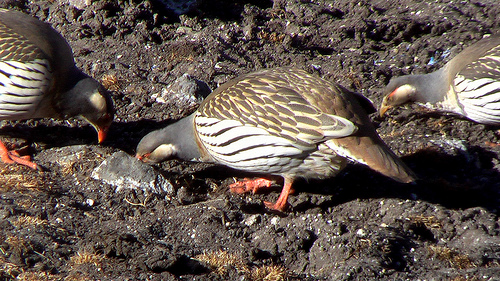
Everyone else had departed at first light over the Cho La, the most difficult of the Three Passes route.
I had a forced rest day. Standing around like this guy.

Disappointing.
see all photos from day 12-13
… on to day 14
Trip report by site editor Rick McCharles.
Over the Kongma La 5535m (18,159ft)
I heard plenty of warnings about the 9hr crossing. But in perfect weather … if you are already acclimatized to altitude, it’s only moderately difficult.
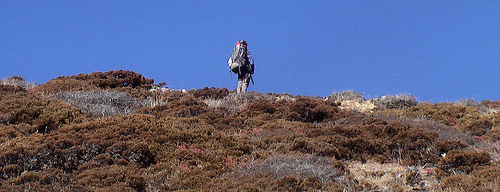
One of two access trails climbs quickly up and away from the Nuptse Glacier. And away from “teahouse trekking”. There are no facilities along the way. This is true high altitude wilderness.
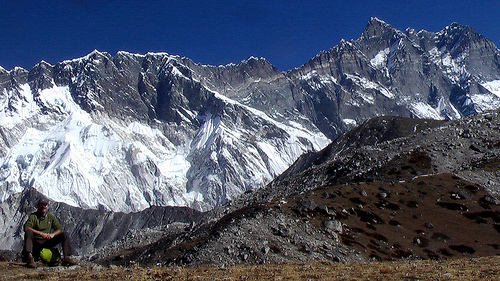
I loved it.
It starts with an easy grassy valley walk. And ends in “… a lunar landscape of icy lakes and frozen ridges …”
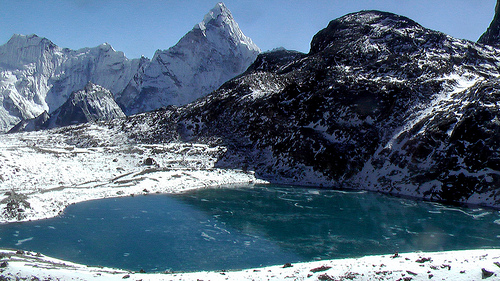
I scrambled part way up a ridge of Pokalde Peak 5806m (19,048ft). As you can see, it’s not difficult.
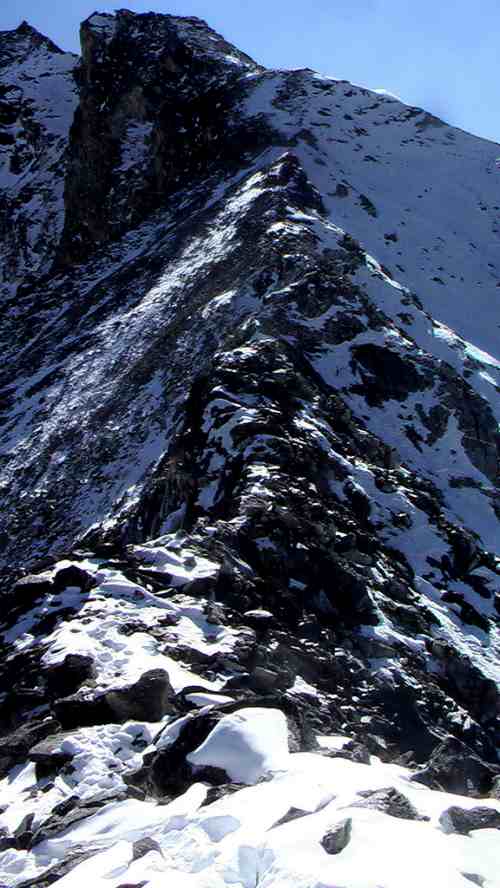
This is not the route used by most trekking peak groups, however. (I didn’t want to get in trouble for not having a “trekking peak permit”.)
What a view from on high!
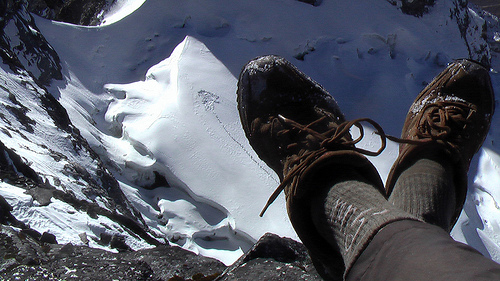
I lingered long at the pass 5535m (18,159ft), so late that I was the last trekker to cross that day.
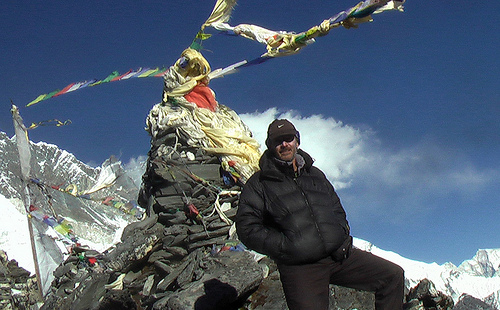
The descent from the pass is the most difficult part of Kongma La … scrambling frozen loose scree for 2hrs Yuck.
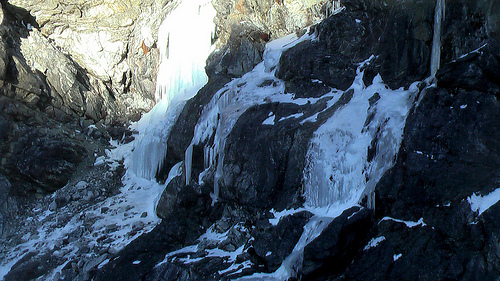
I could have just barely made it down to the village of Lobuche before dark … but I’d heard bad things about those guest houses. Lobuche is a messy, littered place, the least appealing of any accommodation I saw in the Khumbu region.
Instead I set up the tent above 5000m.
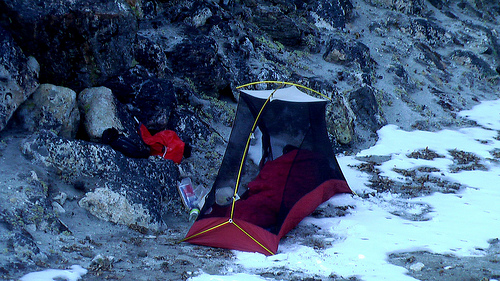
Wish me luck. It’s going to be COLD.
see all photos from day 11
… on to days 12-13
Trip report by site editor Rick McCharles.
Content with success getting to Everest Base Camp and Kala Patthar, I decided to take a rest day before tackling the first of the Three Passes.
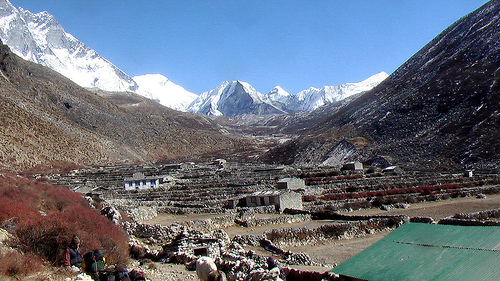
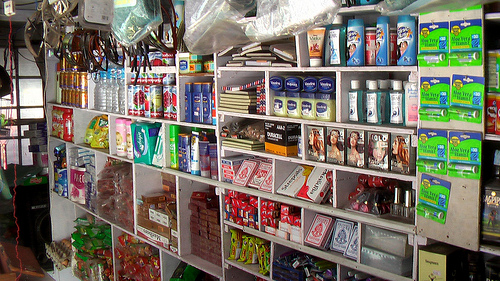
Morning in Dingboche was catching up on email, charging my batteries, and replenishing my personal food at this excellent “grocery store”.
For once I hung around the “teahouse”, chatting with guides and hikers. And eating. The food is surprisingly good.
Regarding the guest houses …
… Rooms are simple, plain, but generally clean and secure …
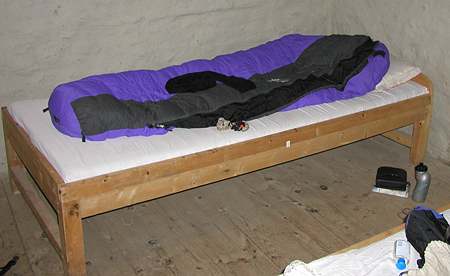
… The beauty of independent trekking in the Annapurna or Everest areas is that you can stay in tea houses or lodges which means all you really need is clothing, a warm sleeping bag, water bottle and some form or water purification, wash kit, basic first aid kit and, erm, money. …
Outdoors Magic – How To: Independent Trekking In Nepal
The biggest complaints are about toilets. Many are dark, dank and cold. Most are squatters.
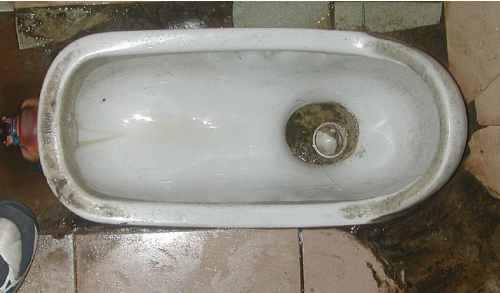
Finding a sitter is a bonus.
The best source of information was the owner of the internet café. He convinced me that the Spring hiking season (March-April) is even better than the Fall (October to early December). Hikers are “healthier” in the Spring, he told. His theory is that the new green vegetation raises the level of oxygen.
I got excited about a possible future climb of Island Peak 6189m (20,305 ft).
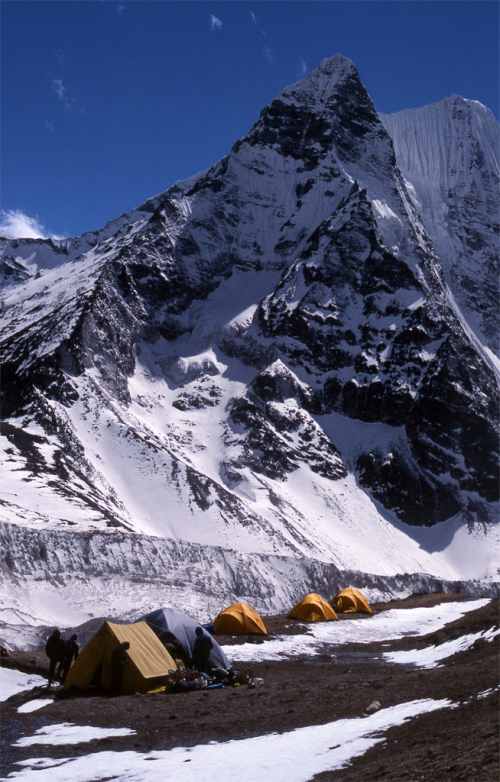
Dozens told me how much they enjoyed the experience. I’d trek to Dingboche independently, then hire a guide and rent gear there. That’s the least expensive way to do it. And all your money goes to the local people.
Late afternoon I took an off trail day hike in the direction of Island Peak.
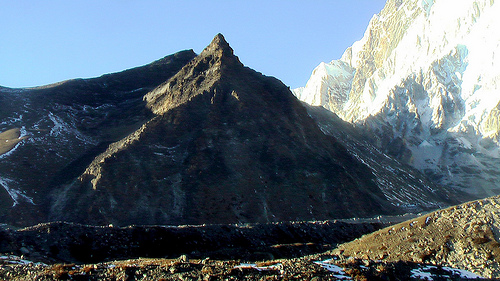
It’s easy to get lost in the glacial moraine ridges. It was dark before I got back to town.
At higher elevations in the National Park it’s illegal to burn wood. Instead they burn dried Yak dung. To get the fire started, dunk a few turds in kerosene.
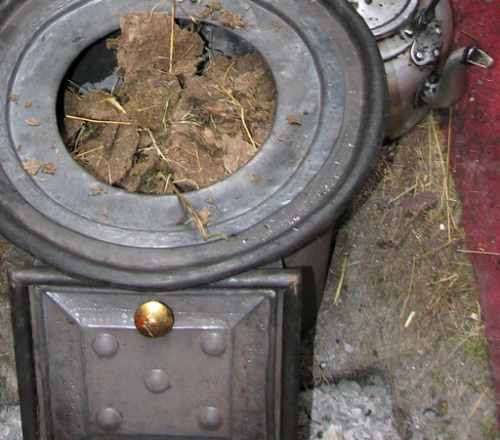
At night hikers hang out around the stove trying to stay warm and awake until 8PM.
all photos from day 10
… on to day 11
Trip report by site editor Rick McCharles.
To Everest Base Camp.
Up the rugged Khumbu glacier moraine …

Sadly, there were very few tents at Base Camp 5360m (17,600 ft). But they set up as close as they can get to the Khumbu Ice Fall.

As I’d often heard, it’s a God Awful place to camp. It must take forever to build new tent platforms each season.

The weather was superb. Above freezing, the glacier collapsing upon itself with melt.
Some hiker goofing at the entrance sign …

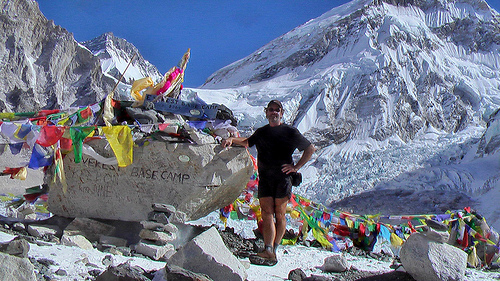
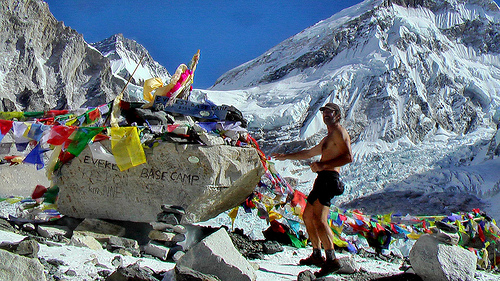
Later I learned that nudity is not allowed near sacred mountains. Israelis who hiked nude over the Thorong La on the Annapurna Circuit were fined $100ea and had their camera SD cards confiscated.
I didn’t linger long as I proposed to backtrack same day all the way to Dingboche. For the first time I could hike as far as I wanted as I would finally be losing elevation.
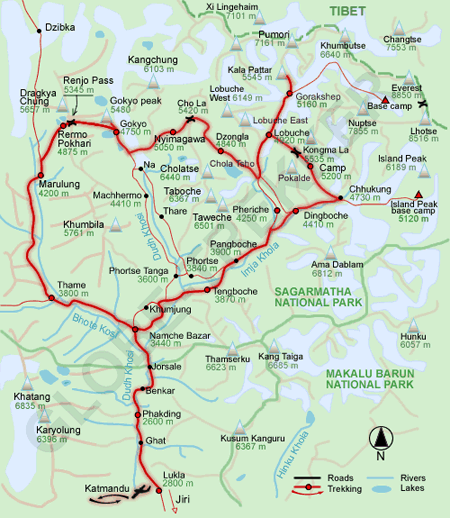
From Dingboche I could resume the Three Passes of Everest itinerary, via Kongma La. This perfect weather was an incentive to hurry.
The only sidetrip on the decent was to checkout the “Italian Pyramid“, a high altitude scientific research station.

It was dark by the time I reached Dingboche. But with every step I felt, psychologically, that the air was more oxygen rich!

see all photos from day 9
… on to day 10
 besthike.com