
The Ultralighter does this trail as an annual pilgrimage.
The summary of his 2009 trip report:
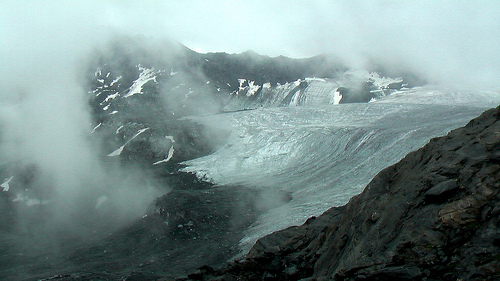
You probably don’t want to try the Loowit Trail now. Maybe 2011 or later, if the Forest Service does a bunch of work. Even Lava Canyon is impassable, unless you are very, very bold. So for now it’s the north half of the mountain or the Smith Creek valley, rewarding in their own ways.
map
He survived his most recent 33mi circuit. But barely.
This trip is no longer an adventure. It is an ordeal.
The greatest backcountry boozer I’ve hiked with is Kelly Mock, then living in Whitehorse, Yukon. It was Kelly that carried a “Bubba” (mini keg of beer) over the Golden Staircase to Happy Camp on the famed Chilkoot Trail in Alaska.
Arriving on the solstice, Kelly bought a round for the house at Happy.
He’s been one-upped.
Michael Popov carried 20lbs of beer up 4,000′ of Mt. Whitney, the highest peak in the continental USA. He was doing some kind of loco carbo loading / altitude acclimatization for his record breaking unsupported John Muir Trail run. (4 days, 5 hours and 25 minutes from Mount Whitney to Yosemite Valley)
Incidentally, Aaron Sorensen will be starting June 28th an attempt on the Unsupported Record on the Lake Tahoe Rim Trail. No one has claimed this record yet. Aaron is looking at 55-60hrs for the 168 miles.
Vital information about natural, unseen hazards that threaten hunters, hikers, campers, and other outdoor activity enthusiasts, including Rabies, Tetanus (Lockjaw), Tularemia (Rabbit Fever), Brusellosis (Undulant Fever), Rocky Mountain Spotted Fever, and Borrelia (Lyme Disease), with CDC advice on how to avoid ticks, and how to remove ticks. Each of the subject diseases is described with symptoms, treatment, history, geographical risk areas, and significant incidence reports. The book is written by Jerry Genesio, a former employee of Cutter Laboratories’ Biological Products Division, and author of a natural history series published by New England Outdoors magazine.
But, once again: “Rangers re-examining safety of popular hike after a fatal fall from cables during final ascent”
It was crowded on the climbing cables leading to the top of Half Dome, but Hirofumi Nohara was seemingly giddy with excitement on what could only be described as a gorgeous Saturday in Yosemite National Park.
The 37-year-old Japanese citizen was talking and laughing with his four friends as they worked their way up the nearly vertical granite slope, witnesses said.
Then he slipped.
Nohara didn’t have time to speak or even shout before he slid off the side of Half Dome to his death, becoming the third fatality within a year off the 4,800-foot granite dome. …
The Best iPhone 3.0 Beta app award at the Apple Design Awards last week is for trekkers.
Rave review … at least if you hike in certain parts of the U.S.A.:
… I haven’t used the application on a hike yet, but the mapping content on the application is very rich, and you can see what the surface of the terrain looks like. The drawbacks are you can’t zoom in as far as the iPhone Google Earth application lets you, and it doesn’t use the iPhone’s auto-tilt function to move to another part of the map like Google Earth does.
AccuTerra lets you share your outdoor experiences with others via Facebook and email. You can post a link of your trek to your Facebook profile or email a link to family and friends that includes the route you traveled and pictures you took along the way. …
Intermap created AccuTerra to fill the void of the modern-day GPS: off-road mapping. Though GPS does a “wonderful job on the road,” acknowledged Thomas, it’s not as useful “once you get to the end of the pavement.” The application also has a library of maps of U.S. national state parks and forests for each state. It had an extensive list of popular hiking and biking trails in the Bay Area, including my favorites, Alum Rock Park and Rancho San Antonio County Park. …
The blissful couple at 17,768-foot Thorung La in Nepal.
… The 128-mile horseshoe-shaped route circles Nepal’s heaven-high Annapurna range, and it’s been hailed as the holy grail of trekking since it was first opened to foreigners in the early 1980s. Travel writers and hikers everywhere gush about the trail …
Season
October is the most popular, thanks to reliably pleasant weather (80°F and humid at 2,000 feet; 20°F and dry at 17,000 feet) and clear skies. …
Map and Books
The best trail guide is Annapurna Trekking Map and Complete Guide, by Partha S. Banerjee (Milestone Guidebooks, $10); it can be found at every bookstore in Kathmandu. Use Trails Illustrated map Annapurna #3003 (natgeomaps.com, $17) and Nepal (Lonely Planet, $25) for pre-trip planning.
Permit
Every trekker needs a permit ($25), but no reservations are necessary. Just pick one up in Kathmandu at the Annapurna Conservation Area Project office on Tridevi Marg (open 8 a.m. to 5 p.m. daily). ntnc.org.np/trekking.php
Trailhead
The trek starts in Besisahar (catch a bus at Kathmandu’s Gongabu Bus Park; they leave regularly) and ends in Pokhara (return on a Greenline Tours bus, greenline.com.np).
Cost (Less Airfare & Rental Car) DIY: Less than $500 // Guided: $1,000-$1,499
Cheap and Easy
Annapurna’s teahouses beat the huts on other classic treks in terms of convenience, cost, and local color. Teahouses charge about $12 per day for a room and meals, and they’re never more than three hours apart, making is easy to keep a flexible itinerary. But that’s not to say there aren’t rules. Here are six: Choose a teahouse before 3 p.m. to beat large guided groups to the nicest places; choose a smaller one for better meal service; take showers immediately after arriving (most hot water is solar heated); order breakfast before going to bed to speed your morning departure; and bring a padlock for your room and a ground pad for the beds, which may be foam, straw, or just blankets.
A few weeks ago – on my first day of mountain biking in the Rockies – I nearly rode into a big black bear on the main trail at Canmore Nordic Centre.
In 2009 are there more bears in the Rockies? Closer to people?
Or am I simply hearing about more bears? And more cougar encounters?
trailex.org tracks encounters and information about trail safety in the Bow Valley (from Banff to Bragg Creek).
That site was set up by the husband of Isabelle Dube who was killed by a grizzly near Canmore.
… Dube, 36, was jogging with two friends when they ran into a grizzly. She scrambled up a tree, but the bear chased after her and mauled the young mother, leading to her death.
She was the first person to be killed by a bear in Alberta since 1998. Since then, two more Albertans have been killed.
Robin Kochorek, a 31-year-old Calgarian, was killed by a male grizzly last July as she was mountain biking on a trail in the Panorama area near Invermere, B.C.
Don Allan Peters, 51, a father of two daughters, was mauled to death by a grizzly last November while he was hunting about 150 kilometres northwest of Calgary. …
Having grown up in bear country, I still sleep well in a tent in the Rockies. I really don’t worry about them.
Cougars are a greater danger. But those encounters much rarer.
My prediction: there will soon be a public backlash against bears near people areas in the Canadian Rockies.
UPDATE: 60-year-old trail runner, Thomas Nerison, of Kalispell, Montana, narrowly avoided serious damage when he was bitten by a Grizzly in Glacier National Park last Sunday.
Most hikers feel it is too hot in June to do valley hikes safely.
Actually, 100 degrees in the shade and zero humidity is not all that uncomfortable. I took plenty of water. And I love these slot canyons.
Fall Canyon is one of many colorful ravines in the hills surrounding Death Valley in California; shaped by occasional flash floods that flow from the higher mountains beyond, the canyon is remote and little-visited; deep and moderately narrow for many miles, with occasional shaded, cave-like passageways of great beauty. Some of these narrow, twisting sections are enclosed by smooth granitic walls with an unusual bluish tint. As with most other Southwest canyons, the rocks are layered, but quite differently to the orderly slot canyons of Utah – here the strata are multi-colored, buckled, twisted and eroded, the result of ancient geological forces. Fall Canyon is easily reached and offers a perfect wilderness experience, though it should be avoided during the summer months when the weather becomes too extreme.
The highlight comes 2.8mi in when you reach this 20ft wall.
Actually, you’d be crazy to scale this wall without ropes.
Instead look for cairns on the right hand side of the cliff. They lead up to a relatively easy path up and over the obstacle.
The next half mile is the best section.
Location: Fall Canyon is located in the Grapevine Mountains, towards the less-traveled north end of Death Valley National Park. It is close to Titus Canyon, another colorful ravine that is popular because of the rough one-way track that extends through it – this is a 4WD route …
Death Valley unfortunately lived up to its name earlier this week, when an Ohio hiker failed to return from a day trip in the park.
On Tuesday morning, May 19, employees at Death Valley National Park received a report of an overdue hiker in the Mesquite Flat Sand Dunes near Stove Pipe Wells Village. The dunes in that area rise nearly 100 feet above the surrounding desert. …