
Howe Sound Crest Trail to the Lions

trip report by besthike editor Rick McCharles

The Lions are a pair of pointed peaks (West Lion – 1,646 m (5,400 ft); East Lion – 1,606 m (5,269 ft)) along the North Shore Mountains in Metro Vancouver, British Columbia, Canada. They can be seen from much of the Greater Vancouver area …

The city’s BC Lions CFL football team is also named in their honour. …

On the September long weekend, a friend dropped me off at Cypress Bowl Ski Resort, only 20min from North Vancouver.

Of several trailhead options to visit the Lions, I recommend this one. Check the elevation profile:

(Most hikers, instead, start closer to sea level on the Binkert Trail, a long slog uphill.)

Here’s my first view of the Lions:

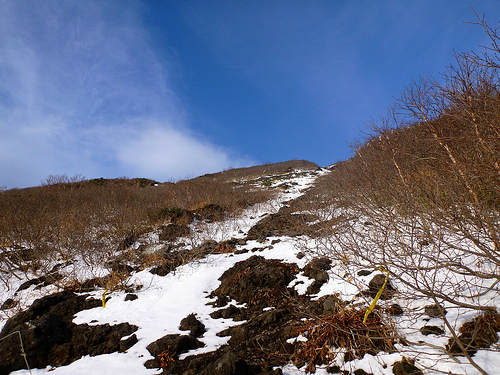
The first hour or so climbing up out of Cypress is tree locked. But you soon find yourself on a wonderful ridge walk with vistas like this:

In early September the #1 question was still: “How’s the snow?”

No problem when I was there. In fact, where the trail crossed snow the footing was good, progress just as fast as on ground.

For lunch I decided to set up the tent on a warm rock.

I read my book. Listened to audiocasts on my iPod. And had a nap. The tent was essential to escape the voracious mosquitoes and bothersome noseeems, unusual on the west coast, especially in September. There were none at lower elevations.

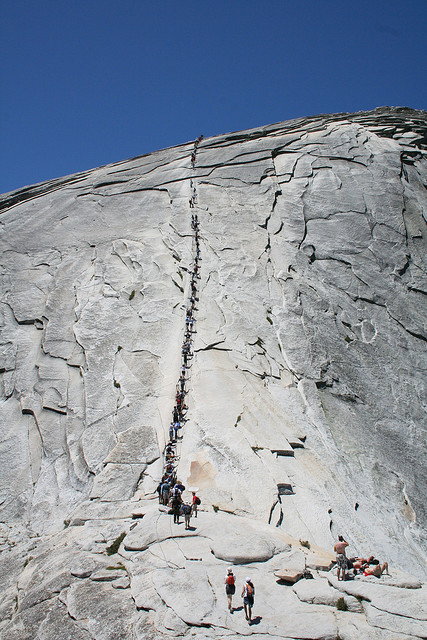
Look closely and you’ll see people atop the west Lion:

There are helicopter rescues nearly every summer weekend. And hikers do fall.

On arriving at the base of the west Lion I instantly decided not to scramble up. It looks sketchy. And there were all kinds of inexperienced, unprepared idiots crowding the route.

Instead I continued on the Howe Sound Crest Trail between the Lions. This traverse section was the trickiest of all. Considerable exposure.

The views of the Lions are stunning from every angle.

east Lion

Past the Lions there are very few hikers. The trail is indistinct, to say the least.

Here I glissaded down towards the lake.

… Unfortunately, the actual trail stays high on the ridge. I need to bushwhack back up to find it.

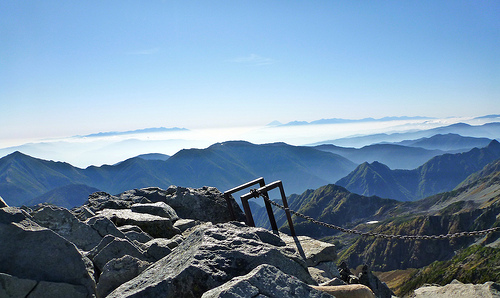
At this point someone had installed a chain and comfort rope, not needed in this ideal weather.

In a nearby cairn, I left a Summit Stone.

Soon after that chain, the trail gets very rough. One hiker with a dog decided to turn around. It was canine impassible.

I got fed up myself after one particularly steep, ugly down scramble. And decided to finally set up my tent for the night.

There was no suitable cliff nor tree limb for hanging my food, so I used the Ursack system for the first time.

… 45min later I could hear some animal clawing a tree. I assumed a bear had taken my food.

I stayed the night as it was impossible to find the faint trail in the dark. When morning dawned I went to photograph the damage, and found the food untouched. One small tree nearby had been broken though. (… I’m still not sure what animal had caused the ruckus I heard the night before.)

Due to too rough trail, I decided to escape the Howe Sound Crest Trail early. The nearest exit was via some new (wet) trail recently hacked out of the woods. It was flagged but poorly signed. People had created home made signage to compensate. This was the most artistic:

I ended up in Lions Bay after connecting to the Binkert. From there you can find a bus back to Vancouver.

_____

Leave a comment if you have a recommendation on the best trail back down to Highway 99. Is it worth continuing to the end of the HSC trail?

In the end, I’d still rank this as one of the best hikes in B.C.

On a clear day, the vistas are stunning.

I have 80 annotated photos posted from the 2 day hike.

Alpacka pack-raft 2.1lbs

At the Expedition Idaho Adventure Race, Director Dave Adlard was surprised (and impressed) to hear that Team GearJunkie/YogaSlackers carried a pack-raft:

… For Idaho, we got more serious about our “flotation devices,” and we brought pack-rafts from Alpacka. The company makes a line of small, packable rafts that weigh as little as 3.5 pounds. But for Idaho, Alpacka built our team prototype rafts that were even smaller and lighter. The one-off “Ghost” model pack-rafts weighed an incredible 2.1 pounds each, and they rolled up small. …

Ultimate Gear Test: 7-Day Adventure Race

Here’s how Pack-rafts inflate, are carried … and what happens when you get dumped into the river.

Click PLAY or watch it on YouTube.

NOW … If I only had the money to buy a 2lb Pack-raft. That one — when released — is likely to cost about $1000.

ACR ResQLink personal locator beacon

ACR ResQLink is world’s smallest personal locator beacon

ACR Electronics has released ResQLink, which it claims is the world’s smallest 406 MHz personal locator beacon. The ResQLink’s small and light waterproof package can be held in one hand and clocks in at less than four inches tall and 4.6 ounces in weight. …

… The monthly service also allows you to send a check-in message to specified contacts via email or text message, without emergency activation. However, no monthly service fee is required for emergency use.

After receiving FCC approval this summer, the ResQLink is now available and retails for $325 (without optional subscription service).

read more on Trailspace

Click PLAY or watch a promo from OR Salt Lake City on YouTube.

Fedak has grave concerns regarding the SPOT devices. Will this be any better do you think?

Black Diamond Ultra Distance Z-Poles

I used (and very much appreciated) a set of Z-Poles the other day. Dave Adlard let me try them out.

Long a critic of hiking canes, I think I’m finally won over to getting a set.

Backpacker calls this version the “best carbon poles we’ve ever tested“.

Editors’ Choice 2011: Black Diamond Ultra Distance Z-Poles (VIDEO review)

$149.95 USD

Sierra Crest Route, California

Ben Egan sends a link to an Adventure I’ve not heard of before. It parallels these two great hikes:

John Muir Trail, 211 miles (340 km), our #2 hike in the world.

Sierra High Route, 195 miles (314 km), is similar, but higher and harder.

Now check out the Sierra Crest Route as documented by Leonard Daughenbaugh.

If the John Muir Trail is for the masses, Roper’s Sierra High Route is more of a mountaineer’s journey. Your Sierra Crest Route takes it to the next level.

—Bob Rockwell, Author and Sierra Mountaineer

I was definitely impressed with the concept and the research.

—Steve Roper, Author and Sierra Mountaineer

read more

The goal is to stay within a mile of the actual Sierra Crest, most often within a half mile.

Be clear. The SCR is not a “hike”:

Leonard Daughenbaugh:

Since the Crest Route is designed to be a mountaineering rather than a rock climbing route, the last requirement is that there be no individual move on the route that is technically more difficult than class 3.

Based on my evaluations, and, where available, ratings in various climbing and mountaineering guidebooks, all moves on the Route meet this requirement. There are, however, two crossings, “Jones Pass” and “Jones Traverse,” that, because of their exposure and route finding difficulties, travelers might feel are more difficult than class 3. …

Sounds great. But the Sierra High Route already is difficult enough for me.

If you are interested, the only place to get more information is SierraCrestRoute.org.

Compression socks for hiking

Speed-hiker extraordinaire Jennifer Pharr Davis this weekend set a new overall thru-hike record on the 2,181-mile Appalachian Trail. Her time of 46 days, 11 hours, and 20 minutes, is the quickest recorded completion of the iconic East Coast trail, which stretches from Georgia to Maine. …

Note that she wore compression socks for some of her (average) 50mi days.

Salomon EXO IV Calf — Salomon’s EXO technology supports calf muscles, improving blood flow for better performance and recovery. …

Gear Junkie – Speed Hiker! Pharr Davis sets Record on Appalachian Trail

Venables – Higher Than the Eagle Soars: A Path to Everest

Stephen Venables is one high altitude mountaineer you’ve heard about, since he didn’t die young.

I really enjoyed his 2008 career retrospective – Higher Than the Eagle Soars: A Path to Everest.

It won Best Book — Mountain Literature at the 2007 Banff Mountain Book Festival.

In 1988, Venables became the first Briton to ascend the summit of Mount Everest without bottled oxygen. His ascent, as far as the South Col, was by a new route up the Kangshung Face from Tibet, with just three other climbers, Americans Robert Anderson and Ed Webster, and Canadian Paul Teare.

All four reached the South Col but Teare decided to descend from here, concerned about incipient altitude sickness. The other three continued up the final section of the normal 1953 route, but Anderson and Webster were forced to turn back at the South Summit.

Meanwhile Venables reached the summit alone, at 3.40 pm.[1] Descending late in the day, he decided to bivouac in the open at about 8,600 metres, rather than risk a fall by continuing in the dark. Anderson and Webster spent the night slightly lower in an abandoned Japanese tent. In the morning all three were reunited and continued down to their own tents on the South Col. It took them a further three days to complete an epic retreat down the Kangshung Face. All three climbers suffered some frostbite, with Webster affected worst. …

Venables is a fine writer. A better writer than climber if his autobiography is to be believed.

An early letter of recommendation from one Dr. Buxton:

Dear Sirs,

Stephen Venables shows little aptitude for academic work, so he might as well spend the summer climbing.

He recently injured himself falling off a cliff in Bristol, so I should imagine that some alpine training would be a very good idea.

Yours sincerely,

John Buxton

His life story is one of one underfunded, under-planned, over-enthusiastic misadventure after another. I’m very happy to be a hiker, not a climber after reading the life & death tale of Kangshung.

Venables as a young man hung out at Snell’s Field in Chamonix while his American contemporaries were living on a shoestring budget at Camp 4 in Yosemite.

Nepal – Bringing Progress to PARADISE

The publisher sent me a review copy. Here’s my REVIEW.

In October 2008, climbing expedition leader and attorney, Jeffrey Rasley, led a trek to a village in a remote valley in the Solu region of Nepal named Basa. His group of three adventurers was only the third group of white people ever seen in this village of subsistence farmers. What he found was a people thoroughly unaffected by Western consumer-culture values. They had no running water, electricity, or anything that moves on wheels. Each family lived in a beautiful, hand-chiseled stone house with a flower garden. Beyond what they already had, it seemed all they wanted was education for the children. He helped them finish a school building already in progress, and then they asked for help getting electricity to their village.

Bringing Progress to Paradise describes Rasley’s transformation from adventurer to committed philanthropist.

… offers Rasley’s critical reflection on the tangled relationship between tourists and locals in “exotic” locales and the effect of Western values on some of the most remote locations on earth.

Rasley presents a thoughtful, honest account of his moral struggle with the dilemma. That struggle is framed in the story of a one week guided fund-raising trip to the village in Oct. 2008.

By books end, I’m no more decided than the author on whether or not their good works are a net gain for the village. It has proceeded, in any case. The school was renovated by 2009, two new teachers hired and budget in place for 3yrs. The composting toilet had been delivered (but not installed).

Next step … Electricity and Internet.

As an independent hiker, the plot of the book is a cautionary tale of the many things that can go wrong on a guided Himalayan trek. (In fact, everyone who considers signing on with a group should be required to read this book first.)

The highlight of the trek for me was Chapter 21 – Basa Magnetism. One of the trekkers, Karen, had an intense day, physically and spiritually. It got me thinking about my own tough days in the mountains.

I recommend it. And recommend trading it in a mountain hostel for another outdoor adventure book. 🙂

details on Red Wheel – Bringing Progress to Paradise
What I Got from Giving to a Mountain Village in Nepal

Jeff Rasley
$15.95
238 pages
October 1, 2010

Jeff answers the question: Is Nepal A Safe Place To Visit?

hill walking the Glendorragha Horseshoe, Ireland

to Hell or Connacht

The Act for the Settlement of Ireland imposed penalties including death and land confiscation … (after) the Irish Rebellion of 1641.

In Ireland they remember Cromwell. They still recall him declaring that Catholic Irish landowners must go, “to Hell or to Connacht“, west of the River Shannon. Whether he said it, or not.

Today rough Connacht has fantastic hill walking. The weather is a challenge.

Click PLAY or watch one man’s Horseshoe on YouTube.

A 7-hour hike of The Glendorragha Horseshoe, in the Nephin Beg mountain range of County Mayo, West of Ireland. At 698 m, Birreencorragh is the highest point of the Horseshoe.

My man Mike, who grew up in the region, wants 8-10hrs for that a nearby route, the Binnlettery/Glencoaghan Horseshoe in the twelve Binns or Beanna Beola area. He declares his Horseshoe the “best day hike in Ireland”.

climbing Croagh Patrick, Ireland

The most popular mountain on the island, perhaps 100,000 attempt the summit each year. St Patrick offers Holy Water at the trailhead.
Croagh Patrick (Irish: Cruach Phádraig), nicknamed the Reek, is a 764 metres (2,507 ft) tall mountain and an important site of pilgrimage in County Mayo, Republic of Ireland.
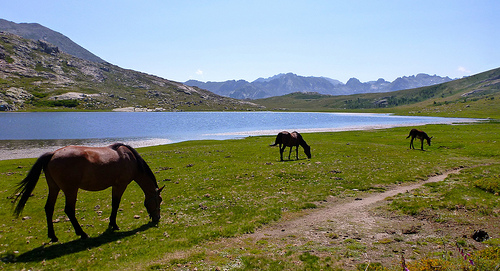
It is 8 kilometres (5 mi) from Westport, above the villages of Murrisk and Lecanvey. It is the third highest mountain in County Mayo after Mweelrea and Nephin. On “Reek Sunday“, the last Sunday in July every year, over 15,000 pilgrims climb it (some barefoot) …
Saint Patrick reputedly fasted on the summit of Croagh Patrick for forty days in the fifth century and built a church there. Popular legend says that at the end of Patrick’s 40-day fast, he threw a silver bell down the side of the mountain, knocking the she-demon Corra from the sky and banishing all the snakes from Ireland. …

This small chapel dates back to 1905.

St. Paddy camped here. I left a Summit Stone as a token of respect for his good works.

Because many amateur, under dressed non-hikers make the pilgrimage, there are more incidents on this peak than any other on the Emerald Isle.

I was in good hands, guided by Mike from the Mayo Mountain Rescue Team.

More photos from our day hike.

The other big celebrity attraction of the remote, rugged region is John Wayne. He filmed The Quiet Man (1952) here. Cong’s gorgeous Ashford Castle, featured in the film, is the centre of the tourist hub bub.