Tom Mangan of Two-Heel Drive posted his favourite photos of 2009. Some from California. Some from his new haunt, North Carolina.
see the rest – Favorite pix of 2009
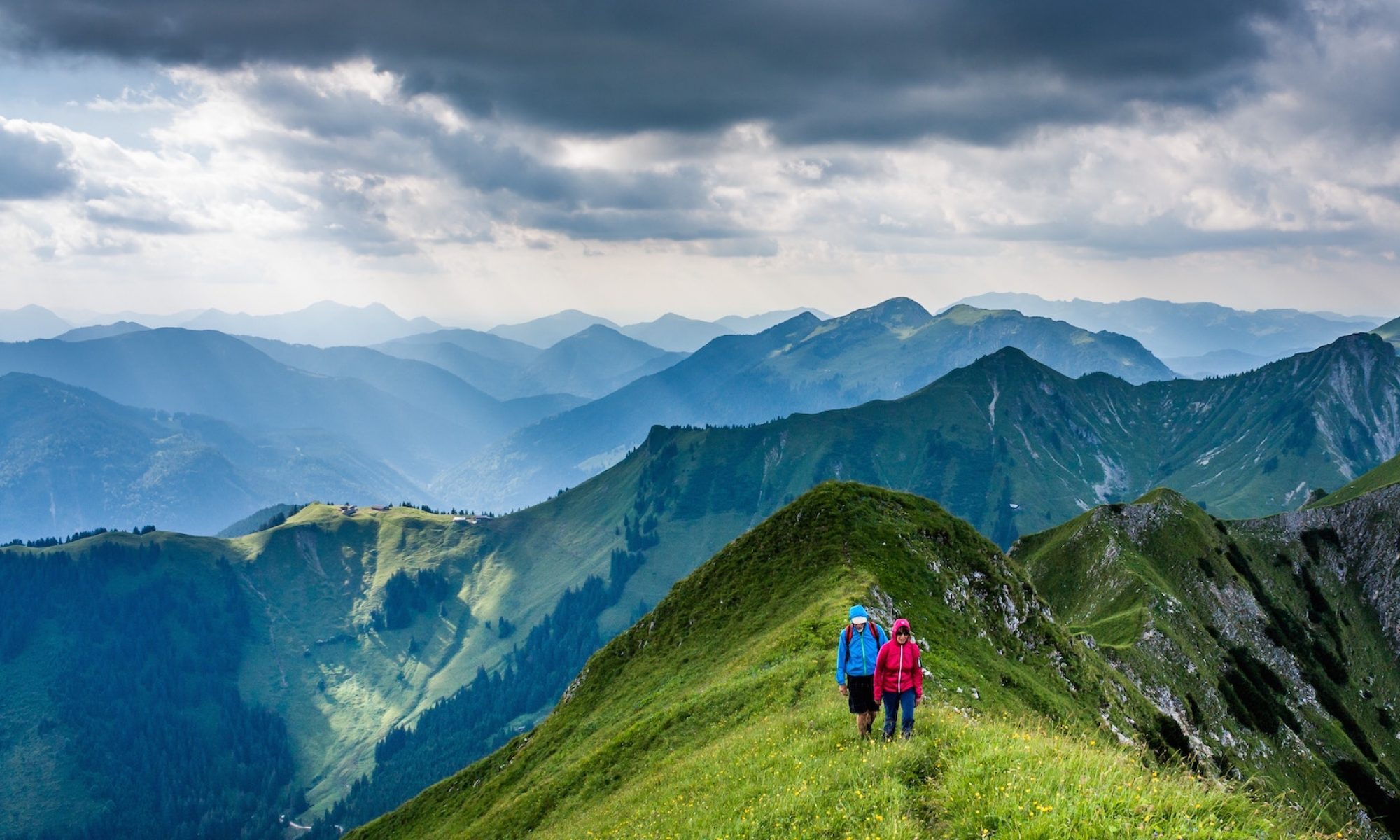

Best hikes, treks, tramps in the world.
Tom Mangan of Two-Heel Drive posted his favourite photos of 2009. Some from California. Some from his new haunt, North Carolina.
see the rest – Favorite pix of 2009
In Calgary the past few weeks we’ve had some amazing hoarfrost and ice fog. Very pretty!
Either on bike or on foot, I’ve been out often with Sasha in the winter wonderland.

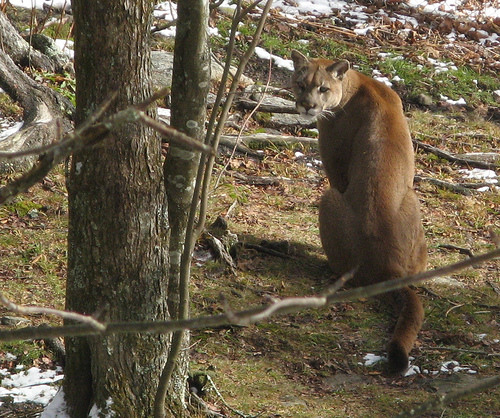
Yesterday a hungry coyote tried to lure Sasha away from me, into the trees.


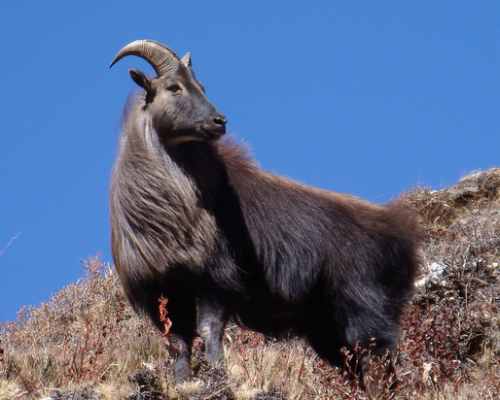
I was disappointed not to see this beautiful animal in Nepal on my recent Everest trek.
The Himalayan Tahr (Hemitragus jemlahicus) (or Himalayan Thar) is a large ungulate related to the wild goat. Its native habitat is in the rugged wooded hills and mountain slopes of the Himalaya from Central Asia in northern Kashmir to China. …
… Adult Himalayan Tahrs range from 135 to 180 kg (300 to 400 lb) in weight, 120 to 170 cm in length, and 60 to 90 cm in height. They are herbivores, subsisting on grass, shrubs, and trees. …
Feral Himalayan Tahr are an introduced species in the South Island of New Zealand, with herds forming in the Southern Alps. In large numbers tahr are regarded as a pest because their browsing has an impact on native vegetation. Tahr hunting is a recreational sport and commercial activity. It has also been introduced to New Mexico, California, South Africa, and Ontario.
… Rick Mercer visited Algonquin Park to do some work on Bear Tagging and research. The video was absolutely hilarious and well worth a look.
Click PLAY or watch it on YouTube.
Thanks George.
The new North Coast Trail is close to the top of my MUST HIKE BEFORE I DIE list.
The North Coast Trail is a 43.1 km wilderness hiking trail in Cape Scott Provincial Park on northern Vancouver Island, British Columbia, Canada.
… in Cape Scott Provincial Park runs along beaches and in forest around the northern tip of Vancouver Island from Shushartie Bay to Nissen Bight. At Nissen Bight it links up with an existing 15 km trail which leads to the trailhead at San Josef River. The total distance for hikers between the trailheads is 61 km. The trail is in a wilderness area and hikers may see deer, elk, black bears, cougars, wolves, sea birds, seals, sea lions, grey whales and sea otters. In two failed attempts, Danish pioneers tried to settle the area at the turn of the twentieth century and the trail incorporates some of their original routes.
Detailed route information is available on the BC Parks – Cape Scott hiking page.

official website – Northern Vancouver Island Coastal Trail
I’ve added it to our list of best hikes in North America
by site editor Rick McCharles
Gokyo to Namche
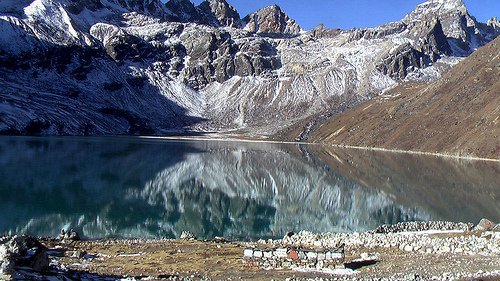
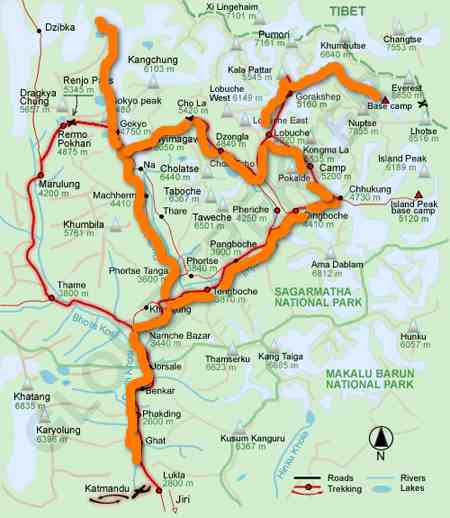
Renjo La should have been the last high alpine crossing on my Three Passes of Everest trek. … It starts with a steep climb from Gokyo over the ridge (5345m) at the top right corner of this photo:
A particularly grueling 10hr trek to Thame.
… Instead I turned south, deciding to end my trek as quickly as possible. I could make it to Namche from here in a long but easy walking day.
My 3 Passes route became a 2 Passes route. In the end, I did the lollypop loop in orange, skipping the Renja Pass in red.
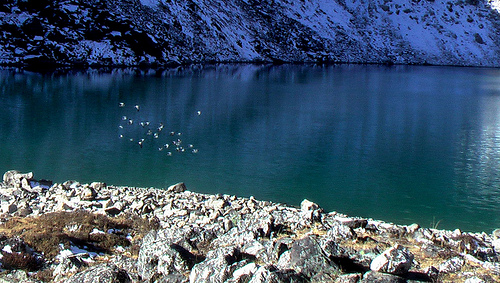
Highlights of this day included 2nd Lake, Taujung Tsho …
… and the Brahminy ducks on Longponga Tsho, 1st Lake.
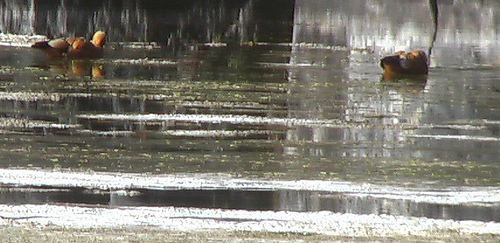
Nobody knows why these birds decided to make their home at such high altitude.
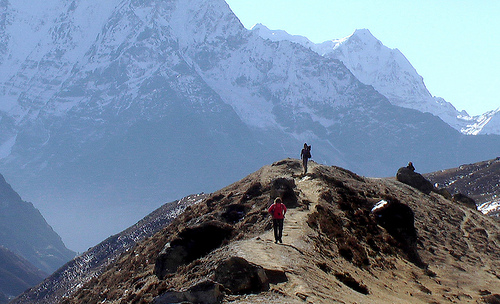
Very quickly I left the snow behind.
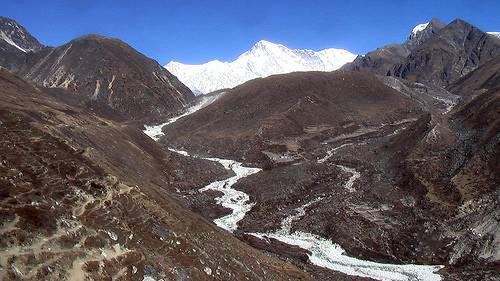
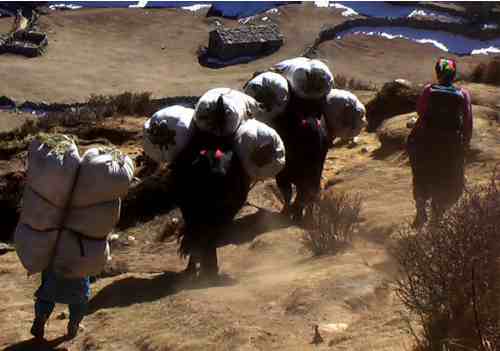
The trail got busier and dustier as I descended.
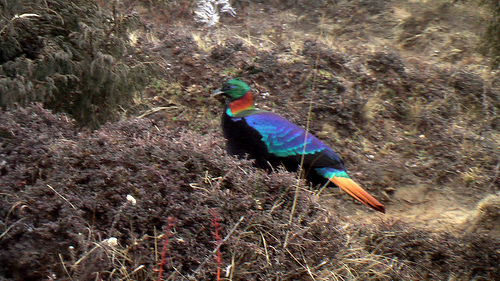
I spotted a colourful male Himalayan Monal (Impeyan Pheasant), much less common than the female, it seemed to me.
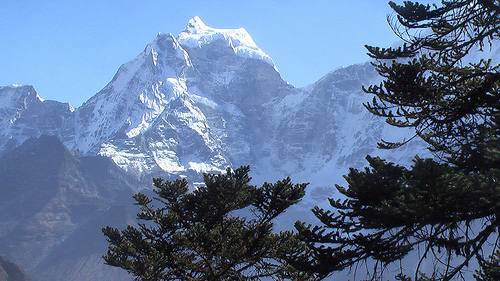
Finally, large trees started providing some shade.
That night in Namche I enjoyed “civilization”, staying (I think) in the same room slept in by Jimmy and Rosalyn Carter in 1985.
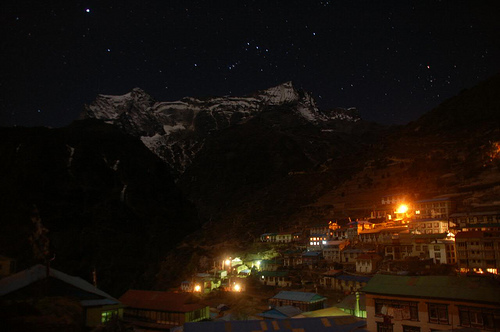
It felt great to be finishing such a long hike.
see all photos from day 16
Trip report by site editor Rick McCharles.
After a long, cold night in the tent, I awoke with “mountaineer’s lassitude“:
… reluctance to put one foot in front of the other …
I’d first read of the condition in the mountaineering parody, The Ascent of Rum Doodle (1956), one of my favourite books.
I was sick again. The same stomach ailment I had on the first 2 days of the trek.
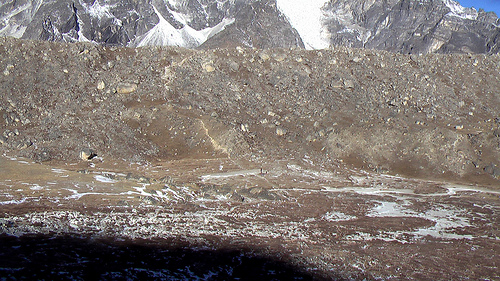
That’s the lateral moraine of the Khumbu Glacier. I first needed to trudge down. Then find a safe way across. Others had advised that it was no problem this season, … if the weather is good.

Fortunately, the weather remained perfect. There was not even snow blowing off the highest peaks!
It seemed to take a long time to reach Lobuche.

I stopped for lunch and to recharge my batteries at a restaurant. Then psyched up for the relatively short and easy walk to Dzonghla (Dzongla).

it was a pity I felt rotten. The weather was stupendous. And the scenery even better.

Late afternoon I finally reached the remote village. But I spent less time in the guesthouse restaurant than in here …

I crashed that evening without eating. And did not get up until Noon the next day.
Mid-day there was only myself and the Nepali National bird, the Himalayan Monal, wandering about the courtyard.
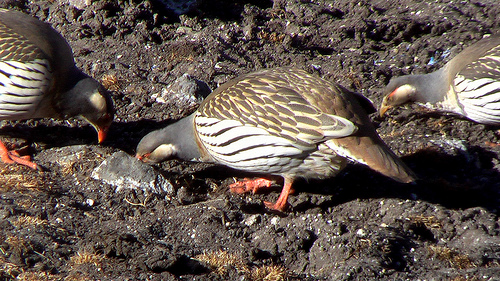
Everyone else had departed at first light over the Cho La, the most difficult of the Three Passes route.
I had a forced rest day. Standing around like this guy.

Disappointing.
see all photos from day 12-13
… on to day 14
Trip report by site editor Rick McCharles.
I slept poorly, quite common at high altitude.
At first light, outside my window, I saw white stuff piled up on the Yaks. An early snowfall, not all that unusual in November.

Instantly I thought of the November 1995 freak snow storm where dozens (46 some say) of hikers, porters and guides were killed throughout the Himalaya, most by avalanche.

At breakfast that morning, after consulting with guides and hikers who had been there, I decided it might be too dangerous to cross the Kongma La 5535m (18,159ft) after a new snowfall. Instead I would head directly to Mt. Everest base camp skipping the recommended acclimatization day. I felt good aside from the lack of sleep.
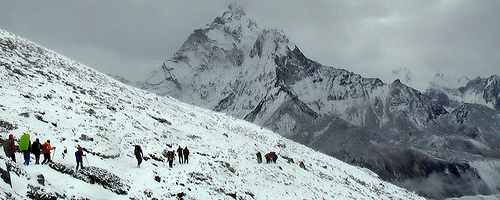
As a Canadian, I had no fear of this light snowfall. In fact, it turned out to be the most beautiful day of the trek.

The bleak, dry terrain was suddenly magical.
The highlight of a wonderfully scenic day was the shrine of Babu Chiri Sherpa at what some call Dughla Pass.
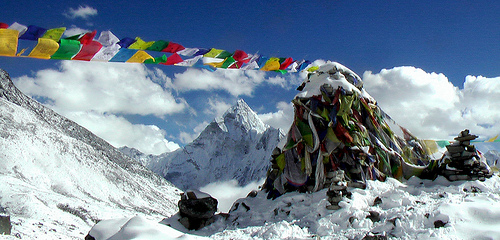
… With ten Everest Summits (including 4 North Side summits), many considered Babu Chiri Sherpa the strongest climber on Everest. …
Babu Chiri Sherpa passed away after unexpectedly falling into a crevasse at Camp II at 1600 hrs on 29 April 2001. …
I left a Summit Stone there in tribute to him and all the Sherpas who have died over the years.
Scott Fisher, ever the showman, has an impressive shrine just beside Babu Chiri.
I was very happy to finally catch up with Ping and Shirley from New York.

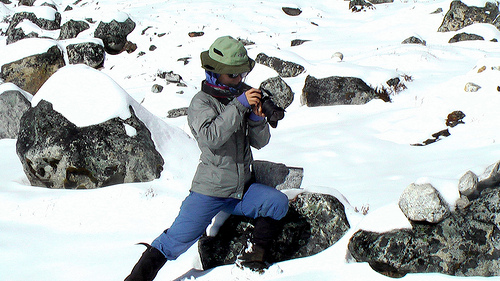
We had flown in and walked together the first day. Due to my altitude sickness I fell behind day 2. Ping and Shirley had only a 2 week holiday to try for Everest and Gokyo. (Short holidays is one of the reasons there are surprisingly few Americans trekking Nepal. You’ll meet more Canadians though Canada has one tenth the population.)
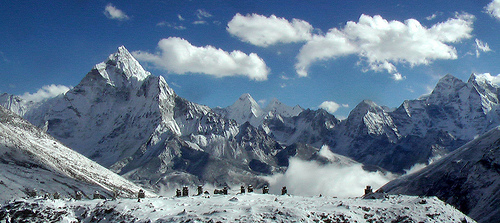
I was so inspired by this beautiful and spiritual place that I decided to pitch my tent right there in the snow amongst the hundreds of shrines to fallen climbers.
I wanted to see sunset from this vantage. Here’s last light as seen from my tent.
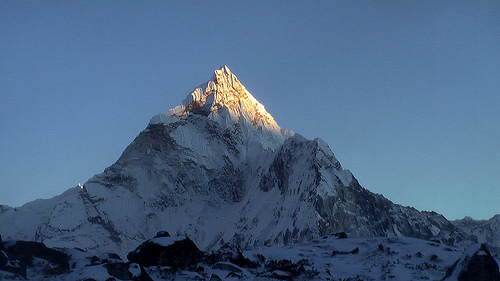
How cold would it be at about 4800m (15,750ft) …
all photos from day 7
… on to day 8
Trip report by site editor Rick McCharles.
Just before dark, the previous evening, I found a perfect tent site by a waterfall just above this bridge.

Wild camping is not illegal in the National Park. But it’s best to be discrete.
Feeling good, I decided to climb all the way to Dingboche at about 4,530m (14,800 ft). Likely I’d need a rest day there doing one or the other of a couple of different side trip options.
Ama Dablam began to loom large.

The trees were gone. Increasingly the scenery became bleaker.
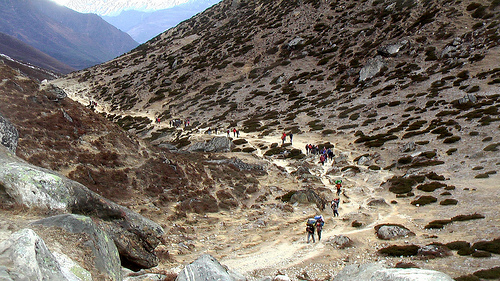

Though nobody ever seemed to mention it, we were disappointed with the weather. In November it should be sunny, clear and cold.

I was psyched, however, upon reaching Dingboche, a memorable village. This is the jumping off point for the excellent Island Peak climb, by far the most popular of the trekking peaks.

The biggest change I found from my last trip to Nepal 11ys ago is mobile phones. All guides and lodges have them. Some European hikers had phones. And phones seem to work almost anywhere.

At first put off by telephone contact in the “wilderness”, I quickly realized what a life saver they must be. Literally. Lives have been saved, I’m sure, by communication.
The second biggest change is that internet has arrived over the past few years. Here is the highest internet cafe in the world.

Actually it was the highest in the world. The owner recently put one laptop and a connection at Gorak Shep 5,164m, right on the doorstep of Mt. Everest.
I took every opportunity to post online my exact whereabouts, as a safety precaution.
Here are the Yaks coming home to my Guest House after a day of grazing barren hills late in the season. I ate much better than the Yaks that day. In fact, I took the ultimate Himalayan culinary challenge … I ordered Yak steak. (Eating meat is strongly discouraged by every guidebook.)

I turned out to be fine. … But I never ordered meat again for the rest of the trip.
all photos from day 6
… on to day 7
Trip report by site editor Rick McCharles.
I’m happy to report that the most popular hike on Maui is one of the best walks in the world. Greeting the dawn atop this volcano is one of the ultimate Hawaiian experiences.
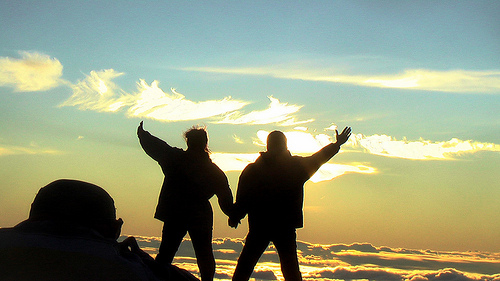
I tented at nearby Hosmer Grove Campground so to not need to drive far in the dark.
My down parka was most useful at that cold altitude. (Many tourists are under dressed, wrapped in beach towels and hotel blankets.)
… next day climbed the remaining nine thousand feet, and anchored on the summit, where we built a fire and froze and roasted by turns, all night. …
Mark Twain
Soon after dawn it’s time to begin the famed Sliding Sands trail.
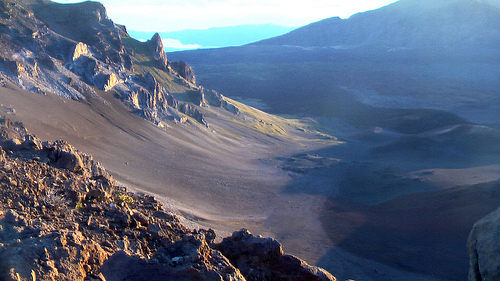
From Trailspotting:
Explore cinder cones and lava flows in the desolate basin of Maui’s Haleakala, possibly the largest dormant volcano on the planet.
Formed by erosion rather than volcanic activity, the valley at the summit of Haleakala boasts much to marvel at, and the packed cinder and soil underfoot makes for a relatively easy hike. Here you’ll find the silversword, an endangered plant found nowhere else on Earth with an alien appearance that compounds the other-worldly appearance of this remote location.
Ascending and looping up the mountain, the road to Haleakala National Park is equally spectacular, climbing through the clouds to the summit. Watch out for tour groups of cyclists on this road who freewheel down the mountain. These popular tours begin in the early hours of the morning so they can witness the sunrise over the island from the summit before they begin their two-wheeled kamikaze return back down the volcano. …
read more (photos, video, GPS, etc.) – Maui: Haleakala Volcano Trail
I went as far as the cinder cone of Ka Lu’u o ka O’o (spelling varies) and backtracked to my vehicle. That’s about 4mi (6.4km).
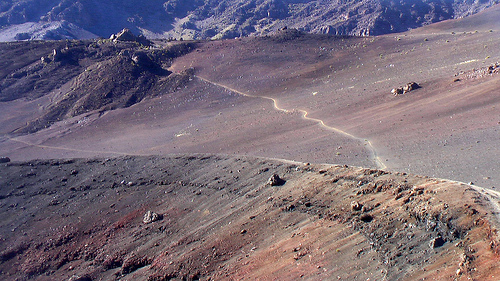
No need to go that far, however. The views are great everywhere … if the vista is clear. Go as far as you want. Savvy hikers check the weather report in advance before making the long, dangerous drive to the summit.
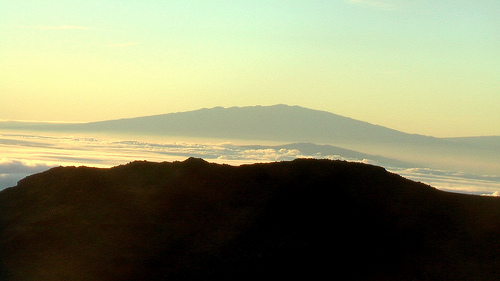
On a nice day you can see a big island volcano.
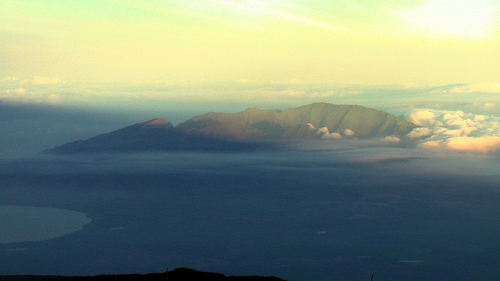
Views over Maui are impressive too.
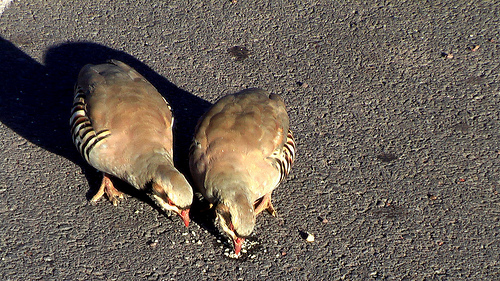
Be aware of various dumb, inevitably endangered birds that chase tourists for handouts. They tend to get run over on this highway, as do the downhill cyclists. And cows.
see the rest of my Sliding Sands photos
related caution – Washington Post – Dawn at Haleakala? Think Again
 besthike.com