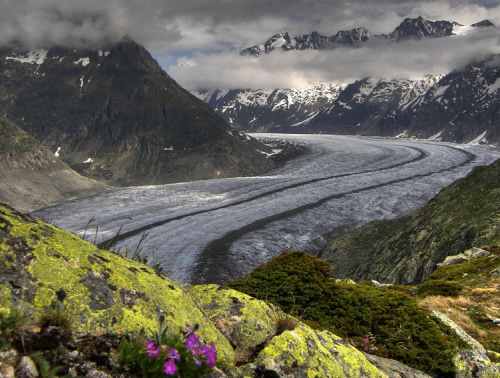
The Grosser Aletschgletscher, the longest glacier in Europe, has recently been designated a UNESCO world heritage site, in recognition of its importance and uniqueness. And this place is special. The first sight of this awesome phenomenon is something a world apart from those diagrams in geography lessons, because this thing is enormous, ancient and on the move. Not millions of years ago, but now. And right there, from horizon to horizon, not a distant tongue of snow and ice poking over a rock wall.
This hike makes a memorable circuit of the Eggishorn, traversing along the slope above the immense glacier, before looping back to take in Southward-looking vistas of the Monte Rosa range and the Matterhorn. It’s a relatively flat walk too, with not much climbing required at all. …
I started at midnight. For the first trip I decided to go up the Mountaineers Route. Despite going from Portal to summit (and much of the way back) in the dark I made good time. It helps that I know the route well. I reached the summit at 3:43am (3 hrs 40 mins from the Portal). I was alone on the summit and the hut was empty. I returned to the Portal a little after sunrise at 6:54am for a total roundtrip time of 6 hrs 51 mins.
This quick time had me briefly wondering whether a 3rd summit would be possible. That dillusion was thoroughly dispelled on my 2nd trip up. For the 2nd trip I decided to go for the Main Trail. I took a half hour break before starting. As much as I knew I needed to eat I couldn’t manage to get much down. I started up the Main Trail at 7:22am.
As I closed in on Trail Camp I began to slow noticeably. Both the MT and MR are hard on the calves (too many steps). Going up the switchbacks my speed slowed further. I past a few other hikers but only just barely. By the time I reached Trail Crest my calves were done. From Trail Crest to summit was agonizingly slow and my calves kept wanting to cramp up. For some reason I kept thinking about my first time up Whitney almost exactly 7 years ago. I reached the summit for the 2nd time at 1:11pm. I was thoroughly depleted. Time from Portal to summit was a less than stellar 5 hrs 49 mins. Roundtrip time was 9 hrs 33 mins.
I regained strength on the way down. I did some running but for the most part just took a fast pace. My priority now was to get down in time for a burger at the Portal. I knew this would probably be my last Portal burger for the year so I was well motivated. I reached the the Portal at 4:53pm. …
Although the 2nd summit was a bit harder than I expected both trips together took less than 17 hours combined. This marked my 28th and 29th Whitney summits.
Trip Report – Picos de Europa Circuit – by site editor Rick McCharles
By morning I had no water. Looking up, my prospects for H2O did not look good.
Though my guidebook said I could find water in two places in the next few hours, I was not confident. This late in the season I might need to climb up high enough to melt snow.
I passed one trickle. Then – finally – saw a sign that I might find a spring.
Before I found the man-made spigot, I was approached by an exhausted looking Spanish mountain climber. He and his partner had gotten lost the previous day near the summit. And were forced to bivouac overnight. They had just gotten back to their tent.
He showed me the water source (about 1hr to fill a 1 litre bottle) and gave me detailed advice on how not to get lost on the next section.
Very quickly I was lost. His advice was all wrong.
Having climbed far too high, I arrived at another of the mountaineering base camps. Instead of retreating, however, I waited for a climber who was descending rapidly from the summit.
lost but elated
It was Constant, an adventurer from France. He was just as lost as I, … but had a vague idea of how to exit the base camp. And a wonderfully relaxed world view. His topo map did us no good at all. You need a topo and a GPS in these mountains.
I followed him directly to “civilization”.
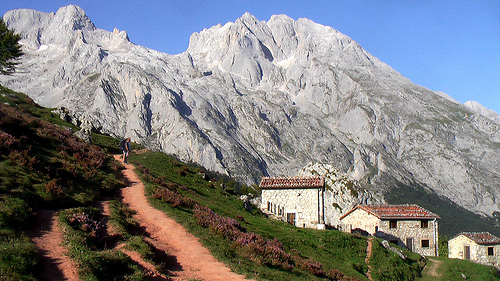
Because of the water supply, I decided to camp (for once) close to the Vegarredonada refugio.
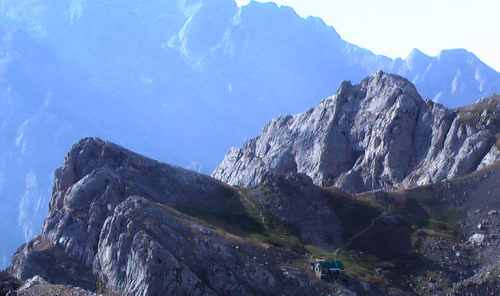
Here’s the bizarre old refugio, no longer used.
Everyone takes an obligatory 7.5km side trip to the old, old refugio at Mirador de Ordiales, guarded by this calf when I visited.
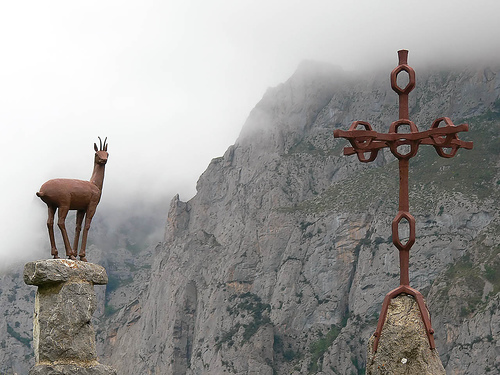
Here is Pedro Pidal’s (1870-1933) final resting place. He founded this, the first National Park in Spain and was named Commissioner General of National Parks.
…. Eight years after his death, his final wish – to be buried at this natural balcony – was fullfilled at last. Engraved in a nearlby rock are words he wrote:
Lover of the Picos, I would love to live, die and eternally rest here in Ordiales. In the enchanted kingdom of the chamois and the eagles.
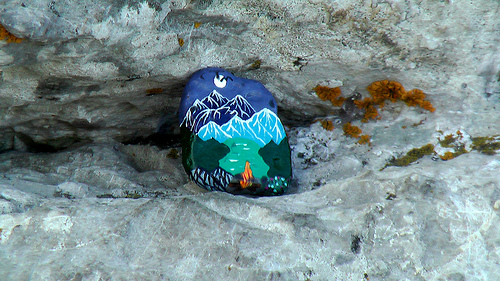
I left a Summit Stone with Pedro, placing it carefully between the stones close to the ground.
Somehow Pedro grabbed it from my fingers, pulling it deep into a crack. I guess he wants to keep it for himself.
My view of the famous vista was obscured. Again. By cloud.
My last night in the wonderful Picos de Europa.
I was truly sorry to leave these mountains. This is a brilliant hike, one of the very best in the world.
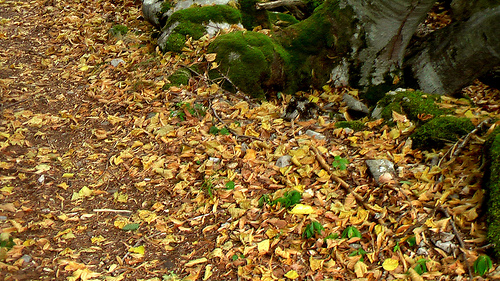
Ascending back into the trees, I was shocked to see the leaves changing. This was the first time it had dawned on me that my summer of hiking Europe was ending. This was to be my last.
Sept. 12th
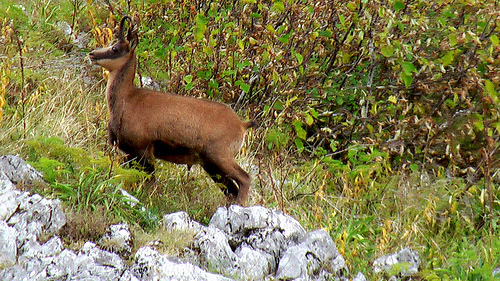
There were many more Chamois on this section of trail, the largest herds I’d yet seen.
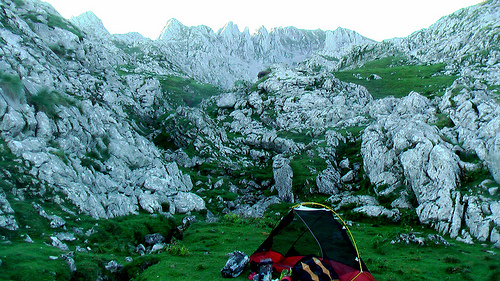
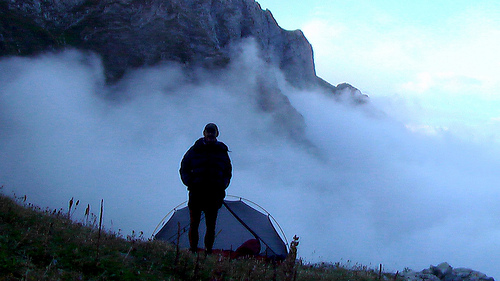
Though I had still not found a water supply, I finally set up the tent in a pretty spot well above the Picos mist.
Laura Jones, a reporter from the U.K., hiked a 10 day tour:
… the lovely thing about the TMB is that the drama of those awesome panoramas of glaciers and mountain peaks are interspersed with walking green valleys filled with Alpine flowers, twisty turney streams, chalky blue mountain lakes – and if you’re lucky marmosettes.
The changing scenery that accompanies the ascents and descents kept me hooked.
There were whole days where we didn’t see another soul as we walked ridges running alongside racks of glaciers.
Other days we passed through hamlets, villages and towns and then really appreciated being back in civilisation:
Champex, Courmayer and La Fouly were particularly lovely. …
Trip Report – Picos de Europa Circuit – by site editor Rick McCharles
This was the most photogenic day. Amazing.
I started by climbing up from Bulnes La Villa through high pasture land towards the central summits.
I was looking forward to the iconic peak of the Picos, Naranjo de Bulnes.
It’s a world class climbing destination, obviously. But I was more surprised by the normally shy Chamois that hang about the Vega d’Urriellu refugio (1953m) as if they are domesticated.
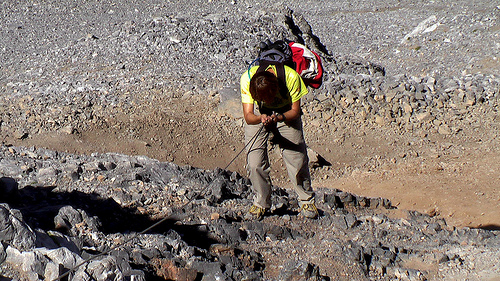
A cable assisted scramble takes you up and over Torre de los Horcados Rojos.
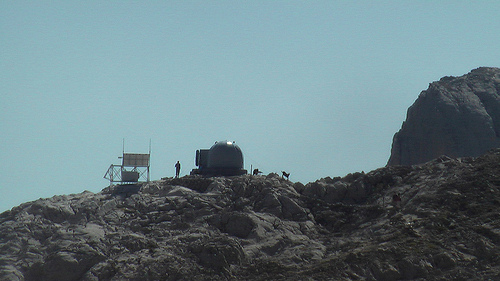
At the top, this weird silver igloo draws your eye. What the heck is it?
That’s Cabaña Veronica (2325m), once an American aircraft carrier cannon mount. Three hikers can sleep in it.
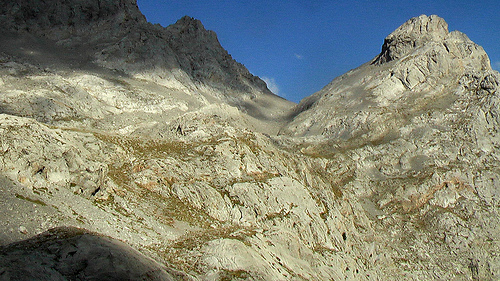
The most difficult part of the entire Circuit for me was the section from Veronica to Refugio Collado Jermoso. Here’s the high, bleak terrain. There are cairns at the start. But soon you’ll be guessing wildly, route finding and scrambling for a couple of hours. Convinced that you are hopelessly off route.
A GPS is essential. …
Somehow I made it. As did a dozen other hikers that day. Many, I noted, arrived late to the refugio.
This was my favourite sunset of the entire summer.
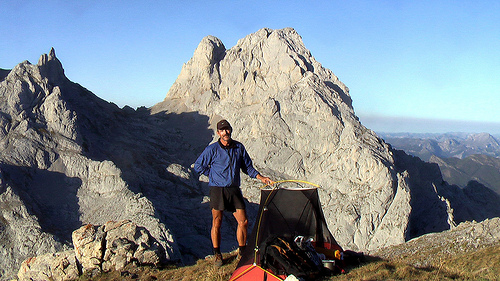
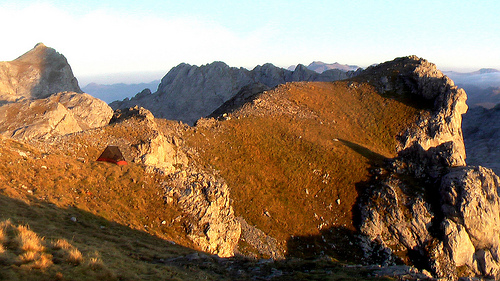
I set up the tent in a marvelous spot, very high with grand vistas in every direction.
Trip Report – Picos de Europa Circuit – by site editor Rick McCharles
The morning dawned clear. Quickly I climbed up above the valley cloud.
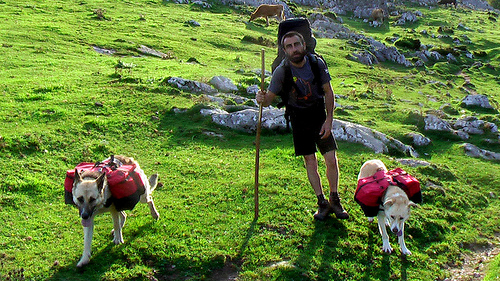
I met one of the alpine hut guards … with his free running dogs.
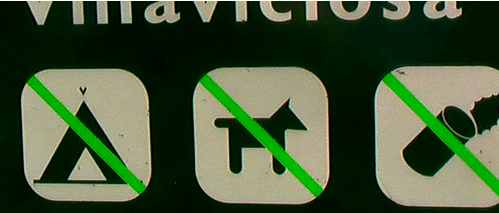
Here’s the large sign posted at his refugio, Marques de Villaviciosa:
National Park regulations are somewhat flexible in Spain. And they vary wildly from place to place.
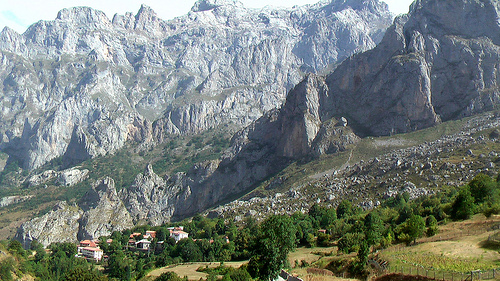
The main “story” of this Circuit are the climbs into and out of the huge Canal de Trea, one of the most spectacular canyons in the world.
descending 1200m of this cliff
There are many slippery and unstable sections before you reach, with relief, the Garganta del Cares gorge at the bottom.
…A remarkable engineering feat, the 3m-wide path running the length of the gorge was gouged out of its sheer walls in 1946 …
This relatively flat day hike is the best and most popular in the Park.
click for larger view
I “cheated” and took the Bulnes Funicular (an underground train) part way up the other side of the gorge, avoiding 4.5km distance and about 400m ascending.
My goal for the next day came into view.
Naranjo de Bulnes (Picu Urriellu)
A long but fantastic hiking day in perfect weather.
Trip Report – Picos de Europa Circuit – by site editor Rick McCharles
An unforgettable (91.5km) route covering the … most extaordinary limestone landscapes – river gorges, alpine lakes, depressions, dense beech woods, narrow canals, cliff hanging trails and peaks with breathtaking views
MAGIC …
Urriellu – photo by Edu-im
The rain in Spain
falls mainly
… in the NORTH.
Green Spain, it’s called, home to a wealth of flora and fauna. Including, perhaps, 90 bears.
The weather in Picos de Europa is very atypical for Spain. Happily, September is normally the best month.
Cangas de Onís is the busiest and most easily accessed of the gateway towns. … and can supply all last-minute needs.
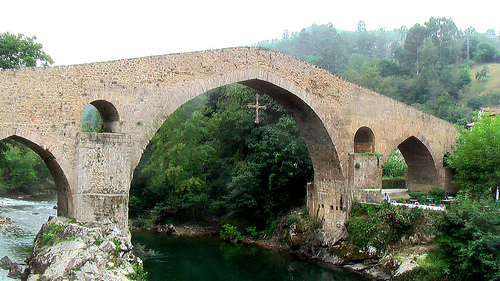
Roman Bridge – Cangas de Onís
Frequent buses deliver you from Cangas to Covadonga, an impressive tourist attraction.
… In 722 AD, Iberian Christians won the battle over the Moors in Covadonga. This was the first significant Christian victory over the occupying Moors; as such, it is often considered to be the start of the Reconquista, the 770-year effort to expel the Moors from Iberia. …
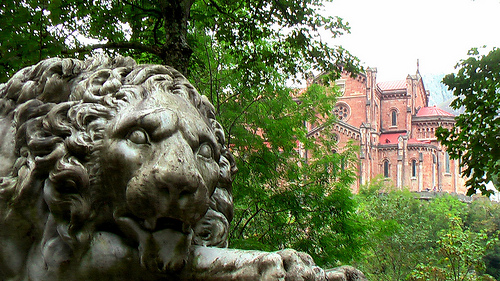
Dom PelayoCovadonga Cathedral
During the summer you can bus all the way from Cangas to the trailhead at Ercina Lake. Unfortunately I arrived the day after those buses stopped running for the season. I hitched the last 12km or so from Covadonga. The Spanish couple who picked me up were also hiking a variation of the circuit staying in refugios, alpine huts providing beds and meals.
Lago Ercina in good weather – Browserd
Here’s how the lakeside looked to me.
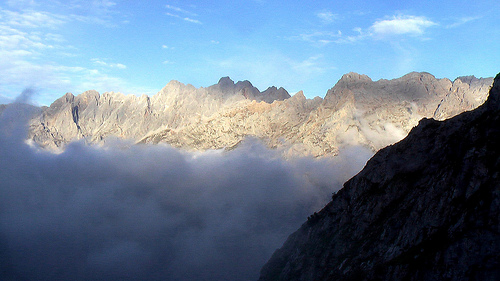
I’d arrived into the frequent, infamous Picos mist. A thick fog bank that often clouds the valleys and lower elvations of this micro climate.
After wandering around blind for 3hrs … I finally set up my tent right at the trailhead. A rotten start to the adventure.
Later I learned the couple that had driven me to the trailhead walked directly to the refugio using GPS.
Note to self: Get me a GPS.
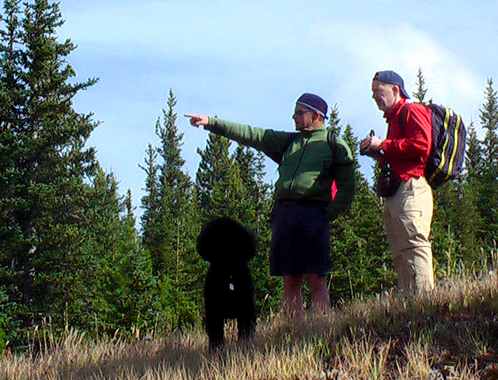
Foolishly Garth and I followed Rocco into the front ranges of the Canadian Rockies for a Fall day hike.
After driving aimlessly on gravel roads for some time, we finally gave up on our original goal, Cox Hill.
Instead, Rocco proposed we park at an unmarked turn-out. And scramble up to what he recalled to be from memory, Jumpingpound Ridge.
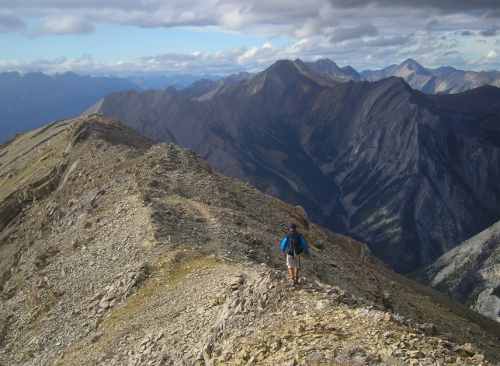
It was a gorgeous day.
While having lunch at the ridge, 3 older (wiser) hikers walked by informing us that we were on a completely different ridge than I was studying in the guidebook. They instructed us carefully on the best, most scenic way to descend.
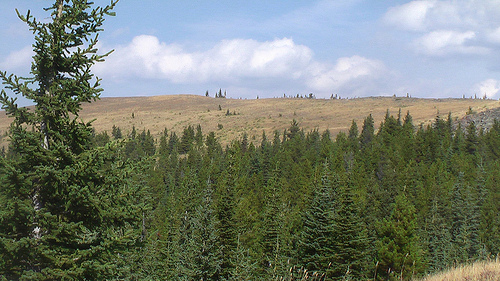
… As you have already guessed, we never found it. But the bushwhack downslope was even nicer than our scrambling ascent.
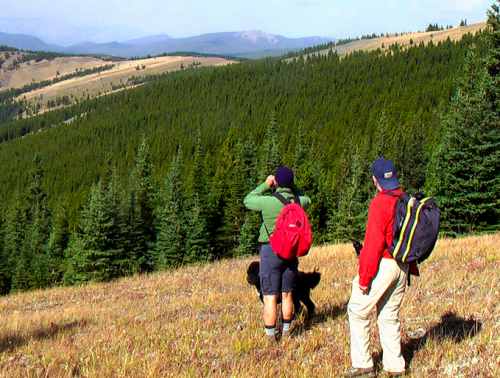
If you ever see these guys scanning the distance with binoculars, stop and help them out. They are lost.


















 besthike.com