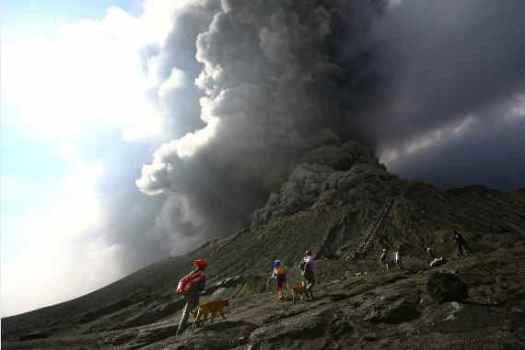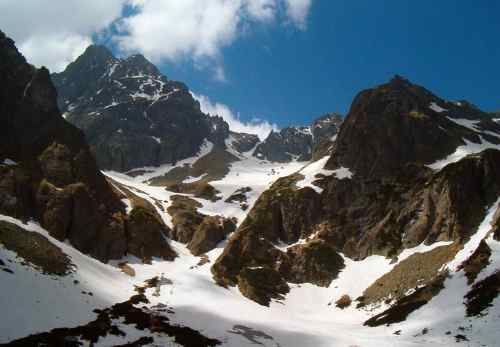

fleeing Mt Yari, Japan

trip report by site editor Rick McCharles

Day 2

I awoke before dawn in one of the best tent sites of my life.

This truly is the land of the rising sun.

Dozens of hikers were already atop nearby Mt Yari. It’s tradition to climb in the dark.

Personally, I was in no rush. The crowds were gone by the time I headed up.

In fact, I had the summit to myself. Nice.

I left a Summit Stone at the Yari summit shrine.

A helicopter arrived. That’s Fuji in the distance.

helicopter and Fuji

An elderly gentleman was evacuated. He looked OK to me but had been on oxygen earlier in the morning.

I’m hoping he had insurance. Choppers are very expensive in Japan.

Here are the famous Yari ladders, trickier on the descent than the climb.

Though the weather could not have been finer, the forecast was for rain next day. I gambled, hoping it would hold off long enough for me to finish the Kamokochi – Yari – Hotaka circuit early next morning.

It was too tempting to spend the day walking the ridge towards Murado. Can you blame me?

This region is wrongly compared with Yosemite. In fact, it’s much like the GR20 in Corsica.

The nearest water to Yari I could find was at Sugoruko-goya.

They have quite an elaborate system ensuring a drinking supply for the hiking season. (But you may need to filter out the insects.)

2pm was my turnaround time. It was even prettier on the way back.

I did not see much wildlife. A pair of Rock Ptarmigan were the highlight.

Can you believe this stunning view from Yari-dake-sanso at sunset?

Here’s my last photo of the day — my tent.

_____

In fact, that was my last photo of the trip.

Going to sleep at 8:30pm, I was awoken at 10:30pm. The storm had arrived.

Wind and driving rain all night kept me up. I listened to an audio book until first light.

It was all I could do to stuff my wet gear and flee back the way I came, the easy way down. This means I MISSED the infamous Diakiretto:

… hole in the ridge
… ladders, chains, big drops …

This is, without doubt, the most exhilarating (or the scariest) bit of hiking in Japan that doesn’t require any specialist skills.

Lonely Planet

That route is too dangerous when wet. I’d been warned by Wes Lang, editor of the Hiking in Japan blog.

See all my photos from day 2 of this adventure on Flickr

Or check Day 1 if you missed it.

climbing Mt Yari, Japan

trip report by site editor Rick McCharles

I’m in Japan for up to two months — including 3wks with an all-you-can-ride Japan Rail pass.

First up — Kamikōchi:

… a remote mountainous highland in the western portion of Nagano Prefecture …

… the entire highland is protected as part of the Chūbu-Sangaku National Park, access is only granted to bus, taxi and local workers’ vehicles. …

Off to climb Mt Yari.

Lonely Planet tells me that the cheapest and easiest way to get there is by night bus from a big city.

We arrived 5:30am.

I was one of the few who took breakfast. Most dashed off up the trail. Japanese love to hike early.

The most popular trail to Yari starts leisurely.

Trees are starting to change colour end of September, but not as spectacularly as I had hoped.

Little of the signage is in English — mainly WARNINGS.

This walk along the Asuza-gawa river is famous in Japan.

The “spear” of Mt Yari compels. But it’s not nearly as close as it appears.

It seemed to take forever to reach my destination — the hugely popular complex called Yari-dake-sanso — every step getting steeper. It seems the 1500m (4500ft) elevation gain all happens over the last few kms. 😦

What an amazing location for an alpine hut, only 120m (about 360ft) below the summit.

The highlight of the day, however, was the shocking location of the campground.

Check the sunset view from my tent.

Exhausted, I couldn’t be happier with the adventure so far.

See all my photos from day 1 of this adventure on Flickr

related:

• kamikochi – official website (ENG)
• Yari Lodge (ENG)

moving the BestHike database

Our database of the best hikes in the world is somewhat orphaned. It was written in Adobe GoLive, software now defunct.

I’m hoping to “move” everything to some sort of wiki, where anyone can make updates. (after being approved)

Wiki software still disappoints. Still not friendly enough for the average hikers. Instead I’m going to try Google Docs.

Leave a comment if you have an opinion. Especially if there is wiki software actually friendly enough for my Mom to update.

walk, trek, hike, stroll, ramble, tramp, hillwalk …

I really enjoyed this comment from Bruno Blackstone for myoutdoorstore.co.uk:

On UK TV during September 2011 was a really enjoyable and fascinating programme involving two UK comedians Rhod Gilbert and Greg Davies. Their task was to travel across Tibet by car from India to China, a feat that at first thought might not seem very challenging but the programme highlighted the chaos rife on Tibetan roads, from cattle on main highways to a landslide causing the road to literally slide away underneath them as they drove over it.

The programme highlighted the tensions surrounding opposing views on opening up the more remote areas held by tourists and locals but what really grabbed my attention was a quip by Rhod which was “what’s the difference between a walk and a trek – people over 40 go for a walk, if you are under 40 it’s a trek”.

This made me want to think about the terms we use for exploring the countryside on foot; walking rambling, trekking, hiking, strolling. So I tried searching in Wikipedia for walking:

“Walking (also known as ambulation) is one of the main gaits of locomotion among legged animals, and is typically slower than running and other gaits. Walking is defined by an ‘inverted pendulum’ gait in which the body vaults over the stiff limb or limbs with each step. This applies regardless of the number of limbs – even arthropods with six, eight or more limbs.”

That did not seem to capture it so I tried Hiking.

“Hiking is an outdoor activity which consists of walking in natural environments, often in mountainous or other scenic terrain.”

Now I felt I was getting closer. Wikipedia then helped further by informing me that

“Trekking is a long journey undertaken on foot in areas where common means of transport is generally not available. Trekking is not mountaineering; it is days of walking, along with adventure.”

However, I got confused again when I read

“Walking in the countryside is also called rambling, and walking in mountainous areas is called hillwalking.”

So I have decided to stick to strolling –

“Strolling is walking along or through at a leisurely pace”.

Strolling captures everything that I like about putting one leg in front of the other whilst outdoors. Enjoying the beautiful countryside that we are blessed with, looking and listening for wildlife, breathing the clean fresh air and, of course, it’s also good exercise

So as a confirmed stroller I’ll just leave the walking to other over 40’s and the trekking to the under 40’s.

Here’s a well deserved shout out:

Whether you are a walker, hiker, trekker, rambler or like me a stroller you’ll need to be prepared for any weather so click here myoutdoorstore.co.uk for the best deals in Waterproof Outdoor Clothing

Mt Yari, Japan

All those terms are usable in English. I find that the most common term varies regionally. In Japan, for example, they tend to use “hiking”.

fleeing the Japanese Alps

by site editor Rick McCharles

Just arrived back to civilization. …

I’m near certain the most popular overnight hiking destination in Japan is Kamikōchi.

People go to walk high ridges and scramble Mount Yari (槍ヶ岳 Yari-ga-take), … one of the 100 Famous Japanese Mountains. … 3,180 m (10,433 ft).

For two days we had perfect weather. (Trip report and photos coming soon.) I put up my tent on a ridge a couple of hundred metres beneath the “spear” (槍 yari).

The first night was fantastic, one of the best spots I’ve ever camped. Both sunset and sunrise.

… but the second night a raucous storm blew in at 10pm. Now I know why none of the Japanese selected such an exposed position.

I listened to an audio book all night, frantic to pack up my soaked belongings at first light, escaping directly to the Tokyo bus.

As a result I missed the infamous “Daikiretto” (die-key-ret-toe – all I see is ‘DIE’).

It will be too late in the season for me this Autumn, but one day I’d love to do the 65km Tate-Yama to Kamikochi traverse of the “Northern Alps”.

It’s somewhat similar to the GR20 in Corsica.

John Muir Trail – Almost There

During the summer of 2011, a group of multimedia artists spent 25 days hiking the 219 mile long John Muir Trail. …

This is the first glimpse into their epic journey, accompanied by the single, ALMOST THERE by Opus Orange.

Click PLAY or watch it on Vimeo.

The John Muir Trail is our #2 hike in the world.

advice – the GR20 trek in Corsica

by Rick McCharles, editor of besthike.com

I’ve hiked many of the best treks of the world. The GR20 compares favorably with the best of the best. But it’s very physically challenging, in fact the toughest hike I’ve ever done.

Read my 7 day trip report.

» day 1 | day 2 | day 3 | cirque | day 4 | day 5 | day 6 | day 7 | advice |

For me the start was extremely grueling. But at the summit of Mt. d’Oro, last day, I was feeling terrific.

Rick McCharles

If YOU are interested in taking on the “toughest hike in Western Europe”, here’s my advice.

Browse the best websites in English:

Corsica.forHikers.com/gr20
le-gr20.com/gb
• Wikipedia GR20

Order one or both of the two best Guidebooks in English:

• Trailblazer Corsica Trekking GR20 by David Abram (2008)
• Cicerone GR20: Corsica: The High-level route by Paddy Dillon (2010)

Both those books describe the trek north to south, but there’s no real reason you couldn’t do it in the opposite direction, leaving the most spectacular and difficult sections to the end.

I also bought Lonely Planet Corsica as a travel guidebook, but was less impressed than usual. The long predicted decline in quality of LP may be proven by this edition. If you are only going for the GR20, you may not need anything more than a trekking guide.

There are no dedicated “hiking maps” for the GR20 that I saw in 2011. The guidebooks are sufficient if you are going to stay on the main trails.

The trail is possible from early June through mid-October.
Best month to hike is June when water (and snow) is more available.

July and August can be VERY HOT. And crowded. Lightning storms frequently drive you off the heights by afternoon.

Keep to the highest (most difficult) route as much as possible.

Due to the wonderful climate, I’d recommend you sleep in a tent. Those can be rented at Refuges, but it’s safer to carry your own. I refused to stay under roof, myself. Refuges are noisy, crowded and unsanitary. That’s just me. Most hikers seem to like them.

Very little English is spoken on the GR20. You’ll need at least a smattering of French to survive.

My biggest mistake was carrying too much food and liquid. My pack was too heavy. Instead I should have carried more Euros and simply bought meals along the way at Refuges.

Most do this adventure independently, but you can sign on with a guiding company. Try …

• Walks Worldwide
• KE Travel Adventure

The easiest, cheapest way to get to Corsica is by Air. Try EasyJet first. Personally I enjoyed taking the overnight ferry to and from the island, saving the cost of accommodation both ways.

Questions? Suggestions?

Leave a comment if you’ve done the GR20 and have advice to add.

GR20 Trek Corsica – day 7

trip report by besthike editor Rick McCharles

» day 1 | day 2 | day 3 | cirque | day 4 | day 5 | day 6 | day 7 | advice |

Saturday, July 2nd, 2011

I was up early, following the rush of hikers up the mountain.

By now the 670m (2200ft) climb before breakfast was ho hum. It felt quite easy.

There’s no water (aside from snow) so everyone had bottles maxed out.

Simple. Follow the ridge. Scramble the peak on the left.

From here it’s only another 300m and some tricky scrambling to get to the summit of Monte d’Oro. On this perfect day, nobody opted for the lower (easier) route.

Soon I was caching a Summit Stone.

And enjoying the big view from 2389m.

All I talked to agreed the ascent was surprisingly easy that day. All dreaded the 1469m (4800ft) descent to the train station at Vizzavona.

I managed to find the steeper, shorter route. Knees and ankles feeling strong, it was not all that bad. My motivation was high knowing that I was going to finish today.

A couple of glisadding sections saved time. That’s the famed pyramid of d’Oro directly behind.

Arriving back in civilization, I joined fellow trekkers for an overpriced glass of wine in a restaurant. They had checked in to a hotel for one night, a splurge before continuing south on the GR20.

I, instead, tried to wash up at the (crappy) campsite.

And caught the next train to Ajaccio, birthplace of Napoleon.

By luck a ferry was leaving that night to return me to Nice, France. I enjoyed the nightlife (VIDEO), had a few too many Gelato cones and got on the boat. …

See more annotated photos from day 7.

Tomorrow I’ll post a wrap-up of the GR20 with advice for anyone who wants to test themselves on the “toughest hike in Western Europe”.