
Saysutshun (Newcastle Island), Vancouver Island

Trip report by BestHike editor Rick McCharles

Saysutshun (Newcastle Island Marine) Park is a family friendly adventure, accessible only by foot passenger ferry or your own boat from NanaimoBritish Columbia, Canada.

I put my bike on an intercity bus. Then rode the fantastic Nanaimo bike trails to get to the ferry.

It’s a quick, scenic trip over to Saysutshun.

Many simply kayak over to the island. It’s quite protected and safe.

I believe it’s obligatory 😀 to take a photo at the first totem pole.

There are a number of trails to explore on foot and (some) on bike. I did both.

Most day trippers spend about 2 hours walking the trails.

With frequent stops for photos.

Surprisingly, coal was mined here 1853 – 1882. Hence the name, Newcastle.

The rocky shelf is perfect for exploration.

Most fun for me was exploring some of the boat wrecks at low tide.

As you can see 😀, I pushed this one boat back into the ocean.

Here’s the one I might want to salvage. 😀

Click PLAY or watch it on YouTube.

You are almost certain to see some of the Nanaimo ferries.

Sandstone quarrying began on Newcastle Island 1869. There is plenty of evidence of that stonework, even today.

Happily, you can still see some huge old growth trees.

I saw many deer. A few rabbits. None of the worrisome racoons.

For the first time at Saysutshun, I camped one night.

18 walk-in campsites are located in a quiet forested area a mere 5-minute walk from the docks.

Five group campsites are also available that can accommodate up to 50 guests.

Potable water is available along with flush and pit toilets, hot showers, and food lockers to protect your rations from local raccoons!

With no cars allowed on the island, the quiet is serene, with nothing but the sound of the ocean, birds and wind in the trees. And with no bears or cougars on the island, there is little worry of any alarming wildlife encounters.

Sites are available on a first-come first-served basis, but reservations are highly recommended.

Reservations can be made through the BC Parks online reservation system.

It took 3 tries and 2 different email addresses to get my campsite booked. Also, you have to book at least 48 hours in advance.

The campsites weren’t full in early June. But group sites were packed with school kids. Having fun.

I enjoyed most cycling and hiking after the last ferry returned to Nanaimo. It’s very peaceful.

I highly recommend you visit Saysutshun (Newcastle Island Marine) Park if you get to Nanaimo.

Hiking Lake Sørvágsvatn, Faroe Islands

Trip report by BestHike editor Rick McCharles

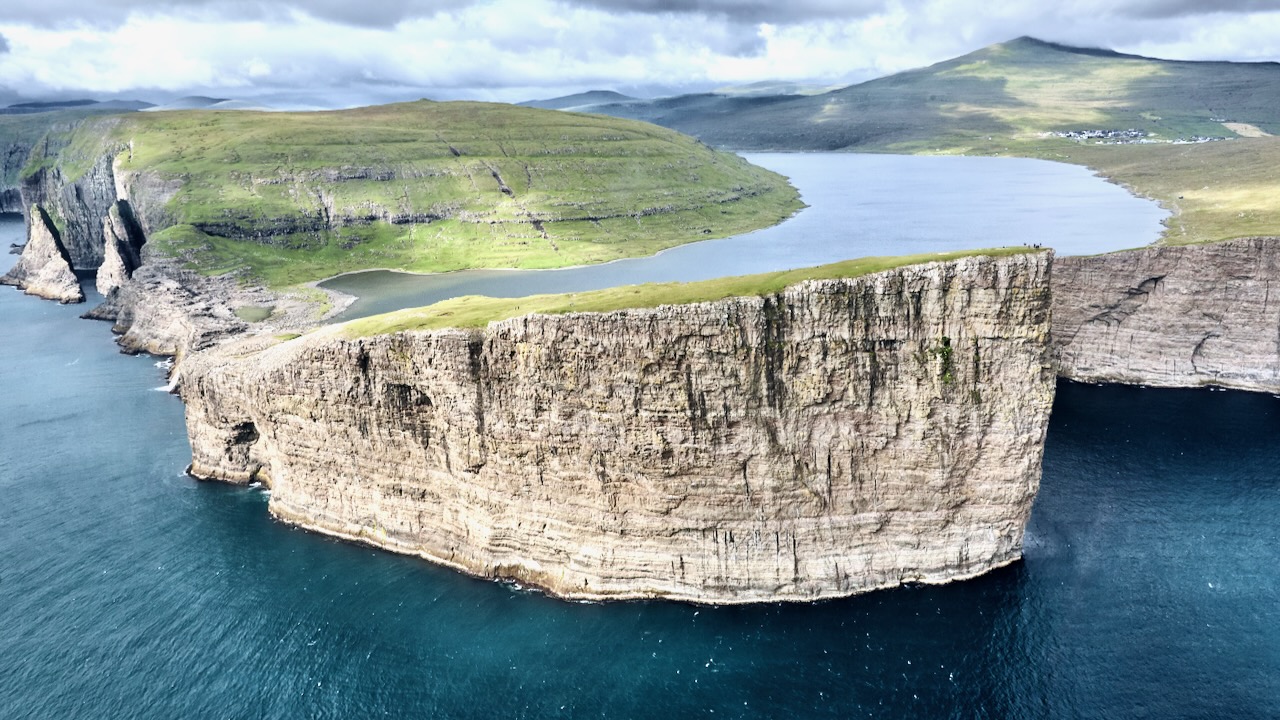
Almost every tourist to the Faroe Islands goes to see the lake hanging over the ocean. Unique and spectacular.

Sørvágsvatn is the largest lake in the Faroe Islands

… surface is about 40 m (130 ft) above the level of the sea.

It is surrounded by a higher cliff which prevents it from emptying fully into the ocean, the waterfall Bøsdalafossur being the outlet.

The greater height of the cliffs on either side of Bøsdalafossur can give the illusion from certain perspectives that the lake is higher above sea level than it is.

The waterfall vista is great. But personally I liked even better walking the Trælanípan cliff — aka the ‘Slave Cliff’. Supposedly where slaves were pushed to their deaths.

There are many, many birds nesting on those vertical sides.

Click PLAY or watch it on YouTube.

In 2024 the hiking fee was 450 kr (USD $42) / adult (ages 15+) for a guided walk. 200 kr (USD $20) / adult (ages 15+) to hike on your own, as I did.

Price is $teep. And has been going up in recent years. Know that there are other great cliff walks free in the Faroe Islands. 😀

official website – tralanipan.fo

related – Moon and Honey – Lake Sørvágsvatn (Floating Lake above the Ocean) and the Trælanípa Hike, Faroe Islands

Moon and Honey – entrance

Amazing Stuðlagil Canyon, Iceland

Trip report by BestHike editor Rick McCharles

When the construction of Kárahnjúkar Hydro Dam was finished 2009, Stuðlagil (Studlagil) Canyon became fully visible.

The water level in the river Jökla, that runs through the canyon, dropped and amazing basalt columns have since become one of the most popular tourist attractions in eastern Iceland.

Click PLAY or get a glimpse on YouTube.

The landowners were still building tourist infrastructure in 2024.

I stayed at the simple campground on the northern side of the river.

A German couple — world travellers — in a camper van, offered me lamb dinner with locally picked mushrooms. And wine! It was my best meal in Iceland. 😀

Once the tourists were gone in the evening, I climbed down a long set of stairs to have the northern viewing platform all to myself.

Next morning, I cycled over to the southern side of the river. It’s the better experience. Go to both sides, if you can.

Stuðlagil (Studlagil) is a canyon in the Eastern Region of Iceland.

It is known for its unusual amount of large columnar basalt rock formations and the turquoise coloured river that runs through it.

The canyon also has an interesting story as it became an unexpected tourist sensation in 2016 after Einar Páll Svavarsson published an article in August of that year on hiticeland.com with spectacular photos.

A year later Einar also wrote an article about Stuðlagil in WOW air magazine in June 2017 and after that the canyon became a popular tourist destination.

It’s an easy detour off the Highway 1 Ring Road. About a 19km/11.8mi sidetrip along road 923. Mostly paved in 2024.

related – All you need to know before visiting Stuðlagil Canyon

official website – studlagil.is