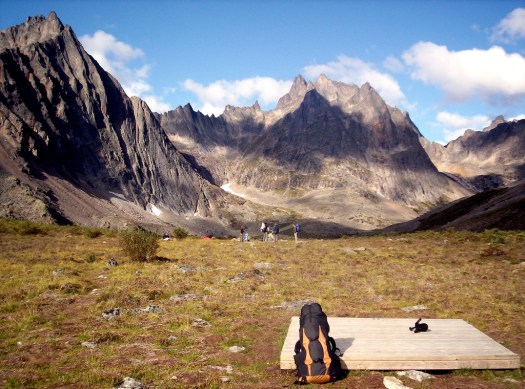
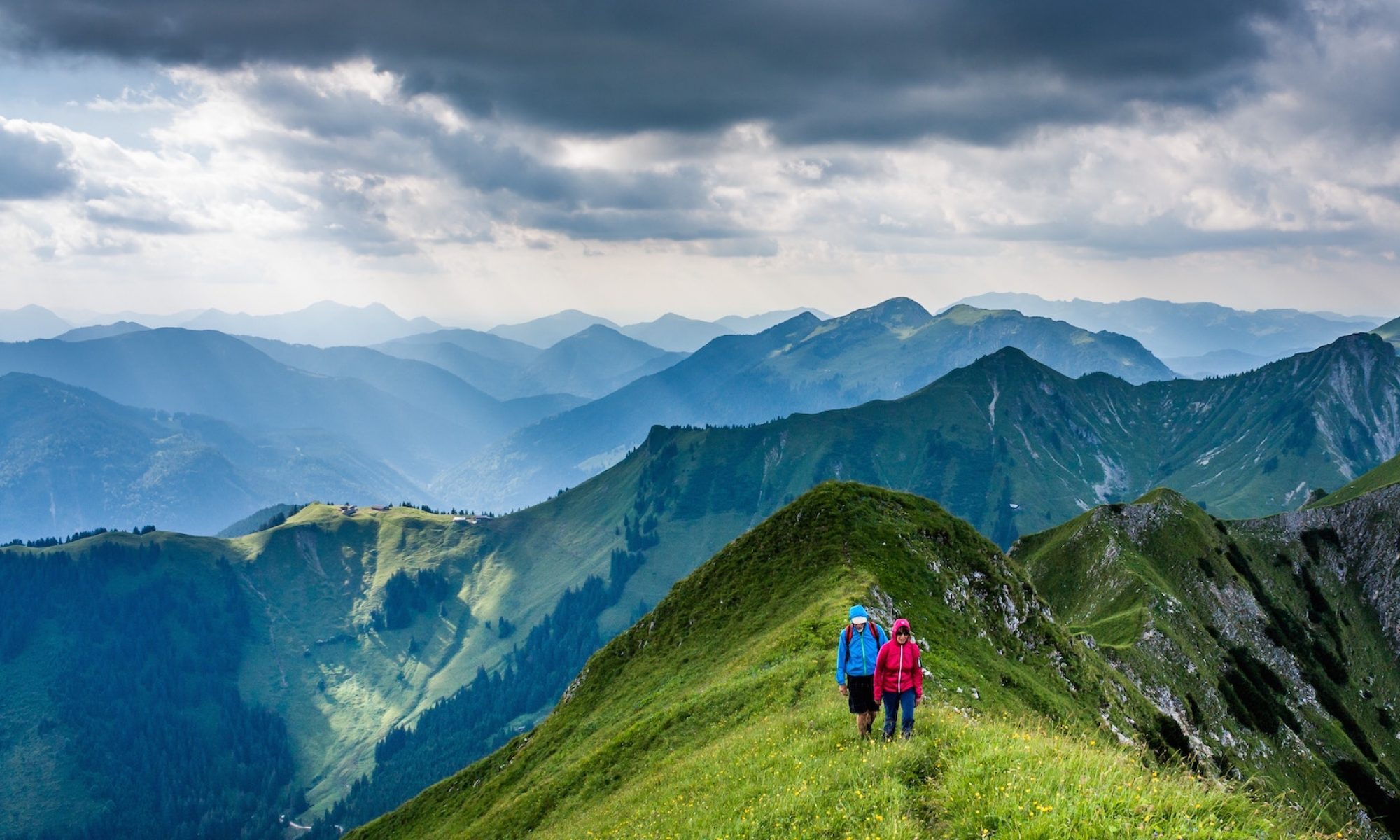
bigger than Switzerland, with much higher mountains

Flying in to Anchorage, Alaska from Juneau I was already worried.

How can anyone possibly hike Wrangell-St. Elias?

It looks the realm of mountaineers, not mere hikers like myself.

alaska.jpg

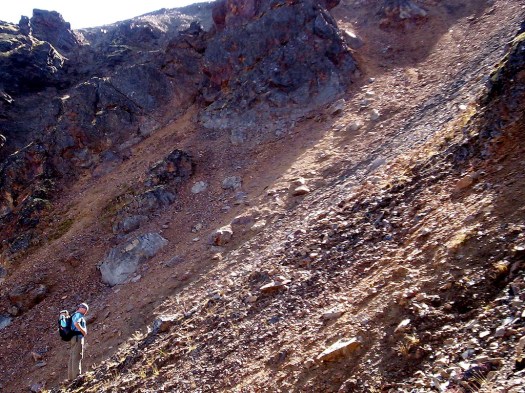
Because there are very few maintained trails within the park, travel through dense brush, along steep scree slopes, and across fast and cold glacial streams and rivers should be expected.

For most routes, map and compass reading skills are essential. Weather in these mountain ranges can vary to extremes in relatively short time periods. It is best to expect (and prepare for) almost any possibility with a variety of layerable clothing (polypropylene, wool or pile), raingear, and extra food. Summer snow storms may occur at elevations of 4,500 feet and above.

Trip Planning

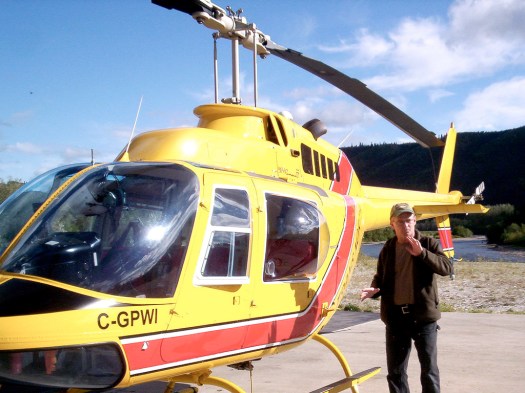
A successful hiking trip requires adequate planning. You should be prepared for everything and should not count on aid or rescue from others. Here, you will be on your own. Caution and good judgment are key ingredients for a pleasant expedition. For many hikers, hiring the services of a local guide will make the trip safer and more enjoyable. In general, the areas above tree line (~3,000′) afford the easiest hiking and best views. These areas are often accessed by chartering a flight to one of the many possible “bush” landing strips. Note that there are many more places to land than are shown on maps. Air taxis will often land on gravel bars or on the tundra.

Wrangell-St. Elias National Park & Preserve – Hiking & Backpacking in Wrangell-St. Elias National Park (U.S. National Park Service)

w-ste-map.jpgWrangell-St. Elias is the largest National Park in the USA. Indeed, if you combine it with the adjacent Parks and reserves it’s the largest protected land mass in the world.

But how does one hike it if you have only a small vehicle, not a helicopter or light plane? (Perhaps I can find some gold nuggets to pay for this trip.)

This will take some reconnaissance.

Wish us luck.

blog – Outdoor Food Simplified

Sarah’s Freezer Bag Cookingâ„¢ | Outdoor Food Simplified is simply the best on the net for hikers looking for great grub.

Check this post as an example:

Often I get asked if one can actually save money by doing their meals at home versus running down to the local REI for meals.

The answer is always “Yes!” but I hadn’t really ever run how much one could save. And simply put, I decided to see if it was more than just money that one could save.

Could you also eat healthier and save money? …

Sarah compared the $6 Mountain House Spaghetti and Meatballs meal-in-a-bag vs preparing her own:

fdversus3.jpg

Made at home Spaghetti (16 ounce serving):

600 calories
700 mg Sodium
13 g Fiber
29 g Protein

As you can easily see, you can save a lot in cost, sodium and you will get a LOT more fiber if you make your own. You will also know exactly what is in your meal. At a savings of about $4 per serving and half the sodium, that alone makes it worthwhile to make your own. You are also avoiding potential hidden MSG, and fillers.

Freezer Bag Cookingâ„¢ | Outdoor Food Simplified

Grand Staircase – Escalante National Monument, Utah

I’ve been getting to the “Four Corners” of the USA for hiking about once a year.

Next trip I plan on checking out Grand Staircase – Escalante and Capitol Reef.

The best hiking photos I can find on this region are posted by Phil Armitage:

The 1.7 million acres of the Grand Staircase – Escalante National Monument, together with the nearby Death Hollow wilderness and Capitol Reef National Park, contain some of the best canyon hiking to be found in the Southwest US.

Although the region is famous for its slot canyons, backpacking trips, and technical canyoneering possibilities, the relatively sparsely visited area also has easier trails that can be accessed out of the small towns of Boulder and Escalante.

This page summarizes some of the best day hikes I’ve found in the Escalante. …

alcove.jpg

arch.jpg

capitol2.jpg

Day hikes in Grand Staircase – Escalante National Monument, Utah

slogging the Dusky Track in New Zealand

Adventurous Jenni and Nick are on an around-the-world trip with stops for some of the best hikes on Earth.

I asked Jenni which was the “best” so far. Instead she let me know which was most “challenging”:

The “epic”, and one we always refer back to as to judge how difficult a trek has been, has got to be the Dusky Track in NZ, a tough 8 days. In fact all the treks we did in NZ were great (Rees Dart, Banks, part of the Copland, Routeburn, Tongario Circuit …

Jenni on Day 1 of the Dusky Track

mud.jpg

Fiordland in New Zealand (like Southwest Tasmania and coastal west Patagonia) is fearsome. Rainy, windy, cold and boggy. And buggy. Did I mention the deadly sandflies?

I was too “chicken” to try any of the more daunting, remote trails in Fiordland when I was there.

Happily, Nick and Jenni were able to complete the entire tramp:

So that was Dusky Track. Damn hard work – you had to concentrate on every step (we reackon we took about 250,000 over the 9 days and 84km) – up and over slippery tree roots, slippery mossy rocks, through mud, bog and rivers, across three wire walkwires to the end all for two good views – the rest was spent in the forest.

I made it, with a lot of help, and my limits were certainly tested.

Would I do it again – no – but I’m glad I’ve done it and I’ve learnt that I prefer the hard slog up the mountain and then spending time high rather than in the forest.

We were so lucky with the weather, it would have been 100 times worse in the rain and the mud would have been dreadful.

Dusky track for me = mud, blood, sweat and quite a few tears.

Dusky Track trip report
– Jenni

dusky.jpg

Related posts:

Nick & Jenni’s Choquequirao to Machu Picchu trek

Nick & Jenni’s Dientes Circuit Trek in Patagonia

climb Bukhan Mountain, Seoul, Korea

The ROK Drop blog has an excellent post on getting into the wild in Korea:

Seoul is a city that is literally surrounded by mountains that provide many great outdoor opportunities for those who want to escape the hustle and bustle of modern, urbanized Korea.

The most popular destination for Seoulites looking to get away from the city and reconnect with nature for a little while is a day trip to Bukhansan (Pukhansan) National Park that towers over the northwestern landscape of Seoul.

So many people visit this park that it is actually the most popular national park in all of Korea. On some days its popularity with the locals leaves you wondering if you have actually left the city or not when you are surrounded with visor wearing ajummas and ajushis dressed as if they are about to undertake a Himalayan expedition.

To escape the crowds, you have to get away from the lower reaches of the park where visitors congregate around the restaurants and soju bars and find your own piece of solitude on one of the upper peaks of the park. …

This national park was first established in 1983 and encompasses nearly 80 squared kilometers of land. There are three main peaks on the mountain, Baekundae (836.5m), Insubong (810.5m) and Mangnyeongdae (799.5m).

This travelog will focus on the route up to the highest peak Baekundae. …

pukhan22.jpg

Things to Do In Korea: Bukhan Mountain National Park at ROK Drop

Bukhansan National Park – official website

10 mountains to see before you die

Erebus (Antarctica)

Khan Tengri (Kazakhstan)

Roraima (Venezuela) – see Roraima Lost World Trek

Torres del Paine – see Torres del Paine Trek

Machupuchare (Nepal) – see Annapurna Circuit

An Teallach (Scotland)

Rainier (USA) – see Wonderland Trail

Kilimanjaro (Tanzania) – see Kilimanjaro Marangu route

Jade Dragon Snow Mountain (China)

Chomolungma (Asia) AKA Mt. Everest

Ten mountains to see before you die – Bluelist – Lonely Planet

antarctica.jpg

Room with a view. An outhouse backed by Mount Erebus, Antarctica’s only active volcano.

Antarctic Journal 20 January 2005 – Kevin Hand

hike Black Canyon Lake, Absaroka-Beartooth wilderness

Yesterday we linked to a trip report from Phil Armitage to The Hounds Tooth in the Bugaboos.

Today, Phil’s trip report from Absaroka-Beartooth wilderness near Red Lodge, Montana:

The 14-mile roundtrip to Black Canyon Lake is an outstanding day hike – the best I found in this part of the Beartooths and one of the most scenic hikes I’ve done anywhere. …

There is a great view of Thunder mountain rising above the creek from the bridge. …

The route climbs through the forest with just a couple of poorly defined sections, reaching timberline at about 8,800 feet along a tributary of Rock Creek. Here, just when the first expansive view of the peaks appears, you should cross the gully to the right bank of the stream and continue on the obvious trail up to the lake – if instead you stay on the left bank you’ll end up in a monstrous field of huge boulders which makes for slow going. In total, it’s probably a mile and half from the main trail until you reach the shore of the vivid turquoise lake, which lies beneath 12,000 foot high Beartooth Mountain and Mount Rearguard. The view here is absolutely spectacular.

Day hikes in the Absaroka-Beartooth wilderness near Red Lodge, Montana

phil.jpg
larger original

If you want crowds, head for nearby Yellowstone and Grand Teton National Parks.

If you want some solitude, check out Absaroka-Beartooth. Phil recommends Hiking the Absaroka-Beartooth Wilderness, 2nd ed. by Schneider.

scramble to Conrad Kain hut in the Bugaboos

Photographer Phil Armitage has a terrific photo gallery that any hiker will love. His best photos are available for sale.

I was particularly interested in Phil’s pics from a hike to shoot “The Hound’s Tooth” in the “Bugs”, a granite range in the Purcell Mountains of eastern British Columbia, Canada.

hounds-tooth.jpg
larger original

From Phil’s trip report:

Bugaboo spires trailhead, at the end of the road in Bugaboo Provincial Park.

Although this is by far the most popular spot in the Purcells, it’s still pretty remote – you’ll need to violate the spirit as well as the letter of a rental car contract to negotiate the 30 miles of dirt roads between Brisco (18 miles north of Radium Hot Springs on Highway 95) and the trailhead.

You’ll need detailed directions from a guidebook, or from maps available locally, but it’s not too tricky to find. In summer 2006 the road was pretty rough, with plenty of potholes, but numerous low clearance 2WD cars and vans had successfully made it to the Park. …

The hike to the Conrad Kain hut is very short – just a 6 mile round trip – but brutally steep. There’s 2200 feet of elevation gain to the hut, all of it attained in the last two miles.

In places the route is protected by cables bolted into the rock, and in one spot you climb a steep section with the aid of a metal ladder, but the trail is in excellent shape and at least in dry weather these aids are more for reassurance than for necessity. The views of the Hound’s Tooth, with the Bugaboo glacier flowing past the spire and down the valley, are continual and astounding throughout the hike. When we did this in mid-August, there were nice patches of wildflowers in several small meadows along the trail.

The hut is perched on a rocky shelf with a panoramic view of both the spires and the valley along which the trail ascends. It’s a great spot for lunch. You can also scramble off-trail without much difficulty to attain a small ridge that allows a closer vantage of the glaciers. This feels about as wild a spot as can be reached by mere hikers. I highly recommend this hike – it’s one of the best short day hikes I’ve done.

Day hikes in the Bugaboos and Purcell Mountains of British Columbia

tooth-2.jpg
larger original

I checked with a local hiking buddy who had done this trip a few years ago. He confirmed it was one of his best hikes ever.

We’ve added Conrad Cain to our list of the best hikes in North America.

Bugaboo Provincial Park
– official website

South Island weekend walks – New Zealand

There are many great hiking guidebooks for New Zealand including our top pick Lonely Planet Tramping in New Zealand.

Rather than compete directly against LP, a new speciality guide takes a different focus:

south-island.jpg

The reality for most New Zealand trampers is that their tramping often has to be fitted into weekends.

In recognition, Nick Groves, a leading New Zealand outdoor photographer, and now writer, has collected together the best of the South Island’s two or three day tramping trips.

These trips, selected from all over the South Island, range in difficulty to ensure that there are tramps for every ability. Essential information on length, grade, time, suitable maps, access and sources of information are provided for each tramp. This is followed by a more detailed description of the tramp and what you might expect to experience.

The book is heavily illustrated, with colour reference maps for each section and the author’s stunning photographs throughout.

South Island Weekend Tramps – New Zealand guide books, books and maps from Clearwater Tarn – Online shop

Sex In A Tent – you wish

Michelle Waitzman is the author of “Sex in a Tent: a wild couple’s guide to getting naughty in nature” (Wilderness Press, Oct. 2007)

She lives in Wellington, New Zealand although she is originally from Toronto, Canada. She loves spending time in the great outdoors.

Hiking, backpacking (or ‘tramping’ as they call it here in NZ), and sea kayaking are some of her favourite ways to enjoy the wilderness. Michelle is also writing “Moon Living Abroad in New Zealand”, a guide for those who would like to follow in her footsteps and move to New Zealand.

Love In A Tent
Michelle Waitzman

– the blog

A Wild Couple\'s Guide to Getting Naughty in Nature

Sex in a Tent: A Wild Couple\’s Guide to Getting Naughty in Nature

(via all the hiking websites edited by those only sleeping in their tents)

This reminds me of the classic How to Shit in the Woods by Kathleen Meyer.