After a long, cold night in the tent, I awoke with “mountaineer’s lassitude“:
… reluctance to put one foot in front of the other …
I’d first read of the condition in the mountaineering parody, The Ascent of Rum Doodle (1956), one of my favourite books.
I was sick again. The same stomach ailment I had on the first 2 days of the trek.
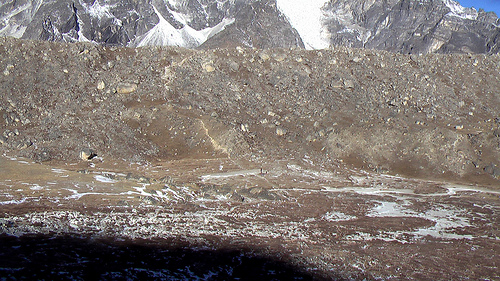
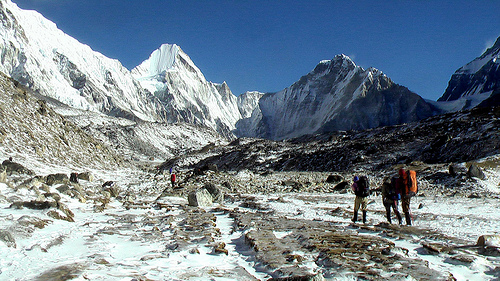
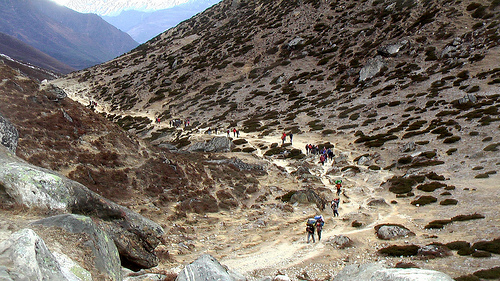
That’s the lateral moraine of the Khumbu Glacier. I first needed to trudge down. Then find a safe way across. Others had advised that it was no problem this season, … if the weather is good.
Fortunately, the weather remained perfect. There was not even snow blowing off the highest peaks!
It seemed to take a long time to reach Lobuche.
I stopped for lunch and to recharge my batteries at a restaurant. Then psyched up for the relatively short and easy walk to Dzonghla (Dzongla).
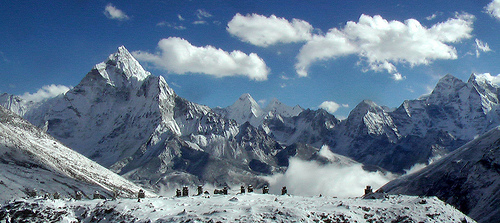
it was a pity I felt rotten. The weather was stupendous. And the scenery even better.
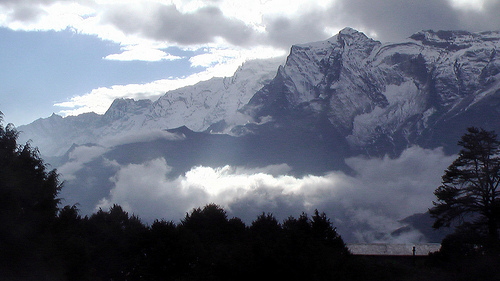
looking back to Ama Dablum
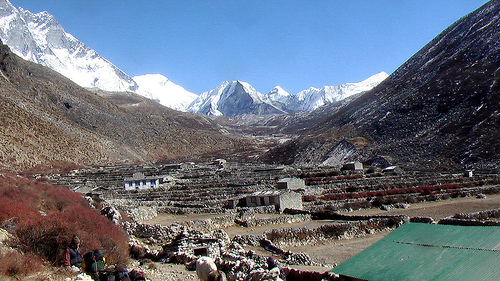
Late afternoon I finally reached the remote village. But I spent less time in the guesthouse restaurant than in here …
I crashed that evening without eating. And did not get up until Noon the next day.
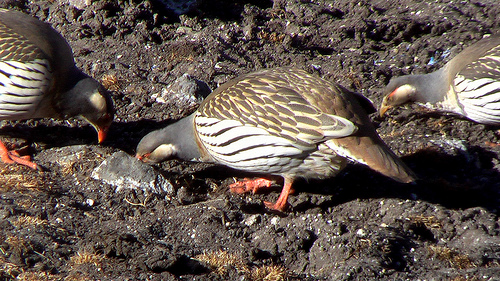
Mid-day there was only myself and the Nepali National bird, the Himalayan Monal, wandering about the courtyard.
Everyone else had departed at first light over the Cho La, the most difficult of the Three Passes route.
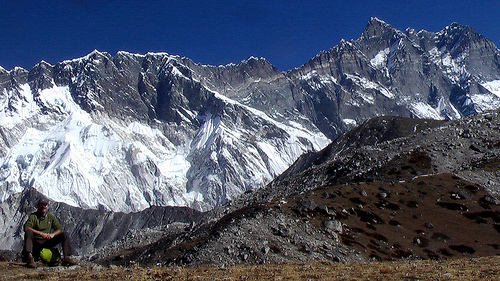
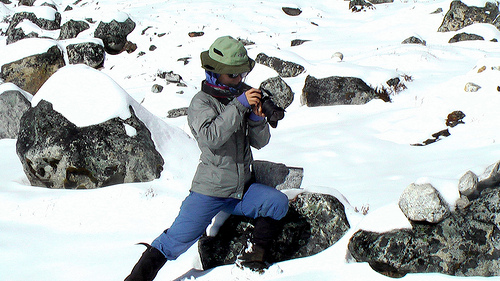
I had a forced rest day. Standing around like this guy.
I heard plenty of warnings about the 9hr crossing. But in perfect weather … if you are already acclimatized to altitude, it’s only moderately difficult.
One of two access trails climbs quickly up and away from the Nuptse Glacier. And away from “teahouse trekking”. There are no facilities along the way. This is true high altitude wilderness.
I loved it.
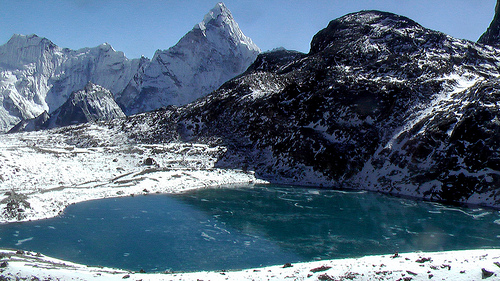
It starts with an easy grassy valley walk. And ends in “… a lunar landscape of icy lakes and frozen ridges …”
Pokhalde Base Camp
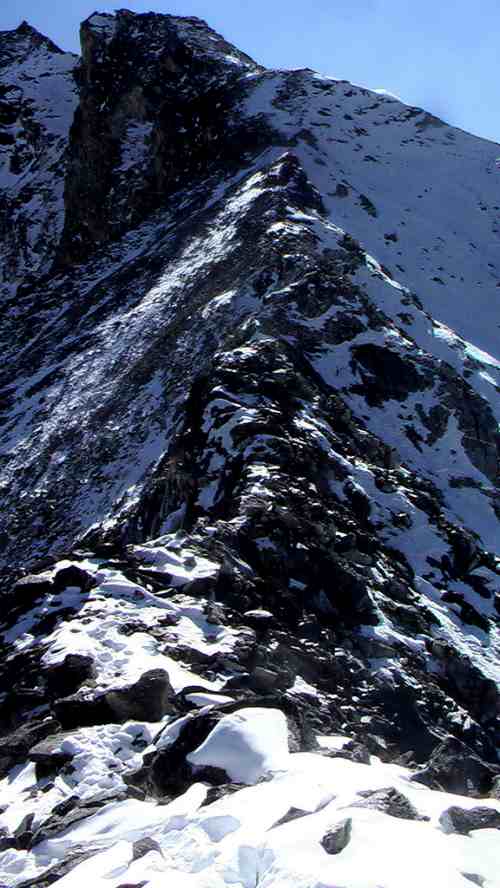
I scrambled part way up a ridge of Pokalde Peak 5806m (19,048ft). As you can see, it’s not difficult.
This is not the route used by most trekking peak groups, however. (I didn’t want to get in trouble for not having a “trekking peak permit”.)
What a view from on high!
I lingered long at the pass 5535m (18,159ft), so late that I was the last trekker to cross that day.
The descent from the pass is the most difficult part of Kongma La … scrambling frozen loose scree for 2hrs Yuck.
I could have just barely made it down to the village of Lobuche before dark … but I’d heard bad things about those guest houses. Lobuche is a messy, littered place, the least appealing of any accommodation I saw in the Khumbu region.
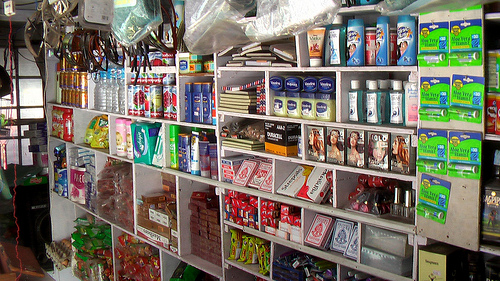
Morning in Dingboche was catching up on email, charging my batteries, and replenishing my personal food at this excellent “grocery store”.
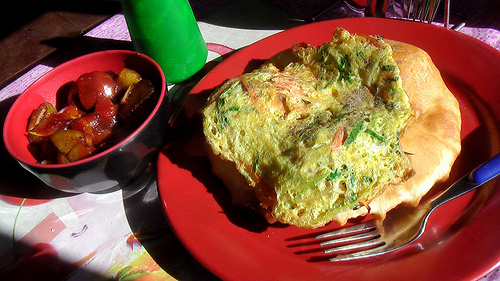
For once I hung around the “teahouse”, chatting with guides and hikers. And eating. The food is surprisingly good.
omelette
Regarding the guest houses …
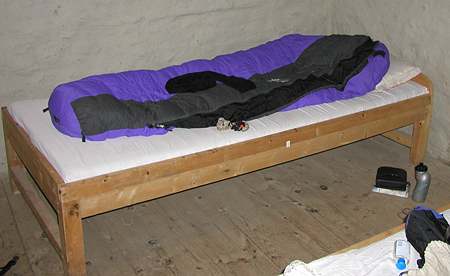
… Rooms are simple, plain, but generally clean and secure …
photo from outdoorsmagic
… The beauty of independent trekking in the Annapurna or Everest areas is that you can stay in tea houses or lodges which means all you really need is clothing, a warm sleeping bag, water bottle and some form or water purification, wash kit, basic first aid kit and, erm, money. …
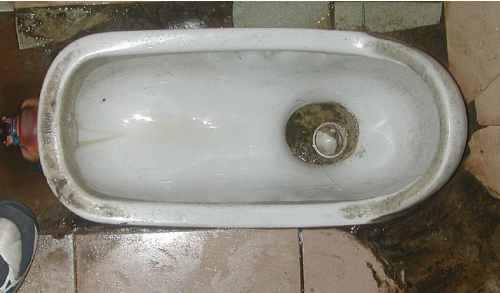
The biggest complaints are about toilets. Many are dark, dank and cold. Most are squatters.
Finding a sitter is a bonus.
The best source of information was the owner of the internet café. He convinced me that the Spring hiking season (March-April) is even better than the Fall (October to early December). Hikers are “healthier” in the Spring, he told. His theory is that the new green vegetation raises the level of oxygen.
I got excited about a possible future climb of Island Peak 6189m (20,305 ft).
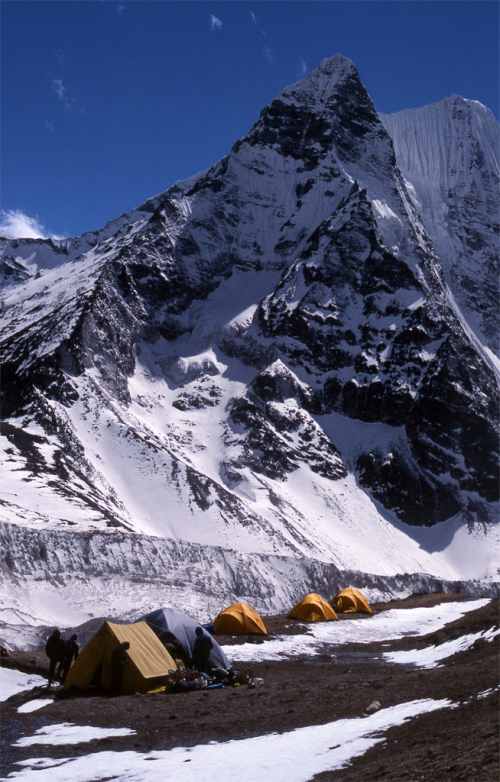
Island Peak high camp
Dozens told me how much they enjoyed the experience. I’d trek to Dingboche independently, then hire a guide and rent gear there. That’s the least expensive way to do it. And all your money goes to the local people.
Late afternoon I took an off trail day hike in the direction of Island Peak.
It’s easy to get lost in the glacial moraine ridges. It was dark before I got back to town.
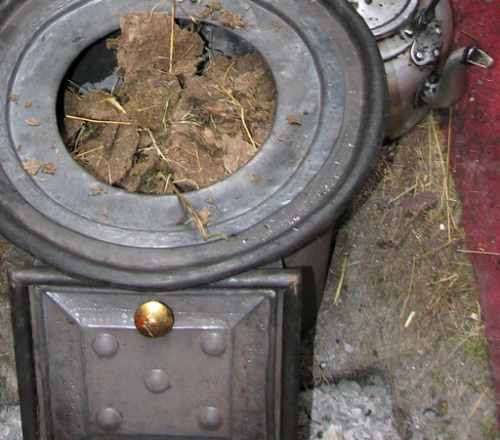
At higher elevations in the National Park it’s illegal to burn wood. Instead they burn dried Yak dung. To get the fire started, dunk a few turds in kerosene.
At night hikers hang out around the stove trying to stay warm and awake until 8PM.
Sadly, there were very few tents at Base Camp 5360m (17,600 ft). But they set up as close as they can get to the Khumbu Ice Fall.
As I’d often heard, it’s a God Awful place to camp. It must take forever to build new tent platforms each season.
The weather was superb. Above freezing, the glacier collapsing upon itself with melt.
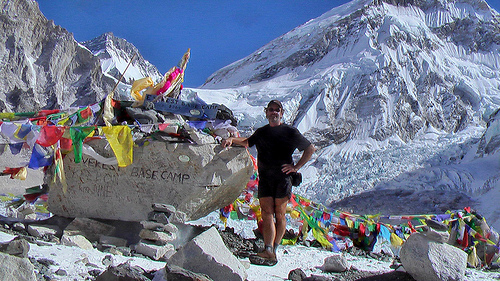
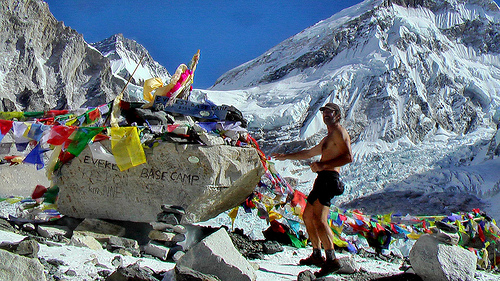
Some hiker goofing at the entrance sign …
Later I learned that nudity is not allowed near sacred mountains. Israelis who hiked nude over the Thorong La on the Annapurna Circuit were fined $100ea and had their camera SD cards confiscated.
I didn’t linger long as I proposed to backtrack same day all the way to Dingboche. For the first time I could hike as far as I wanted as I would finally be losing elevation.
hiking counter clockwise
From Dingboche I could resume the Three Passes of Everest itinerary, via Kongma La. This perfect weather was an incentive to hurry.
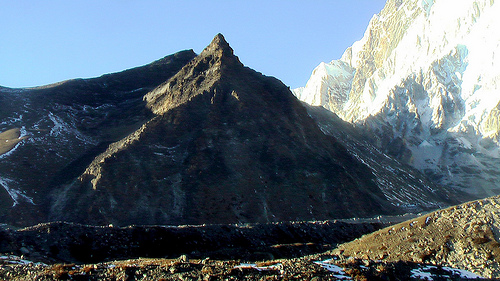
The only sidetrip on the decent was to checkout the “Italian Pyramid“, a high altitude scientific research station.
It was dark by the time I reached Dingboche. But with every step I felt, psychologically, that the air was more oxygen rich!
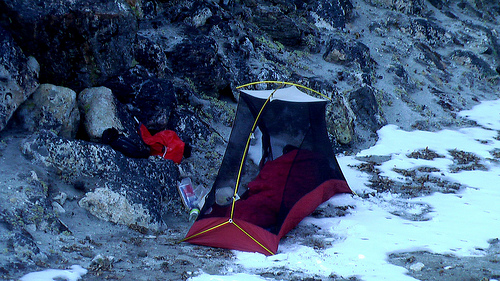
It might have been a mistake to tent at 4800m (15,750ft). I was 12hrs huddling, full clothed, in the sleeping bag with my electronics. (Freezing the batteries would kill them.)
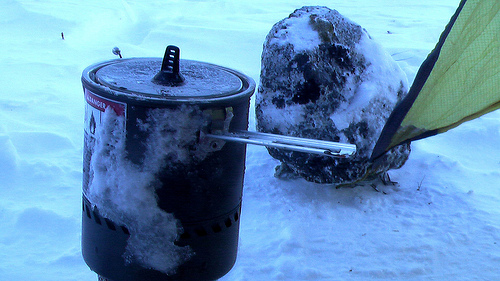
Next morning neither of my lighters wanted to function. My boots and stove were frozen solid.
After much fussing, I finally managed to light the stove … to unthaw my boots enough to get my feet into them. Yeesh!
Fact is, I’m one of the only independent hikers carrying a tent. (People thought I was crazy to carry the weight when rooms cost less than $3 and restaurants are available every hour along the main trails.)
But I enjoy sleeping in a tent. You feel much more connected with the mountains.
Happily the morning dawned sunny, cold and clear.
Everyone had the same idea … RUSH to Everest to see the summit in good weather. The world’s highest mountain’s notoriously hostile microclimate oft has the peak in cloud. It had been shrouded for at least the past week.
But for me that would mean over 800m elevation gain in one day. Risky.
hmmm … I decided to go for it.
Gorak Shep 5164m (translation Dead Ravens) is the last village before Mt Everest.
I’d heard some bad things about these remote guest houses. But I loved the outpost. One of my favourite stops on the entire trek.
After lunch I psyched up for the 2hr climb up this deceptively easy looking “hill”, Kala Patthar. 5643m (18,513ft). It has a couple of false summits.
Kala Patthar as seen from Gorek Shep
The intimidating mountain in the background is Pumori 7161m (23,494 ft).
Most agree that the best viewpoint of Mt Everest from the south is from the brown top of that lump. That said, there truly are no great hiking trail vistas of Everest from the south. All it’s neighbours look higher and more impressive.
As usual, it was very windy at the top of Kala Patthar.
But I was thrilled to have made it here with such good visibility.
Rick and Mt. Everest
Everyone was thankful we had been so “lucky” with the weather.
At this point I felt my trek had already been a “success”. The rest would be bonus.
At first light, outside my window, I saw white stuff piled up on the Yaks. An early snowfall, not all that unusual in November.
Instantly I thought of the November 1995 freak snow storm where dozens (46 some say) of hikers, porters and guides were killed throughout the Himalaya, most by avalanche.
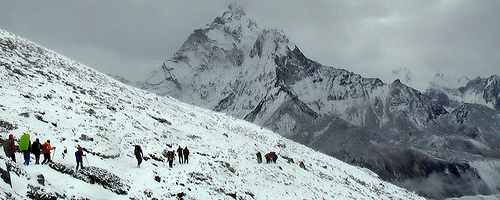
At breakfast that morning, after consulting with guides and hikers who had been there, I decided it might be too dangerous to cross the Kongma La 5535m (18,159ft) after a new snowfall. Instead I would head directly to Mt. Everest base camp skipping the recommended acclimatization day. I felt good aside from the lack of sleep.
As a Canadian, I had no fear of this light snowfall. In fact, it turned out to be the most beautiful day of the trek.
The bleak, dry terrain was suddenly magical.
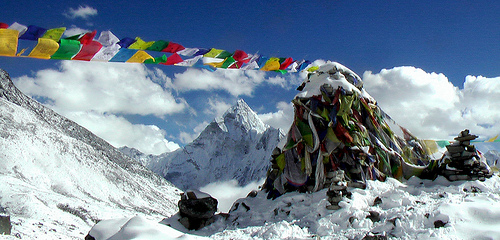
The highlight of a wonderfully scenic day was the shrine of Babu Chiri Sherpa at what some call Dughla Pass.
… With ten Everest Summits (including 4 North Side summits), many considered Babu Chiri Sherpa the strongest climber on Everest. …
Babu Chiri Sherpa passed away after unexpectedly falling into a crevasse at Camp II at 1600 hrs on 29 April 2001. …
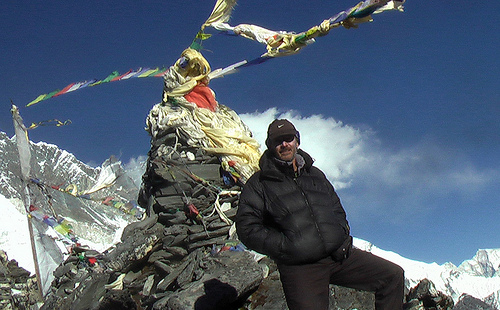
I left a Summit Stone there in tribute to him and all the Sherpas who have died over the years.
I was very happy to finally catch up with Ping and Shirley from New York.
Ping and RickShirley
We had flown in and walked together the first day. Due to my altitude sickness I fell behind day 2. Ping and Shirley had only a 2 week holiday to try for Everest and Gokyo. (Short holidays is one of the reasons there are surprisingly few Americans trekking Nepal. You’ll meet more Canadians though Canada has one tenth the population.)
I was so inspired by this beautiful and spiritual place that I decided to pitch my tent right there in the snow amongst the hundreds of shrines to fallen climbers.
I wanted to see sunset from this vantage. Here’s last light as seen from my tent.
Just before dark, the previous evening, I found a perfect tent site by a waterfall just above this bridge.
Wild camping is not illegal in the National Park. But it’s best to be discrete.
Feeling good, I decided to climb all the way to Dingboche at about 4,530m (14,800 ft). Likely I’d need a rest day there doing one or the other of a couple of different side trip options.
Ama Dablam began to loom large.
The trees were gone. Increasingly the scenery became bleaker.
Though nobody ever seemed to mention it, we were disappointed with the weather. In November it should be sunny, clear and cold.
I was psyched, however, upon reaching Dingboche, a memorable village. This is the jumping off point for the excellent Island Peak climb, by far the most popular of the trekking peaks.
The biggest change I found from my last trip to Nepal 11ys ago is mobile phones. All guides and lodges have them. Some European hikers had phones. And phones seem to work almost anywhere.
At first put off by telephone contact in the “wilderness”, I quickly realized what a life saver they must be. Literally. Lives have been saved, I’m sure, by communication.
The second biggest change is that internet has arrived over the past few years. Here is the highest internet cafe in the world.
Actually it was the highest in the world. The owner recently put one laptop and a connection at Gorak Shep 5,164m, right on the doorstep of Mt. Everest.
I took every opportunity to post online my exact whereabouts, as a safety precaution.
Here are the Yaks coming home to my Guest House after a day of grazing barren hills late in the season. I ate much better than the Yaks that day. In fact, I took the ultimate Himalayan culinary challenge … I ordered Yak steak. (Eating meat is strongly discouraged by every guidebook.)
I turned out to be fine. … But I never ordered meat again for the rest of the trip.
Namche Bazaar is the last village of (comparative) civilization before the high Himalaya. My batteries were literally and figuratively recharged after a rest day there.
Almost all hikers leaving Namche head towards Tengboche 3,867m (12,687 ft).
hiking counter clockwise
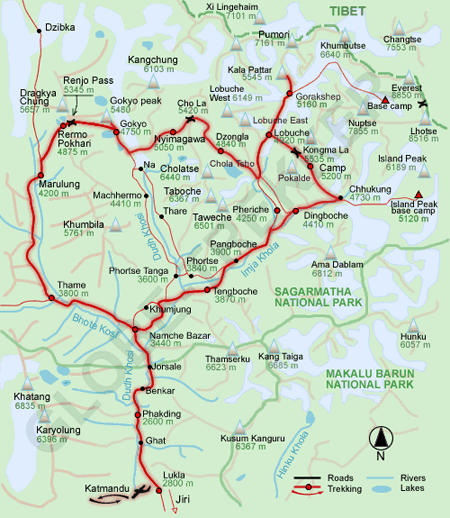
I did, as well, intending to do the Three Passes of Everest trek, a relatively new itinerary. It’s basically a big lollypop loop hike as shown in red above.
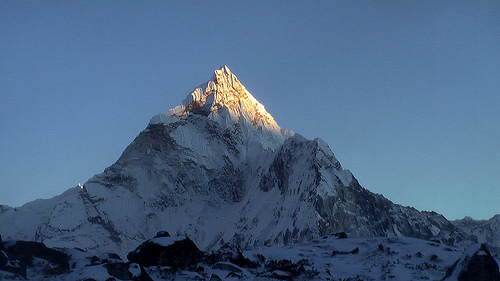
Tengboche is not all that difficult a hiking day as the gain in altitude is reasonable. But the scenery quickly becomes more dramatic. Meet Ama Dablam, soon to become my favourite mountain in the region.
Many guest houses sell “hot showers” for about $3. That gets you 20 liters of solar heated luke warm water. I washed, instead, as do the Nepalis, in a freezing mountain spring or from a standing tap.
The mountain women all have lovely, thick long hair. But washing it and staving off lice is challenging.
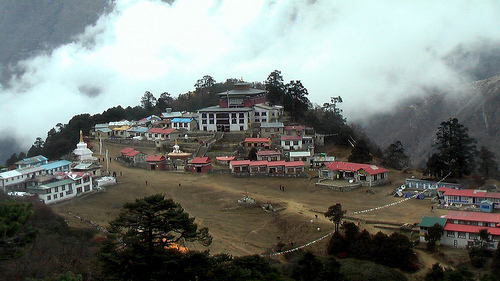
Tengboche is a popular stop because of the famed Buddhist monastery, the largest in the Khumbu region. It was rebuilt after a fire in 1989.
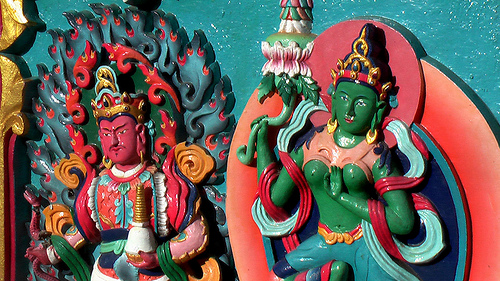
I love these colourful monasteries having visited dozens in Tibet 11yrs ago.
But the highlight for me that day was meeting a Sherpa who had 5 times been to the summit of Everest working for Russell Brice of Chamonix Experience. He shared great stories with tourists and monks, there as a guest for a big Puja. High altitude Sherpas are wealthy celebrities in the Khumbu.
Rarely can I pass by any bakery. The one in Tengboche is particularly good.
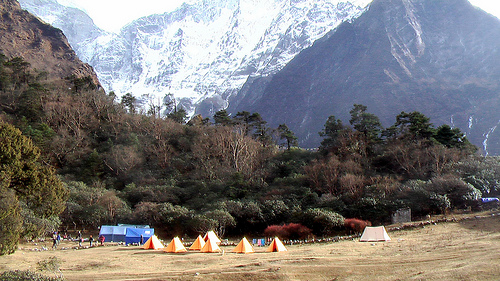
I was tempted to set up the tent. It’s a charming place.
… But with a couple of hours of daylight remaining, I decided to gain another couple of hundred metres. Altitude and attitude are everything when trekking up to Everest.
If you feel ill, stop. If you feel good, climb higher. As an independent hiker, I had this option. I was not bound by the itinerary of any group. In fact, most hikers stricken with altitude sickness are in groups, denying illness, trying to keep up.


















 besthike.com