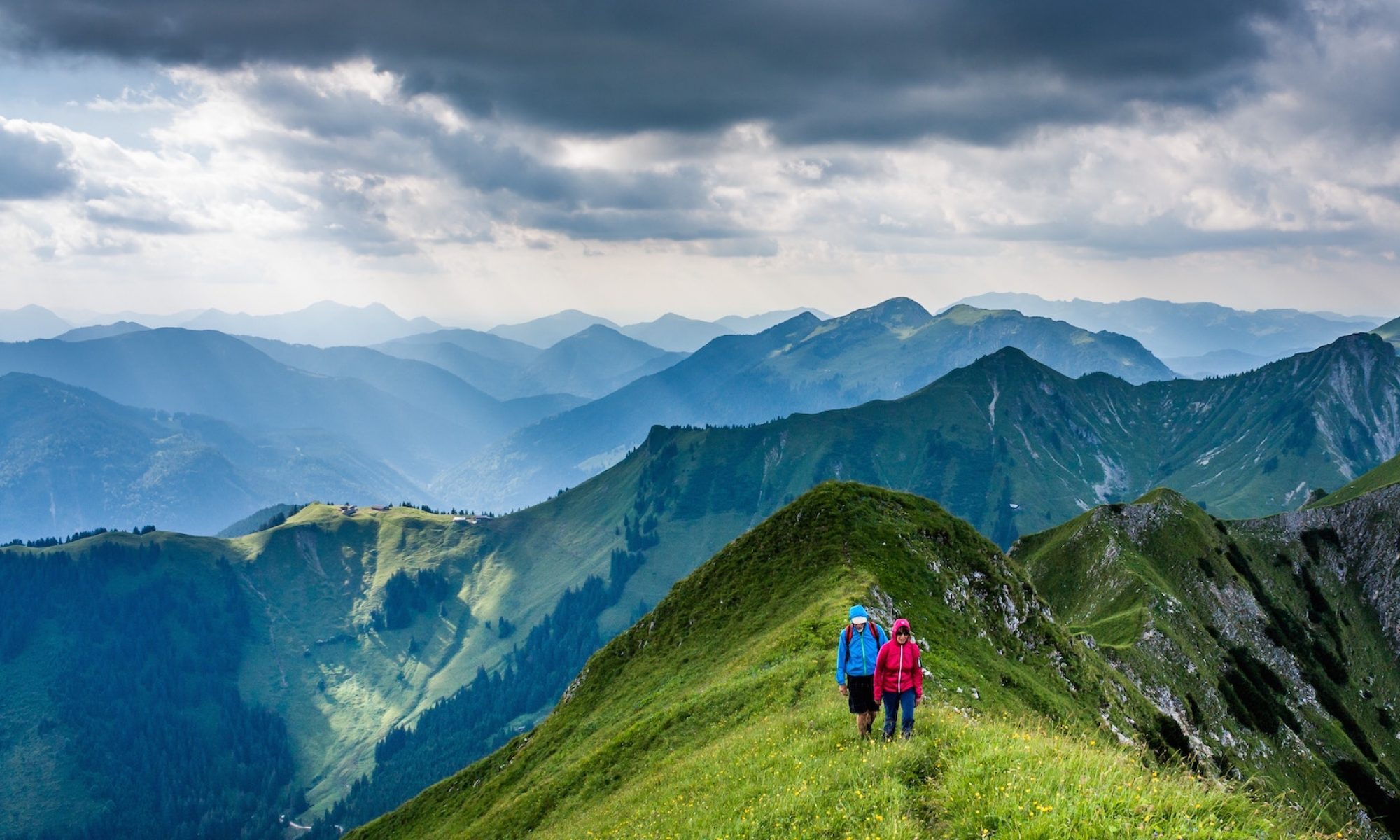
The ultimate goal is to establish, develop, maintain, preserve and promote a long distance, public, non-motorized trail running north/south through the short grass prairies of the Great Plains of North America
… a trail that runs from Canada’s Grassland National Park on the U.S./ Canada border to the summit of Guadalupe Peak in Guadalupe Mountains National Park, Texas.
The trail will allow for hiking, horseback riding, and in most areas, mountain biking. …
Barefoot Jake doesn’t always go barefoot. On this weekend adventure out of Ozette Lake he wore his Luna ATS Huaraches and Vibram Five Finger KSO.
This terrain and climate is ideal for minimal footwear.
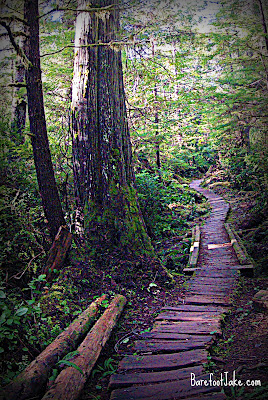
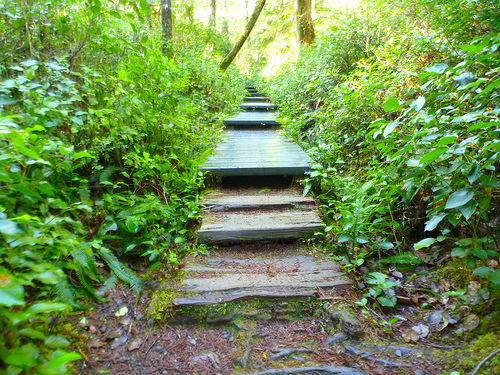
… over 90% Board Walk made up of new, old and really old planks that have been in place for probably longer than I have been born. Figured this would be a perfect opportunity to to break in my Luna ATS Huaraches further. Felt great to let the feet air out …
… this is maybe the best travel video I’ve seen in the last year. It’s a combination of several things — the narrative is rich and well timed, the landscapes are beautiful and lush — but I think that the most important thing is the way in which it appeals to the traveler. …
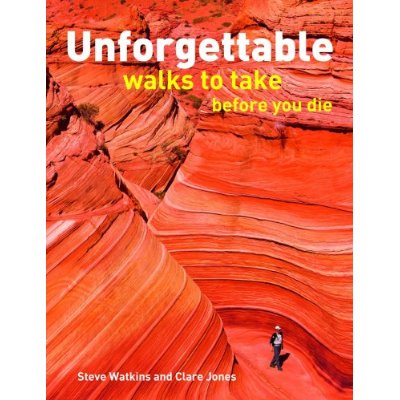
Unforgettable Walks to Take Before You Die is the fifth title (2008) in an exciting series of books that will help you search out essential sights and experiences around the world.
Photographers and writers Steve Watkins and Clare Jones draw on their years of international travel experience in selecting thirty of the world’s most inspiring, spectacular and beautiful walks, each of which can be done within the space of a two-week break. …
Also called “Cape Alava – Sand Point Loop“, the trailhead is Ozette Lake.
Ozette Lake offers several trails leading to the Pacific Coast Marine Sanctuary. I chose this adventure as it’s open year round. And because I was hiking alone, preferring a loop trail over an out-and-back.
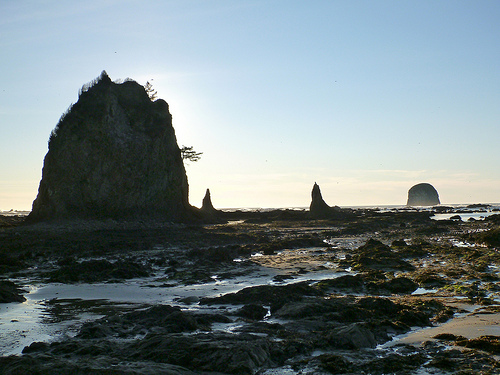
With sea stacks, sea otters, sea lions, and ocean scenery for as far as you can see, the 9.4-mile Ozette Triangle is one of the finest hikes on the Olympic Coast. Easily accessible and a loop hike, the Triangle (named for the loop’s shape) is a perfect introduction to America’s wildest coastline south of Alaska. …
There are literally MILES of boardwalk.
A ranger warned me of the dangers of slipping … but (as a Canadian) even those slicked over with frost were fun for me. I ‘skated’ some of the downhill sections.
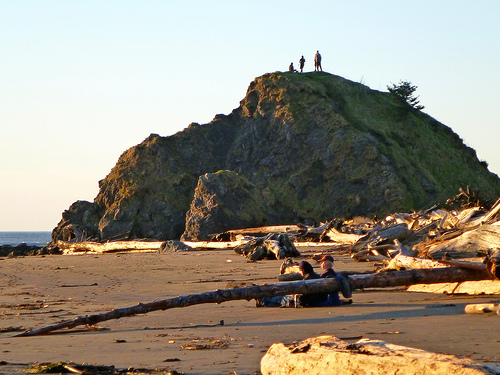
On arrival at Cape Alva, I decided to detour Tskawahan “island”. It’s actually connected to mainland at most tides.
I left a Summit Stone atop that feature, one of the westerly most points of land on the lower 48 States.
Beach walking is gorgeous. Nobody could believe this was early February — it looks like July!
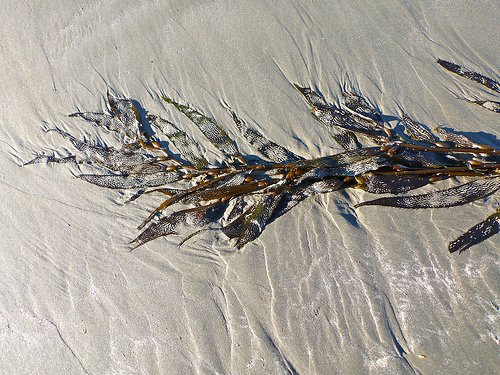
There’s some fascinating flotsam or jetsam around every corner. This hot tub, for example.
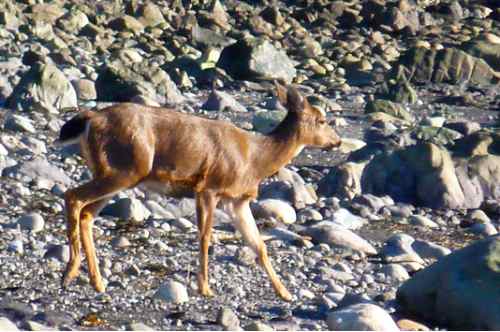
… A doe and fawn passed our camp a few times. We also saw golden eagles, bald eagles, crabs, raccoons, and a fur seal pup on the beach.
Speaking of raccoons, they are as much a problem for campers as bears in the high country. (But at least you don’t have to worry about raccoons dragging your friends into the woods and mauling them.) Come prepared to hang your food and anything else scented in a tough container, like a bucket, day and night. Take your backpack into the tent with you at night, to keep the varmints from ripping it open with their razor-sharp little claws. During the day, leave your tent open and empty. I once lost an empty dome tent to raccoons who wanted to see what was inside. Don’t underestimate their tenacity or intelligence. …
At this point I was certain I’d not get back to the trailhead before dark. The sun was sinking fast.
Perhaps I should have camped here. There’s plenty of space and plenty of (tannin stained) water. 🙂
But I’d left the tent in my vehicle, so could only enjoy this vista before plunging back into the trees …
I’m inspired next time to hike Cape Alava all the way to Rialto Beach, a slow, but gorgeous, 20.2mi. That’s called “Olympic Coast North: The Shipwreck Coast“.
I might even add on “Olympic Coast South: The Wildcatter Coast”, another 17.5mi.
That’s the closet American equivalent to the West Coast Trailnot far away on Vancouver Island, Canada.
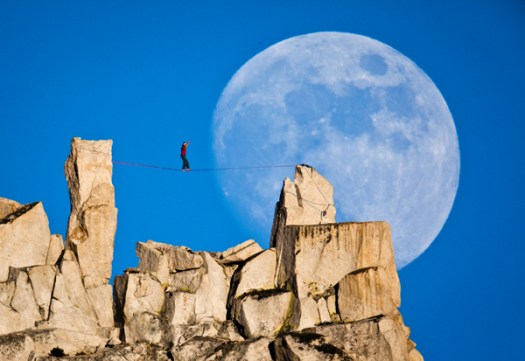
“I am completely confident with my ability to catch the line if I were to fall.
Highlining at Cathedral Peak, Yosemite, California
Photograph by Mikey Schaefer
This shot is just one spectacular scene from “The Man Who Can Fly,” an episode of Explorer airing Sunday, February 12, at 8 p.m. ET/PT on the National Geographic Channel. The show captures Potter’s quest for true human flight, with first feats in free soloing and wing suit flying in Yosemite, California, and British Columbia, Canada. …