Mary Jane Falls, Nevada … in winter

trip report by site editor Rick McCharles

April is a fantastic month for hiking out of Las Vegas.

desert near Las Vegas

It’s not too hot. Cactus flowers bloom.

cactus flowers

The closest hiking destination to Las Vegas is Red Rock. Millions visit each year.

The second closest major hiking area is much less well known, though it’s less than an hour’s drive from “the strip”.

I arrived April 15th in shorts and t-shirt at the Spring Mountains National Recreation Area and Mount Charleston Visitor Center, the woman there asked me: “Do you have snowshoes?”

Snowshoes?

Almost all of the 51mi of trails were “snowed in”. I needed to come back the end of May, or later, she told me.

Mount Charleston is totally different than Red Rock. Dense Bristlecone pine forests. It feels more like you’re in Colorado, than Nevada. There’s even a ski resort here!

Who knew?

I had been planning to start with the most popular trail, Mary Jane Falls.

Guidebook author and editor of Hiking Las Vegas, Branch Whitney says: “If you don’t enjoy this trail, forget hiking.”

Less than 3mi, return, be ready for a series of switchbacks. Your rewards is walking up to and behind a gorgeous waterfall. There’s a cave to explore, as well.

(A more challenging alternative is the boulder hopping scramble up to Big Falls from the same trailhead as Mary Jane.)

I took a look at the trailhead, just in case.

Mary Jane Falls hike, Las Vegas

How hard could it be?

I tramped up the packed snow. No problem … for a Canadian, like myself.

But on arrival at “the Falls” …

Mary Jane Falls hike, Las Vegas

No water. It was, of course, frozen up above.

Oh well, I’ve an excuse now to return in the Summer.

☺☺☺

Final recommendation …

Drive the scenic road Highways 95 to 158 to 156 back to 95. The prettiest I’ve done in Nevada. Even better, cycle down from the Ski Resort to 95.

Alaska-Yukon Expedition – Andrew Skurka

Andrew Skurka is the greatest hiker of all time. His 6,875-mile Great Western Loop was only one of many fantastic hiking accomplishments.

What could he do to top the Great Western Loop?

4,700 miles in 7 months via skis, foot, and a packraft

official Alaska-Yukon Expedition home page

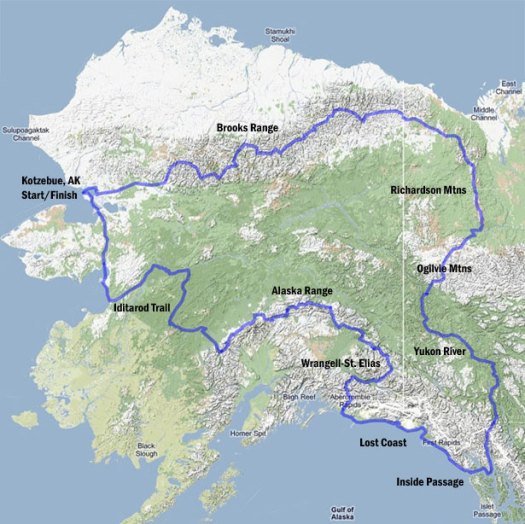
… On Saturday, March 13, a small plane will land early morning in Kotzebue, Alaska. Andy Skurka will get off the airplane, put on his headlamp in the pre-dawn darkness, pull on some clothes in the zero degree temperature, and start skiing. He would ski for 12 hours straight, and do at least that every day for the next month and a half. Then he’ll hike and packraft 16 hours every day for the next 5 months.

He’s circumnavigating the entire state, crossing the entire Alaska Range, Brooks Range, and parts of the Yukon. An estimated 4,720 miles, in hopefully 6 1/2 months. Almost all off-trail. Plenty of bears, brush, snow, raging rivers, glaciers (and mosquitos). …

read more from Buzz on the Adventure Running Blog)

Santa hikes the Grand Canyon

Hank Leukart calls his Without Baggage blog posts “Essays“.

Magazine quality writing. One of my favourite sites.

I’m one of those readers who believes Hank’s secret motto is, “Whoever dies on the craziest, most dangerous adventure, wins,”

This time Hank was frustrated he couldn’t get a permit to hike the Grand Canyon Rim-to-Rim.

Solution? Do it late December when no sane person would want a permit. Who cares that the North Rim is closed in winter.

Starting at the south rim Bright Angel Trailhead, Hank and his brother couldn’t find the biggest hole in the U.S.A. with both hands. They were lost immediately. Not an auspicious start.

And why not put a Santa Claus suit in with your lightweight winter camping gear?

Why not?

In the end, it turned out that the Santa suit was the best decision they made.

… Early the next morning, Brian puts on the Santa suit and goes to fill his Camelbak with water. A twenty-something-year-old woman interrupts him.

“Santa! Do you mind if I sit on your lap and get a picture?” she asks.

“Of course not,” my brother says. “It’s my job.”

Highly recommended.

part 1 – santa claus snowshoes the grand canyon, rim to rim to rim.

part 2 – hiking in santa claus’s bright celebrity spotlight.

part 3 – how i came to believe in santa claus.

… hardest single trekking day of their lives …

best hikes in Norway

Recommended by Aasmund Godal by email:

Jotunheimen and Rondane are considered the classics for Norwegians.

Jotunheimen

Jotunheimen (English: The Home of the Giants) is a mountainous area of roughly 3,500 km² in Southern Norway. Jotunheimen is a part of the long Scandinavian Mountains range. The 29 highest mountains in Norway are in Jotunheimen, including the very highest – Galdhøpiggen (2469 m). …

The Jotunheimen area contains the Jotunheimen National Park, ….

Jotunheimen is very popular among hikers and climbers, and the Norwegian Mountain Touring Association maintains a number mountain lodges in the area, as well as marked trails between the lodges and to some of the peaks. …

Hikers normally stay in cabins. Some of the popular trails out of Bessheim:

traildatabase.org - click for larger version

What about nearby Rondane?

Rondane National Park

… Rondane is a typical high mountain area, with large plateaus and a total of ten peaks above 2,000 m (6,560 ft). The highest point is Rondeslottet (“The Rondane Castle”) at an altitude of 2,178 m (7,146 ft). The lowest point is just below the tree line, which is approximately 1,000 to 1,100 m (about 3,300 to 3,600 ft) above sea level. The climate is mild but relatively arid.

Apart from the White Birch trees of the lower areas, the soil and rocks are covered by heather and lichen, since they lack nutrients. The largest mountains are almost entirely barren; above 1,500 m (5,000 ft) nothing but the hardiest lichens grow on the bare stones. …

It would be convenient to hike both these National Parks on one trip.

And there are more great adventures listed on our list of best hikes in Europe.

I almost bought a ticket to Norway last Summer. Next time I cross the Atlantic it will be for Iceland and Norway.

Aasmund recommends the Norwegian Trekking Association website as the best place to start research.

Everest trek – day 15

by site editor Rick McCharles

I awoke to this gorgeous view from Gokyo village 4790m (15,715ft).

The brown hill off to the right (in shadow) is Gokyo Ri (5360m). Famed for its view of four 8000m peaks, including Everest.

Here’s the world’s highest mountain from the top:

That’s not my photo. Actually I did not make the ascent because a guide had told me that the view en route to Renjo La, was identical. Renjo La would be the last alpine crossing on my Three Passes of Everest trek.

Instead I waited for the sun to come out while chatting with guests at Gokyo Resort.

The most interesting and entertaining was Doug Benn, Professor of Glaciology, teaching at University of St Andrews, UK and The University Centre in Svalbard, Norway.

This was Doug’s 6th trip to Gokyo. He and a number of researchers were taking measurements on the Ngozumpa Glacier, the largest in Nepal.

Diplomatically, Doug answered my questions about “Climate Change”. Al Gore is not measuring glacial retreat, Doug is.

Doug confirmed that all glaciers are retreating aside from 4 areas of the world. Climate is changing, as it has been changing since the beginning of the Earth. He wouldn’t speculate as to why. Or what could be done about it.

photo – Ngozumpa Glacier Project

Later I found Doug’s Ngozumpa Glacier Project page online:

… Glaciers in many parts of the Himalayas have undergone significant shrinkage in the last century in response to climatic warming, which in some areas is occurring faster than the global average. Some of this warming is part of a natural climatic cycle, although over the last 50 years or so probably about half of the warming is attributable to human sources (greenhouse gases) …

Doug’s research was to get hard data on what is happening. His goal was to help people and nations better prepare for that change. He said that in every climate shift some species in some regions are winners, some are losers.

I took a leisurely off-trail hike along the crumbling moraine ridge north towards Tibet. Up to Thonak Tscho 4870m.

This one way side trip is called The Sacred Lakes of Gokyo. Six lakes are sacred to both Hindus and Buddhists.

The next, Ngozumpa Tscho, was groaning and moaning like some distressed beast. Weird. I tried to capture the sound on video, but it didn’t work. It was the sound of ice freezing.

The highlight of the day wasn’t the lakes, but rather my old friend Cho Oyu, the friendliest 8000+m peak. I got as close as I could.

Eleven years ago we did the same thing, walking towards Cho Oyu from the Tibet side. The summit is on the border. For me it was déjà vu all over again.

Two hikers from the U.K. and I walked as far as possible up the glacier, hoping we might even reach Cho Oyu base camp. That turned out to be impossible. Late in the afternoon, the Brits departed with haste, trying to get back to Gokyo before dark.

I stayed to climb this boulder, the obvious viewpoint at the very end of the normal trail. This was as close as you can get to Tibet without descending down to the glacier.

I left a Summit Stone on top. The next hiker to scramble up would find it.

… All day I’d had a feeling I should end this adventure soon. This seemed a suitable finale.

It was night by the time I got back to Gokyo. But by now I was getting used to stumbling into my lodge in the dark.

see all photos from day 15

… on to day 16

days: 1|2|3|4|5|6|7|8|9|10|11|12-13|14|15|16|17| info page

Everest trek – day 14

Trip report by site editor Rick McCharles.

Over the Cho La 5420m (17,782ft)

There are no tea houses. No restaurants. The Cho La is seriously dangerous. Often a guide, ice axes and ropes are needed. Yaks can only rarely cross.

I may not have been looking better, but I was feeling better after headache and some diarrhea the day before. (All I could stomach was Pringles, the first time I’d ever bought them.)

Actually, I awoke with a very stiff neck, a condition (cause unknown) that lingered for 2wks!

Departing Dzonghla the mountains look impassible.

High, steep and intensely glaciated.

Here’s the crux. Crossing the Cho La Glacier.

I waltzed across like it was a sidewalk.

The astonishing weather had encouraged many guides to bring their groups to cross the Pass today. There must have been 50 people eating lunch at the Cho La.

vista from Cho La (5420m)

The descent is a crappy scree scramble.

Everyone but me stopped in the next village, Tagnag (Dragnag). A charming, clean and well-organized stop.

Having lost a day to illness, I thought I’d push on to Gokyo on the other side of the Ngozumpa Glacier.

… How far could it be?

The torturous and exhausting traverse seemed to take forever. Crossing glaciers is by far the most difficult and dangerous thing hikers do in this region.

It was well after dark when I finally rolled into famed Gokyo 4790m (15,715ft).

see all photos from day 14

… on to day 15

days: 1|2|3|4|5|6|7|8|9|10|11|12-13|14|15|16|17| info page

where to hike Summer 2010

Hmm. …

I’m leaning towards the U.S.A.

Possibilities:

→ Sierra High Route, California

→ Continental Divide Trail – Indian Peaks Wilderness to the South San Juan Wilderness, Colorado

→ Lake Tahoe Rim Trail, California

Wonderland Trail, Washington

Enchantment Traverse, Washington (friends loved this area, hiking it this past summer)

Chinese Wall, Montana

Maroon Bells Loop, Colorado

Comments?

The toughest option there is the High Route. Route finding. Off-trail. Scrambles. Snow. Bugs. And no protection from the sun.

I’d try to duplicate the trip undertaken by the world’s greatest hiker, Andrew Skurka.

Skurka-Sierra

his trip report – Sierra High Route — July 2008

… Leave a comment if you’ve an opinion on the best hike of these listed. Or any other in the continental USA.