Trip Report – Picos de Europa Circuit – by site editor Rick McCharles
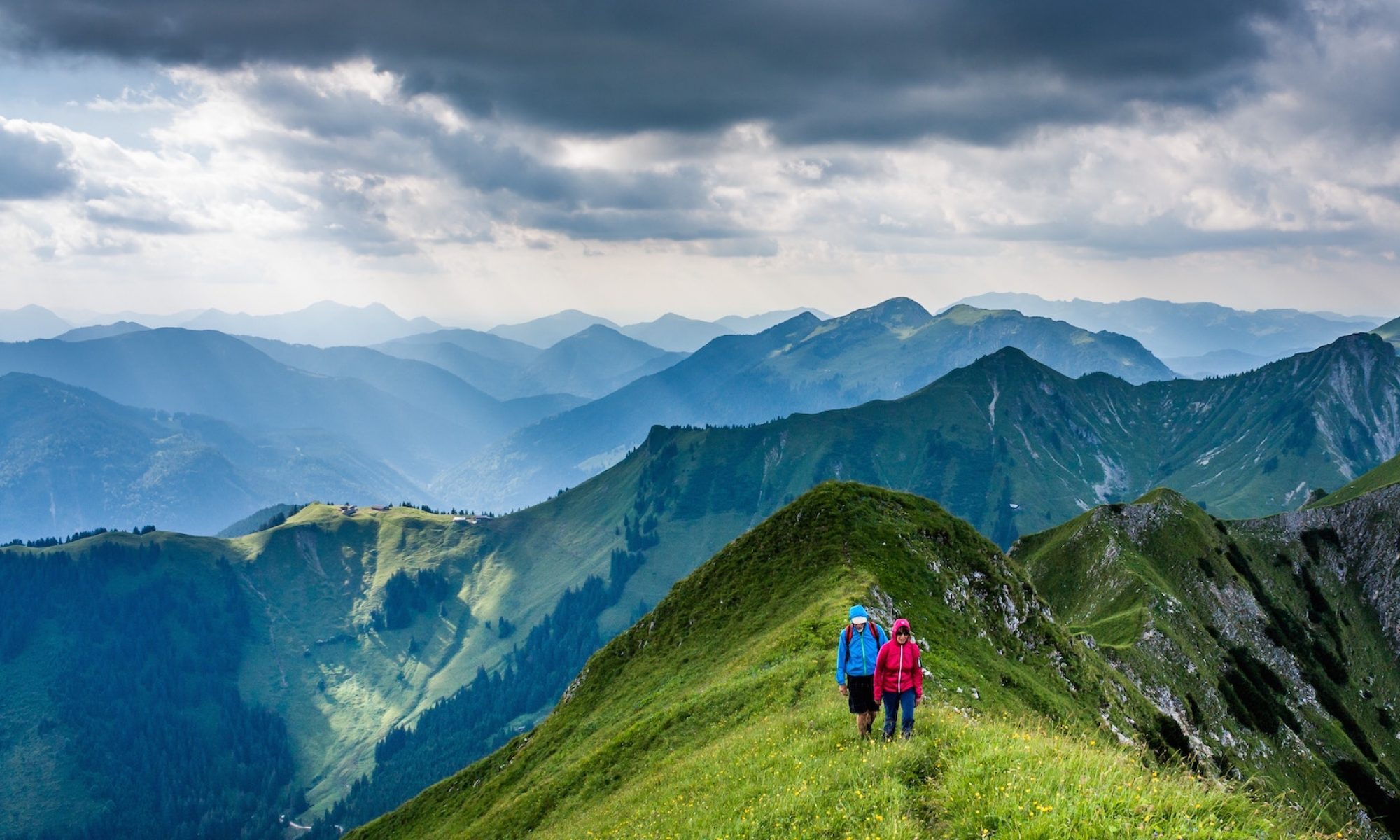
The morning dawned clear. Quickly I climbed up above the valley cloud.
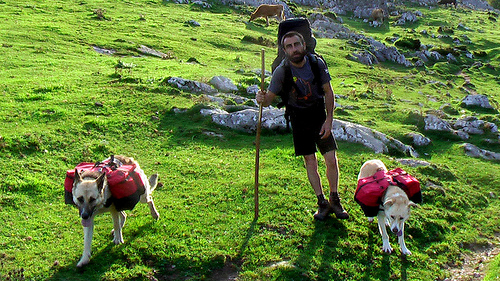
I met one of the alpine hut guards … with his free running dogs.
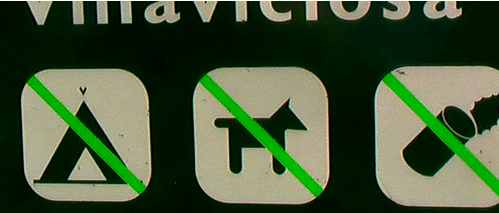
Here’s the large sign posted at his refugio, Marques de Villaviciosa:
National Park regulations are somewhat flexible in Spain. And they vary wildly from place to place.
The main “story” of this Circuit are the climbs into and out of the huge Canal de Trea, one of the most spectacular canyons in the world.
descending 1200m of this cliff
There are many slippery and unstable sections before you reach, with relief, the Garganta del Cares gorge at the bottom.
…A remarkable engineering feat, the 3m-wide path running the length of the gorge was gouged out of its sheer walls in 1946 …
This relatively flat day hike is the best and most popular in the Park.
click for larger view
I “cheated” and took the Bulnes Funicular (an underground train) part way up the other side of the gorge, avoiding 4.5km distance and about 400m ascending.
My goal for the next day came into view.
Naranjo de Bulnes (Picu Urriellu)
A long but fantastic hiking day in perfect weather.
Rob and Jude this week did Burstall to see the larch changing on a classic Canadian Rockies day hike. They biked in and out 3km each direction, saving that time for a nap in the sunshine at the Pass.
Elevation Gain: 451 m (1,480 ft).
Great views once on top, with lots of opportunities for further hiking or scrambling.
I would grade this trail as difficult only if Burstall Creek is high (eg. late afternoon, early summer). Otherwise it is a good trail of average to moderate difficulty.
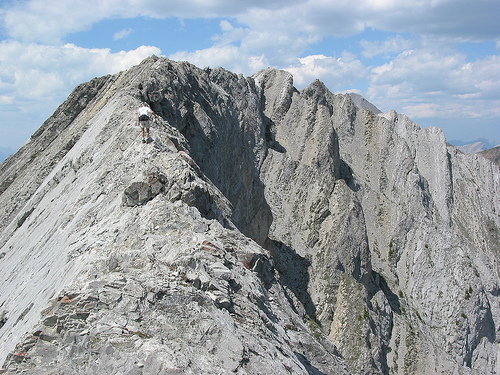
Get the guidebook. I did not have it with me, ending up taking the wrong ridge up. And the wrong ridge down. And missed a highlight, the “Hole in the Wall”.
Taking the wrong ridge is quite common:
… It is imperative that you are at the right spot, as I went up the wrong rib on this mountain years ago and was forced to redo this route in 2005 to complete it. There are several large ribs coming down from Mount Cory. You want the eastern most rib which is identified as light-colored shaley cliffs with a deep ravine to its right.
I was elated to get to the top after 4hrs. To celebrate, I rocked out to Coldplay for a half hour, enjoying the perfect weather close to 3000m. This is rare in the Canadian Rockies, any day of the year.
Chris Townsend in 1988 was the first to walk the continental divide of the Canadian Rockies, a 1600mi challenge. He declared the days from Assiniboine to Sunshine to Lake Ohara the finest section.
One of the best day hikes out of my home town, Calgary, is Banded Peak. But it’s a big day:
Something like 37 km return, a 1416m (4645ft) height gain.
Perhaps 27km on the bike and a 10km return hike/scree scramble to the 2,934m (9,626ft) summit.
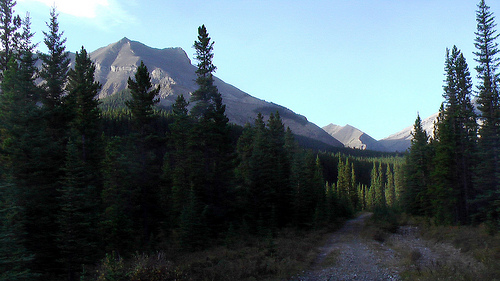
Banded Peak from near the trailhead
Here’s the final deceptively easy looking approach.
summit
Banded Peak, together with Mount Glasgow, Mount Cornwall, and Outlaw Peak, forms a small range which lies between the Little Elbow River to the north and the Elbow River to the south. …
It’s become a tradition with the families of some of my hiking buddies to take their sons on this adventure as something of a rite of passage to manhood.
On Sept. 19th, 2009 we took three 13-yr-olds. They had to get to the top … or die trying.
Rob Glaser, our leader, was far from certain that a group this big could finish. And finish in time before night fall.
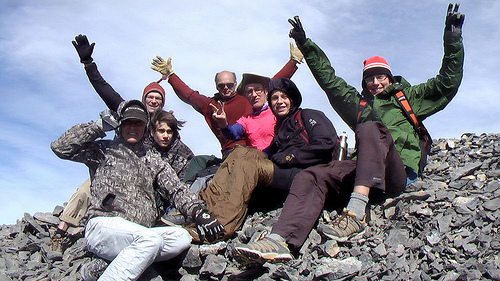
Here we are on the summit. Everyone made it. Somehow.
It was extremely windy on top. I’d estimate 80km/hr (50MPH).
Other than that, the weather was great for this time of the year. We were lucky.
Our best fun was some of the scree runs on descent.
Happily, we all made it back to the trailhead by 5:30PM.
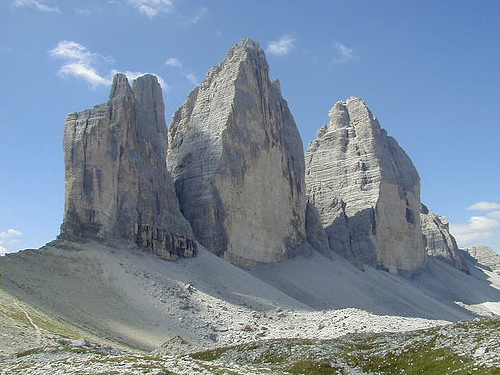
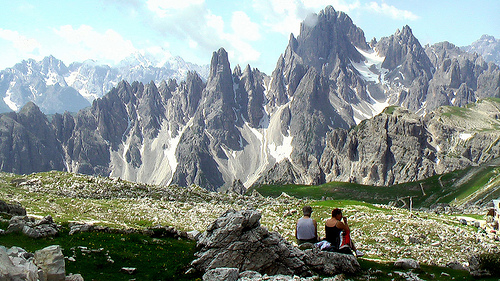
These are the famed and disclaimed 3 Peaks. The most photographed mountains in the Dolomites, I reckon.
… The Drei Zinnen (German for “Three Peaks”), also called the Tre Cime di Lavaredo (Italian), are three distinctive battlement-like peaks, in the Sexten Dolomites of northeastern Italy. They are probably one of the best-known mountain groups in the Alps. …
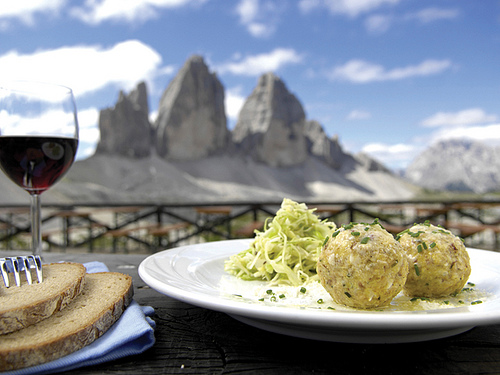
People come to the Locatelli Refuge (IT Rif. Locatelli) to enjoy a fine meal at high altititude.
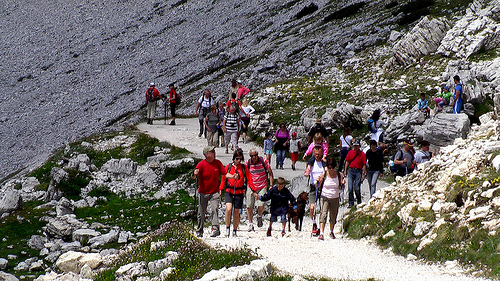
I’ve never seen so many hikers in one place at one time before, except on the Tongariro Crossing in New Zealand.
Why are they here?
It’s easy to take a bus right to 2300m (7545ft), the very base of the mountains.
But, for some reason, the crowds did not bother me. It was wonderful to see so many people exposed to hiking in such an easy and painless way.
If you hate crowds of enthralled visitors, go hike Alaska.
I adored everything about this hike.
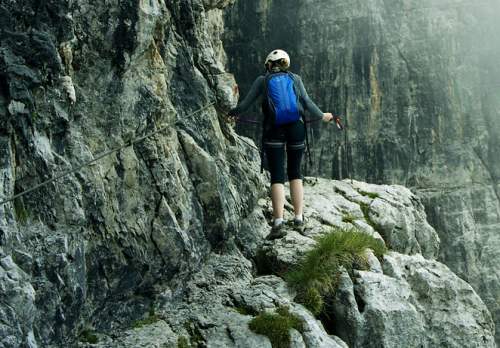
I loved the wild flowers. Alpine meadows. The WW 1 history. The tunnels. Especially the Via ferrata (Iron Way) side trips. I think I’ve found a new life passion.
Hiking in Italy is far easier than I expected.
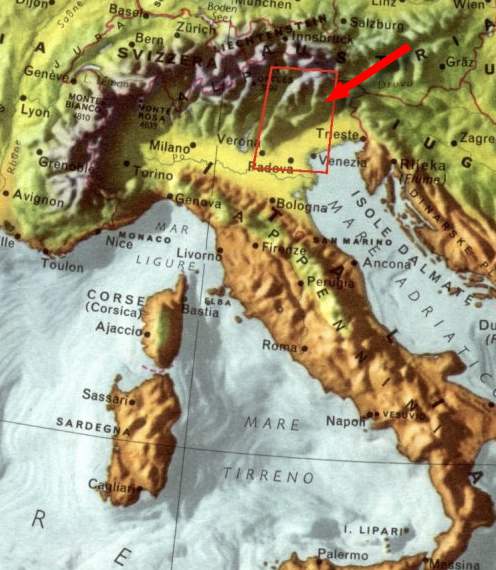
1) Travel to Cortina, Italy
2) Buy a bus ticket to TRAILHEAD at Rif. Auronzo
3) Wander where you like for as long as you like
4) Take a LOT of photos
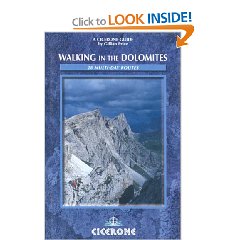
I used Walking in the Dolomites: 28 Multi-Day Routes by Gillian Price. This Cicerone title is the best available in English for this region. This area is covered by hikes 1,2 and 3. Buy your guidebooks in advance of travelling to Italy. English books are not widely available here as there are so many other titles in German and Italian.
No need to carry a hiking pack. There are great mountain huts every hour or two. Hosts will feed you and give you a bed for 40-50 Euro a day.
hiking in the clouds
I left a Summit Stone on behalf of artist DSD. Look for it in the cairn atop the carved stone steps starting the Via ferrata closest to Refugio Pian de Cengia. (That’s a FUN Via ferrata by the way. Exhilarating, but safe.)
If looking for more inspiration to plan a trip to Italy, see all 134 of my photos. (I went crazy with the camera.)
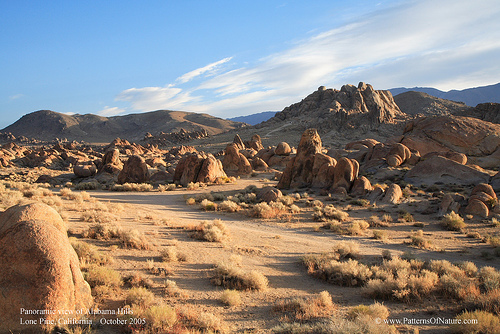
… The Alabama Hills are a popular location for television and movie productions (especially Westerns) set in an archetypical “rugged” environment. Since the early 1920s, 150 movies and about a dozen television shows have been filmed here … Gunga Din, Springfield Rifle, and How the West Was Won, as well as more recent productions such as Tremors and Joshua Tree…. In Gladiator, actor Russell Crowe rides a horse in front of the Alabamas, with Mount Whitney in the background, for a scene presumably set in Spain. Star Trek Generations was filmed here …. More recently, many parts of the film Ironman (film) were filmed here. …
I went to scramble the boulders at dusk. Gorgeous.
… There are two main types of rock exposed at Alabama Hills. One is an orange, drab weathered metamorphosed volcanic rock that is 150-200 million years old. The other type of rock exposed here is 90 million year old granite which weathers to potato-shaped large boulders, many of which stand on end due to spheroidal weathering acting on many nearly vertical joints in the rock. …
I was looking for a good first hike of the season. And a chance to test my full set of gear.
My original plan of scrambling Ha Ling, then wild camping, was abandoned after I heard about a better option from local hiker Kelly Mock.
In fact, I walked out Kelly’s front door directly to the trailhead and up the mountain to this gorgeous vista.
… Just above the treeline you’ll find a large helicopter landing pad, a steel ramp for paragliders, and the remains of a teahouse that was being constructed but is now abandoned. A gazebo just to the east of the teahouse sits on the edge of a large cliff. The views from here are spectacular. A number of hikers end their hike here as it’s already been a hard push to get this far, and the scree slope above can be daunting for non-scramblers. …
Actually, it’s an easy and popular hike straight up to the ill fated teahouse. Most do not go higher as it’s recommended you have mountaineering skills on the ridge.
That’s not far wrong. The slippery scree takes you up to a knife edge ridge with killer views into the Cougar Creek drainage. In summer it’s merely daunting.
Lady MacDonald is a terrific option for fit hikers. Each in your group can stop where they want. Most will relax at the teahouse or the gazebo until the adventurous return from the ridge.
This is a good hike with dogs. Don’t let them chase after the resident mountain sheep.
The The Mozmonkey Blog is planning for summer 2009, as well:
… Typically the climb and decent will take two days, although, some people do it in one.
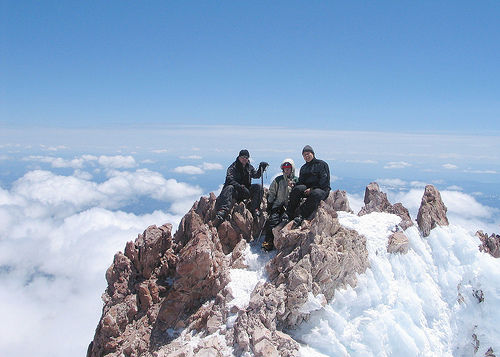
Day 1 starts with a 4 – 6 hour hike from the parking lot up to Helen Lake (which is really just a glacier) where you setup base camp. The rest of the day is spent admiring the view, making food (yay, dehydrated meals!) and preparing your day pack for the next morning.
The summit ascent begins somewhere between 12 AM – 3 AM the next morning. You’ll want to start super early while the snow is still firm and solid and get to red banks before the sun starts making it soft and slushy.
When you reach the summit stop to enjoy the view, regain your energy and prepare for the best part of the journey — glissading down the mountain! This literally means you will sit on your butt in the groove created by the people before you and slide down the entire mountain; stopping briefly at base camp to collect the rest of your gear. Not to worry, you will have an ice axe with you as a safety device that will help you regulate your speed down the mountain.
So that’s it, 2 days to get to the top and and 3 – 4 hours down. …










 1) Travel to Cortina, Italy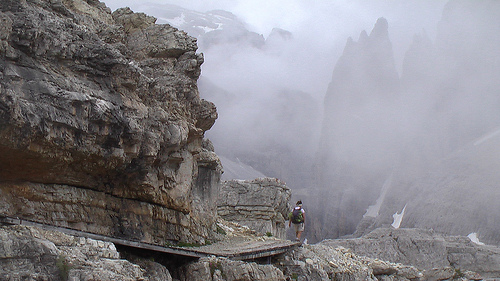





 besthike.com