my gear 2007 – besthike editor

Rick McCharles

After being drenched several days in series on the John Muir Trail by the remnants of Hurricane Dean, I finally got a chance to dry out my gear in the hot morning sun.

It gave me a chance to take photos of my current gear set. This is about as light as I have ever hiked on a multi-day trip. I used everything I carried on big trips in the Yukon and the JMT.

Sleeping system: MSR Hubba tent, down sleeping bag, silk sleeping bag liner, 3/4 length therm-a-rest, dry bag stuff sack “pillow”, headlamp.
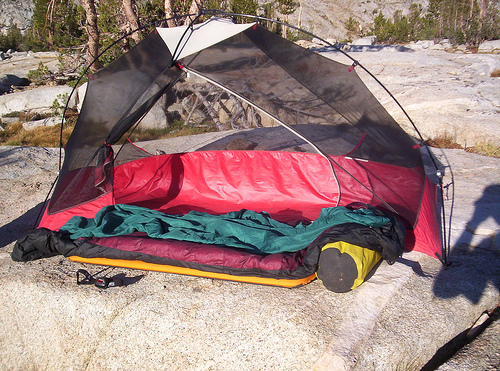
sleeping-system

Tent and sleeping bag are stored in a kayak dry bag with purge valve. (Heavy, but worth it, I think.)
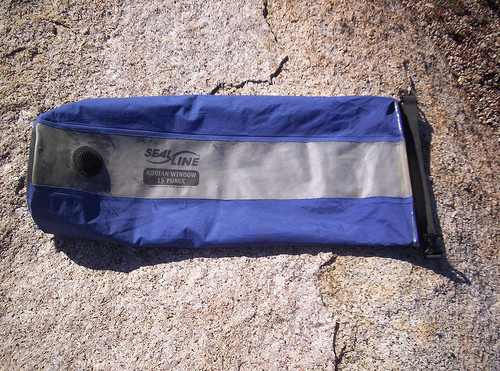
kayak-bag

kayak-bag.jpg

Outdoor clothes: unlined nylon pants, wicking t-shirt, ultra lightweight wind jacket, Gortex jacket, long brim baseball cap.
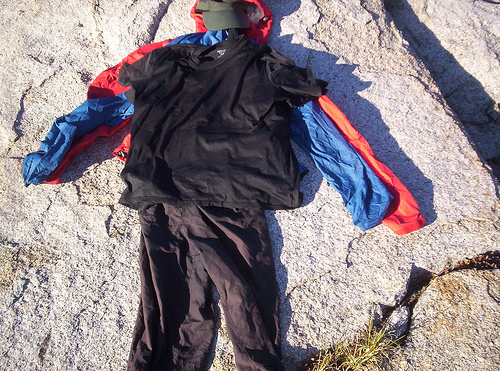
outdoor-clothes

Tent and camp clothes: fleece pants, shirt and “touque” (hat), down vest, tent socks.
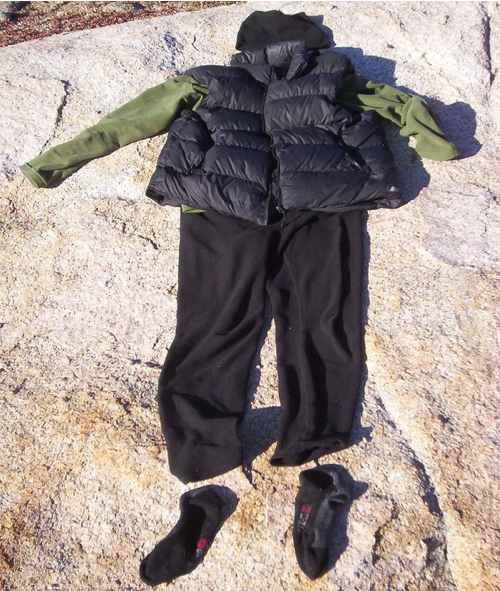
indoor-clothes

Shoes and socks. I, as usual, took only 1 pair of shoes and 1 pair of outdoor socks. Ultimately this turned out to be a mistake. Due to the unusual, unexpected amount of rain I eventually got blisters. (Very rare for me.)
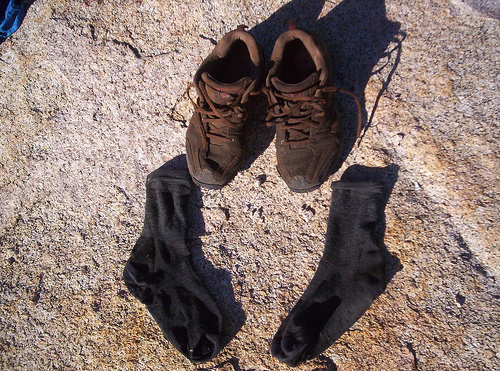
shoes

Hydration: Nalgene water bottle, extra soft drink water bottle, MSR water filter. (I would use chemicals next time.)
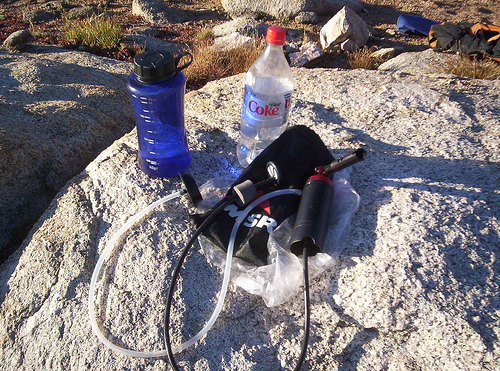
hydration

Food: Large bear vault, spoon, JetBoil stove, extra fuel canister. (Started with 7 days grub.)
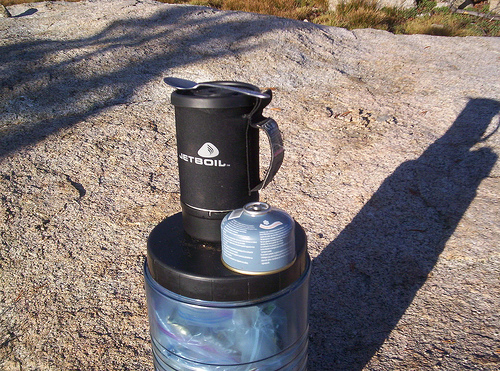
bearvault

Navigation / Entertainment: Topo maps, hiking guidebook, novel, iPod Nano (books on MP3), All-in-one Map Tool. I know, this is VERY HEAVY and could be reduced.
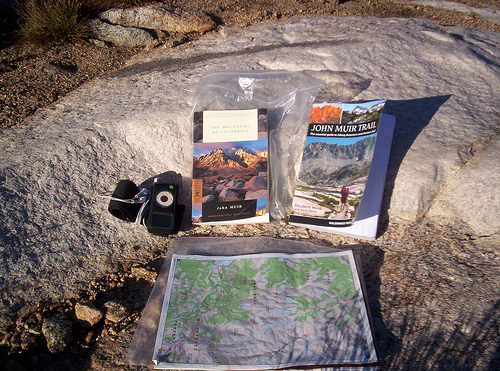
books-ipod

Defecation: Toilet paper, lighter, disinfectant gel, Camp Suds, paper soap.
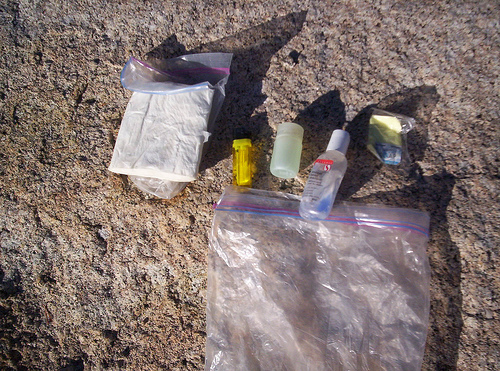
defecation

Personal items in hip pack: Cash, Swiss Army Knife, sun screen, note pad, pen, Tylenol, mini-toothpaste, mini-toothbrush, mobile phone, etc. Camera and extra batteries.
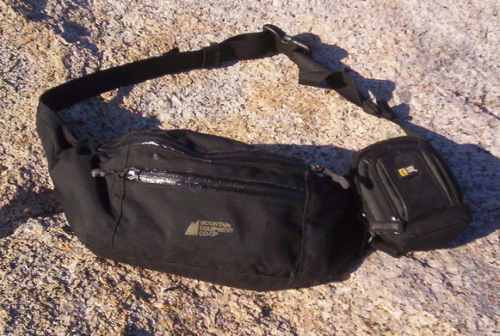
fanny-pack

Finally, and importantly, bandanas and a Buff. Multi-purpose.
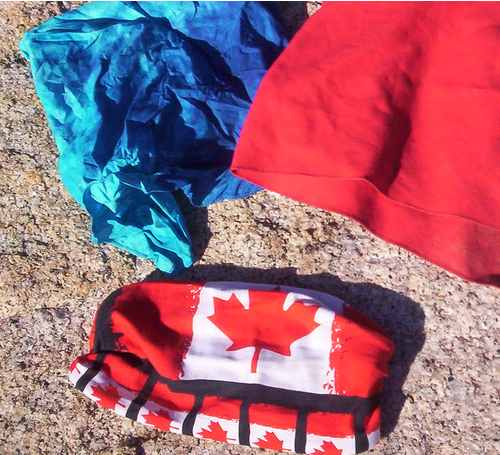
bandanas

Everything fits into my lightweight Virga backpack by Granite Gear.
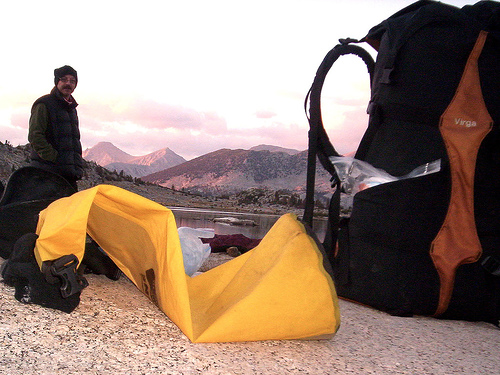
Virga

I will make very few changes for my next long hike. This works for me.

virga.jpg

Compare this with Caroline’s gear list for the PCT: As The Crow Flies blog.
bag your poop on Mt. Whitney, California

UPDATE: Steve Sergeant posted a terrific Wildebeat audiocast on this last year – The Poop on Mount Whitney

Pack out what you pack in.

This is the age-old outdoor rule. And here, taking this decree to the extreme, is a good friend of mine who recently climbed Mt. Whitney in California.

I’ll let you guess what he’s packing out.

photo-8-30-07.jpg

Photo of the Day (9/13/07) – Gadling

I hiked Whitney in 2006. Some of the pit toilets were still in place, though they stunk to high Heaven.

In 2007 you must bag it.

Pack-out kits are available at the InterAgency Visitors Center in Lone Pine, and at Crabtree Ranger Station. They are also available at many stores that sell hiking, backpacking and climbing equipment. You should also bring toilet paper and hand sanitizer. A kit will serve a person for 2 to 3 days.

Each kit contains two plastic bags for securely “double-bagging” your waste. The large inner bag contains a powder that absorbs liquids and turns into an odor-fighting gel. The outer zip-closure bag seals everything up for transport.

How to Use Pack-Out Kits

1. Find a secluded location.
2. Spread the large inner bag on the ground. Don’t spill the powder!
3. Crouch over the bag and relieve yourself. Dispose of toilet paper in the bag.
4. Tie a loose knot in the bag, and then seal it inside the zip-close outer bag.

Inyo National Forest

It’s no big deal. These pack-out kits work quite well.

Organize to hike Mt. Whitney, highest peak in the continental USA.

Mt Kenya – hike the OTHER Kilimanjaro

The Adventure Junkie of The Adventure Blog keeps close tabs on what’s happening in Africa (and the rest of the world).

His recent post Adventure On Mount Kenya caught my eye. It links to Matthew Power’s project to re-enact the Mt Kenya climb of British prisoners of war in 1943. (That “escape” was documented in the classic No Picnic on Mount Kenya: A Daring Escape, A Perilous Climb by Felice Benuzzi).

This got me thinking …

I’m interested in how to trek Mount Kenya independently. Or with a minimum of local support.

Of the eight standard walking routes, Naro Moru sounds appealing. It’s possible to ascend in only 3 days (unless the altitude gets you) and has bunkhouses at each camp so a tent is not required.

Africa’s “other Kilimanjaro,” 17,058-foot (5,199-meter) Mount Kenya, boasts all the virtues of its slightly loftier cousin—glaciers, surreal landscapes, and cloud-carpeted vistas—but with about half the hikers. Plus, it sits at the heart of the Kenyan Highlands, a patchwork of jungle and savanna where visitors can mingle with local tribes and track Africa’s Big Five on their own two feet.

Climbing:

While scaling the twin peaks of Batian and Nelion requires technical mountaineering skills and equipment, Point Lenana (16,354 feet or 4,985 meters), Mount Kenya’s third highest summit, can be reached with no specialized skills. The most popular trek is the 23-mile (37-kilometer) Naro Moru Route, which begins above Mount Kenya National Park headquarters. Plan to spend at least five days on the mountain. Porters are not required but are customary; they can be hired through Mount Kenya Guides & Porters ($10 a day; 011 254 062 62015).

Adventure Guide: Mount Kenya – National Geographic Adventure Magazine

Mt Kenya lies 150km (95mi) NE of Nairobi.

descent.jpg

Bernd Reinkemeier posted a trip report and photos of his 3-day ascent on the Naro Moru route.

Mountain Club of Kenya – Hiking & Trekking

problems hiking the John Muir Trail, California

The JMT is our #2 hike in the World, about 220mi of trail without crossing a road.

I’ve been section hiking it over the past 3yrs. This summer I thought I’d try to knock off about 110 miles.

I brashly announced I’d hike 20mi / day from Bishop Pass to Tuolumne in 6 or 7 days.

1356633232_33f6e81d1e.jpg

It was not to be.

My first mistake was underestimating the difficulty of the required elevation loss and gain. This thing is a roller coaster!

jmt.gif
larger map – PCT.org

I started from South Lake near Bishop after hearing great things about Bishop Pass and Dusy Basin. Both are gorgeous!

1356651710_5ae9e004be.jpg

My favourite section of many favourite sections was Evolution Basin.

1355803357_8e5da75eec.jpg
vista from John Muir Pass to Evolution Basin

But the BIG story of my hike was Hurricane Dean. More exactly, the remnant circulation of Dean which brought serious thunder storms to California and Nevada.

1355811941_c21a14e5c5.jpg
threatening skies

One day I was pinned down in my tent losing 5hrs of daylight. Here’s the hail outside my tent.

hail.jpg

Another morning I awoke early to a cloudy day. A storm climbed up from the valley to pound me. (I hid in low brush to avoid death by lightning.)

storm-morning.jpg

When the storm finally cleared, I had been walking for days in wet socks and shoes. My feet, for the first time in many years, were blistered.

I love the JMT — but had to exit over 30mi earlier than planned, limping out at Red’s Meadow Resort.

1355853995_ba761d9388.jpg

My only complaint with the John Muir Trail is that it’s a horse track.

1355796841_0a55ef4d03.jpg
hiking pack animals

Historically it was pioneered for animals. The trail drops down to valley and water on regular intervals. Animals need grazing. I don’t.

I’d much rather stay HIGH on — for example — the Sierra High Route. This is a mostly off-trail adventure running in parallel with the JMT which tries not to drop down into the valleys.

Check out all my photos from the JMT on flickr.

If you might want to hike it yourself, check our JMT besthike information page.

Nepalese Government In Turmoil

BAD NEWS

the Maoist faction has withdrawn from the provisional government in Nepal

Last year, the Maoist Rebels gave up their 10 year struggle, which was at times bloody, in order to take part in the process of forming a new government. They were one of eight factions that were trying to create a new system that moved away from the monarchy that has long been a part of Nepal’s history. Apparently, the discussions broke down when the Maoists accused King Gyanendra of attempting to influence and sabotage the elections, scheduled for November, in his favor. …

With the Fall climbing season upon us, any unrest now could be disastrous. In years past, trekkers and climbers were often beset by the rebels in remote areas and shook down for cash. With the signing of the peace accords last Fall, it looked like Nepal was finally going to have stability, allowing for safe travel once more. It also meant a likely end to the general strikes that plagued the country each year as the tourists and climbers arrived. Thankfully, most of the climbers have already left Kathmandu and are either on their respective mountains or at least en route.

Details – The Adventure Blog: Nepalese Government In Turmoil!

lightning – serious backcountry hazard

A 21-year-old man John Cowan Jr. died when lightning struck near his tent in Colorado, the electric current traveling through the ground killing him.

Cowan had taken shelter in a tent with three others who suffered only minor injuries.

John Cowan Jr. and his three companions were hiking a trail near St. Peter’s Dome along Old Stage Road, about five miles west of the Broadmoor Hotel in Colorado Springs. They had hiked to a lookout point which provides a panoramic view of the Front Range.

Vail Daily

Lightning is one of the greatest dangers in the wild. I was well aware of the risk when caught in a number of extreme lightning storms in the Sierra Nevada mountains this summer.

Early one morning on the John Muir Trail a menacing cloud climbed up the valley and enveloped me.

storm-morning.jpg

The storm began quickly. At one point the time between lightning flash and thunder clap was one second. Very conscious of the metal in my tent, I hid in the rain in low brush watching to see if it would be hit.

tent_lightning.gif

Overall, in the U.S. there are between 50 and 300 deaths per year from lightning strikes. …

Lightning bolts can strike up to 10 kilometers in front or behind a thunderstorm cell. This explains the classic “bolt from the blue” — which is a real entity.

Since thunder travels at the speed of sound and the lightning flash travels at the speed of light, you can estimate how far the strike was from you with some simple math. Divide the time in seconds between the flash and the sound of a thunder clap by five and you get approximately the number of miles from you to the strike. Five seconds from strike to sound, and there was 1 mile from you to the lightning bolt.

So, how does one avoid being a victim of lightning? Here are some tips:

• Do not be the tallest object in the area when there are storms around.

• Don’t be next to the tallest object in the area when there are storms around. Move to lower terrain and protection.

• Stay off ridge tops and mountaintops if there are storms around.

• Remember a storm up to 10 miles away can reach out and touch you.

• If you are caught in the mountains, stay low, even in a grove of trees if you have to.

• If you are in a group in a storm, spread out so that one strike will not injure several people at once.

Dr. Collins: Lightning can be a backcountry hazard | Idaho Statesman

I did not see any lighting strike during several storms this summer. But it was hairy.

Be careful out there.

Rick the nude hiker

Not me.

That would be Rick of the Nudehiker blog.

I once on this site — like many others — made light of the sport of hiking sans clothing. Rick challenged me to try it first before mocking others who enjoy walking in the buff.

Well, Rick …

rick-nude-hiker.jpg

That’s me. I walked away from my tent one morning in the Sierra Nevada mountains feeling very … breezy.

Though there was almost zero chance of encountering (offending) others I still felt somewhat nervous and did not get comfortable at any time over the (admittedly brief) venture.

Seems to me that most aboriginal cultures cover their genitals, if only for safety.

But I do promise to try it again, Rick, in future. Perhaps, with time, I can get to relax and then enjoy the sensation.

Torngat Mountains National Park, Labrador, Canada

One of the classiest and best travel photo sites is BluePeak edited by Rogier Gruys.

He is one of the few who have travelled to remote Torngat.

Even better, Rogier created a superb landing page for the Park where the rest of us now have a chance to see that weird, fantastical landscape.

… The Inuit refer to the far northern tip of Labrador as Torngait, the place of the spirits. It is thought that it is the home of Torngarsuak, the Inuit Great Spirit. To outsiders it is known for its deep fiords, the highest mountains east of the rockies, some of the world’s oldest rocks, the only tundra-dwelling population of black bears, and polar bears. Lots of polar bears. …

Access

The park, 9,700 sq.km, is probably one of the most difficult parks in Canada to reach. Even the parks in Nunavut are easier to get to. It’s not only the remoteness, but especially the weather and fericious winds that make getting here an adventure in itself.

If the weather is good, then the park is about 1 hours’ flying or up to two days by fishing boat north of Nain, Labrador’s northernmost community. There are no scheduled flights or boats to the park, and once you arrive, there are no facilities.

Safety is a real concern, as polar bears roam throughout the park. Since only Inuit are allowed to carry arms, visitors should always be accompanied by an Inuit guide. A good idea in any case, as the area is also infamous for its quickly changing weather and strong “ghost” winds that can appear out of nowhere.

Visiting the park

Due to the difficult logistics and its reputation for bad weather, there are currently very few if any organized treks into the park. Nature Trek has led expeditions into the park, but in the future they may only plan occasional treks, due to the extreme logistical challenges involved with organizing them. …

saglek-cliffs.jpg

north-arm.jpg

more photos – Torngat Mountains National Park – Rogier Gruys

climbing White Mountain with 4WheelBob

Rick McCharles, besthike editor

Tomorrow morning Tom Mangan and I head out to rendezvous with wheelchair hiker 4WheelBob

Read the details on Tom’s Two-Heel Drive blog (which is far better written than this one).

4WheelBob thinks he can wheel himself to the summit of White Mountain in the Eastern Sierra near Big Pine, CA. I’m going to tag along and document the experience here when we get back.

… We’ll be car camping at the Grandview Campground near the Ancient Bristlecone Pine forest till Wednesday morning, when we head up to the approach to White Mountain. Bob has a pass to park at the Barcroft Lab, six miles — and about 1,800 feet of climb — from the summit. He’s planning on camping on the mountain, summiting and returning on Thursday (he can go much much faster downhill). …

Two-Heel Drive: Where I’m going next week

Tom and I are the safety support team. Though this is the easiest high mountain climb in the USA, it’s not easy. The odds are against us.

white.jpg

White Mountain – Wikipedia