are running shoes ruining your feet?

UPDATE: Tony Rix recommends Vibram’s latest model, the KSO Trek. (see the comments)

That’s one of the themes of a fantastic book I’ve just finished:

Born to Run: A Hidden Tribe, Superathletes, and the Greatest Race the World Has Never Seen

I’m convinced that author Christopher McDougall is on to something.

For specifics, check this article: The painful truth about trainers: Are running shoes a waste of money?

His theory is that we evolved running barefoot. And became the dominant species on the planet because of that advantage.

Running barefoot … an advantage?

It seems counter intuitive. Yet the case laid out in his book seems irrefutable.

Shoe companies, especially Nike, seeking mad profits, have convinced us to buy technology that changes our natural technique.

In recent years I’ve been hiking and trail running in one of the cheapest pairs of shoes made by New Balance. I bought them because of bunions. Perhaps, by luck, this soft, flat-soled shoe is what I need.

I’m tempted to try hiking in Vibram Fivefingers. That’s what the author is using now for distance running.
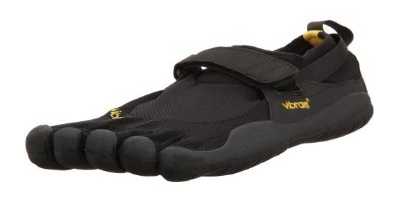
… That might be going too far.

Instead, I’ll pull out my old sandals. I’ve hiked in those before, very comfortably. Those feel like “bare feet”, but keep the pebbles and grit out.

Leave a comment if you’ve experimented with tossing your hiking boots in the closet. And getting back to something more natural.
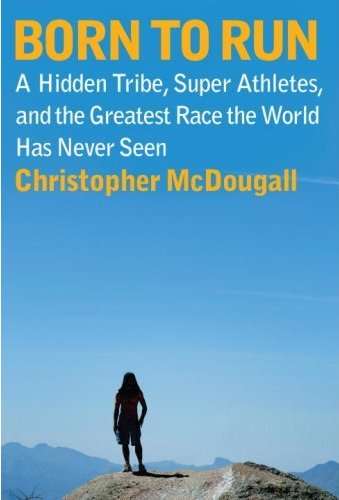

book review – Born to Run

On the insistence of my Adventure Racing buddy, Dave Adlard, I bought a book.

Born to Run: A Hidden Tribe, Superathletes, and the Greatest Race the World Has Never Seen

A fantastic read, even for non-runners. The author, Christopher McDougall, (video) is a master story teller. I was gripped by this true life story.

Full of incredible characters, amazing athletic achievements, cutting-edge science, and, most of all, pure inspiration, Born to Run is an epic adventure that began with one simple question: Why does my foot hurt? In search of an answer, Christopher McDougall sets off to find a tribe of the world’s greatest distance runners and learn their secrets, and in the process shows us that everything we thought we knew about running is wrong. …

It’s available on Audible.com, as well as in a Kindle edition.

Get it!

Christopher Mcdougall reminds me of Jon Krakauer, another magazine scribe turned author.

Born to Run is as engaging as anything by Krakauer.

The culminating Greatest Race the World Has Never Seen is set in Mexico’s Copper Canyon. I visited as a tourist in 1999. Fantastic.

I’ve long planned to return for some serious hiking there. Unfortunately, as the book describes vividly, it’s very dangerous today as the Canyons are home to big marijuana plantations. You might get shot.

tweet, facebook from anywhere on Earth

Here’s a system I would use. Posting my geolocation along with text trip report updates.

Details on Gadling:

… allow adventurers to more effectively communicate from locations that are not covered by cell service.

The new device pairs one of DeLorme’s GPS units with SPOT’s next generation Satellite Communicator, to send custom message from the backcountry. The Earthmate wil have all the regular features you’d expect from a GPS, including base maps, in this case covering the entire world, navigation, electronic compass, and so on. But it will also wirelessly pair with the Communicator, allowing the user to type text messages and send them to friends and family back home via satellite. …

It’s designed so you can call for help from anywhere, should an emergency develop.

… it also lets the user to share tracking information and custom messages that can easily be interfaced with Twitter, Facebook, Geocaching.com, and SPOT’s own SPOTadventures.com. …

Pricing not available until the Earthmate PN-60w is made available later this Spring.

If you are interested, click through to the article – New device will let you text, twitter from remote places

Indian Himalaya – new trekking routes

High on my list of future hiking destinations is the Indian Himalaya.

Good news on Gadling:

Adventure travelers were given even more incentive to travel to India recently when it was announced that the government would begin allowing access to previously restricted areas in the remote Jammu and Kashmir provinces. …

Backpackers will find plenty to love in this remote and stunningly beautiful region as well. High altitude passes and trails that have previously been off limits are now open to foreign travelers, including a route that leads to the village of Turtuk in the Nubra Valley. …

Kraig Becker – India opens remote trekking and mountaineering routes

I’ll get a copy of Trekking in the Indian Himalaya (2009) and start planning.

The author’s favourite trek is Markha Valley in Ladakh. I’d like to do some of the recently opened region on the same trip.

If interested, be sure you get the most recent edition. It’s great to see Lonely Planet updating their excellent trekking guidebooks.

I may even buy, for the first time, the PDF version. You can “Pick & Mix“, buying only the chapters you need. I’d put those on my iTouch for the trek rather than carrying paper.

The PDF version has free samples including the Table of Treks (PDF).

Now … when will independent hiking be allowed in Bhutan?

AMERICA’S 10 MOST DANGEROUS HIKES

You can tell we are SERIOUS from the all caps typeface.

Kelly Bastone in Backpacker posted this list in 2008:

From a slippery Sierra catwalk to a treacherous Hawaiian paradise, we name the country’s 10 most hazardous hikes. Then we break down the dangers and provide local beta for conquering each route.

The Maze, UT

Bright Angel Trail, Grand Canyon, AZ

Barr Trail, Pikes Peak, CO

Mt. Washington, NH

Muir Snowfield, Mt. Rainier, WA

Huckleberry Mtn., Apgar Range, MT

Kalalau Trail, Kauai, HI

Buckskin Gulch, UT

Abrams Falls, Great Smoky Mtns., TN

Mist Trail, Half Dome, CA

click through for details on each – Backpacker

Buckskin Gulch

Flash flood is a greater worry to me than getting lost or being avalanched. Recall April 2008 when 7 of 12 “canyoneers”, most students, were killed in a flash flood in New Zealand.

Kolby Kirk – 100 hikes

He did it. Kolby Kirk vowed May 4th, 2009 that he would do 100 serious hikes by Jan. 1st.

And he made it.

Congratulations.

Number of miles hiked: 417.4 miles
Longest hike: 15.9 miles (Hike #48 – San Gorgonio Mountain)
Hardest hike: Hike #21 (Telescope Peak, Death Valley)
Furthest hike from home: Hike #86 (Villarrica, Chile – 5,864 miles from Arcadia, CA)

click through for details – 100hikes.com

dangers of the Lost City trek, Colombia

Ciudad Perdida (Lost City) in Colombia is one of our best hikes in South America.

It’s fantastic. But safety concerns have stopped many over the years from traveling to Colombia. And stopped others from doing the trek.

Bt82 joined a group of 11 hikers to do it in the Fall of 2009. No problema. Everything went great.

… Everything went great until the post-hike celebration. That evening was a disaster.

Tricked into a meal at an expensive restaurant. Porn movies and strippers at the bar. Prostitutes. One hiker caught with Marijuana. Police demanding a $1000 bribe.

Yeesh.

Click through to TravelPod to read the sorry details – Ciudad Perdida

Or our besthike Lost City trek information page.

Everest trek – day 14

Trip report by site editor Rick McCharles.

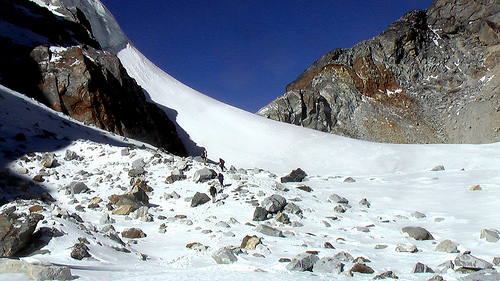
Over the Cho La 5420m (17,782ft)

There are no tea houses. No restaurants. The Cho La is seriously dangerous. Often a guide, ice axes and ropes are needed. Yaks can only rarely cross.

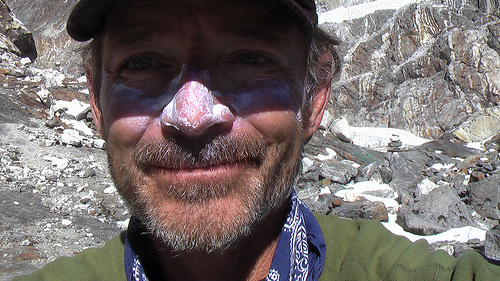
I may not have been looking better, but I was feeling better after headache and some diarrhea the day before. (All I could stomach was Pringles, the first time I’d ever bought them.)

Actually, I awoke with a very stiff neck, a condition (cause unknown) that lingered for 2wks!

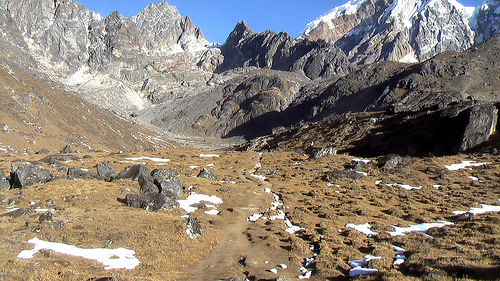
Departing Dzonghla the mountains look impassible.

High, steep and intensely glaciated.

Here’s the crux. Crossing the Cho La Glacier.

I waltzed across like it was a sidewalk.

The astonishing weather had encouraged many guides to bring their groups to cross the Pass today. There must have been 50 people eating lunch at the Cho La.

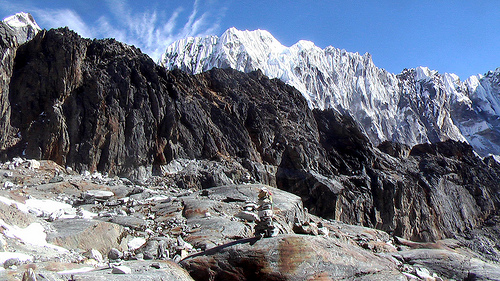
vista from Cho La (5420m)

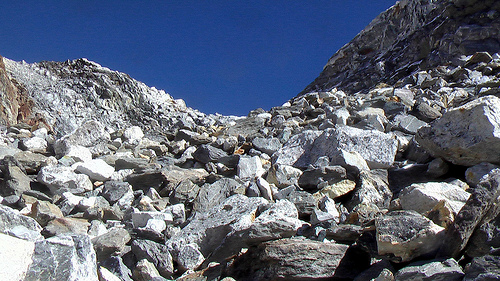
The descent is a crappy scree scramble.

Everyone but me stopped in the next village, Tagnag (Dragnag). A charming, clean and well-organized stop.

Having lost a day to illness, I thought I’d push on to Gokyo on the other side of the Ngozumpa Glacier.

… How far could it be?

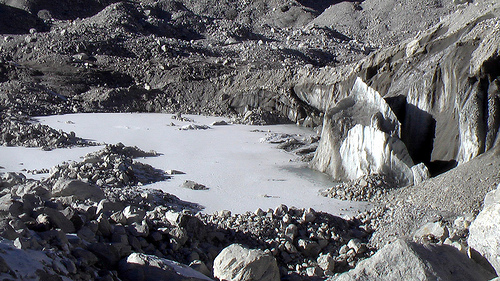
The torturous and exhausting traverse seemed to take forever. Crossing glaciers is by far the most difficult and dangerous thing hikers do in this region.

It was well after dark when I finally rolled into famed Gokyo 4790m (15,715ft).

see all photos from day 14

… on to day 15

days: 1|2|3|4|5|6|7|8|9|10|11|12-13|14|15|16|17| info page

Everest trek – day 12-13

Trip report by site editor Rick McCharles.

After a long, cold night in the tent, I awoke with “mountaineer’s lassitude“:

… reluctance to put one foot in front of the other …

I’d first read of the condition in the mountaineering parody, The Ascent of Rum Doodle (1956), one of my favourite books.

I was sick again. The same stomach ailment I had on the first 2 days of the trek.

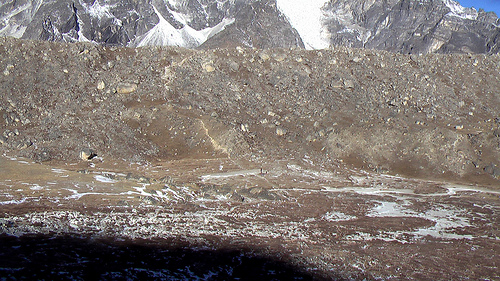
That’s the lateral moraine of the Khumbu Glacier. I first needed to trudge down. Then find a safe way across. Others had advised that it was no problem this season, … if the weather is good.

Fortunately, the weather remained perfect. There was not even snow blowing off the highest peaks!

It seemed to take a long time to reach Lobuche.

I stopped for lunch and to recharge my batteries at a restaurant. Then psyched up for the relatively short and easy walk to Dzonghla (Dzongla).

it was a pity I felt rotten. The weather was stupendous. And the scenery even better.

looking back to Ama Dablum

Late afternoon I finally reached the remote village. But I spent less time in the guesthouse restaurant than in here …

I crashed that evening without eating. And did not get up until Noon the next day.

Mid-day there was only myself and the Nepali National bird, the Himalayan Monal, wandering about the courtyard.

Everyone else had departed at first light over the Cho La, the most difficult of the Three Passes route.

I had a forced rest day. Standing around like this guy.

Disappointing.

see all photos from day 12-13

… on to day 14

days: 1|2|3|4|5|6|7|8|9|10|11|12-13|14|15|16|17| info page