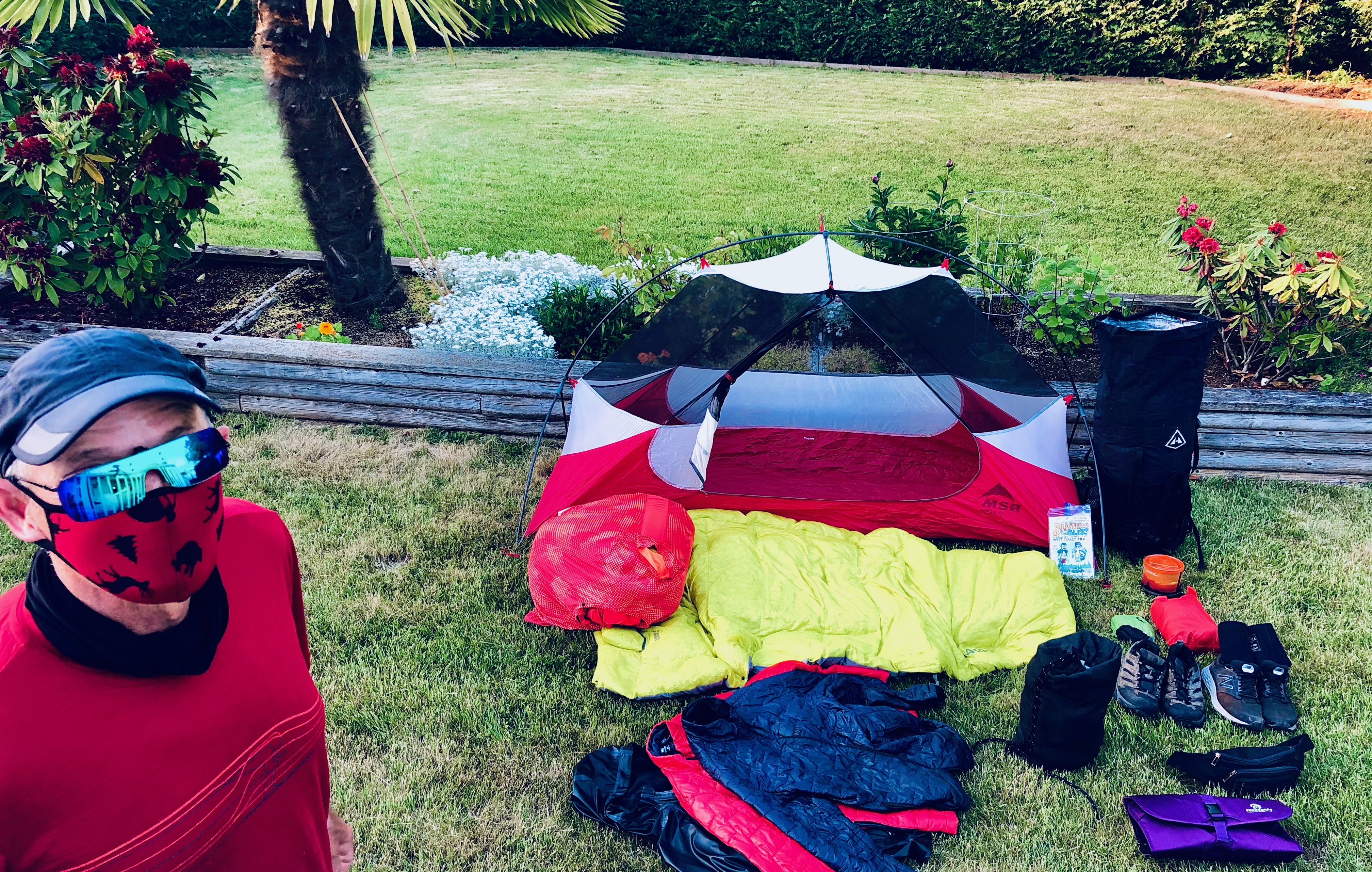
HIKING CLOTHES Soffe Running shorts #2 (as underwear) Running Room 7″ perforated run shorts red Nike quick dry t-shirt waterproof stuff sack Buff #2 long brim ball cap fingerless gloves
OUTER LAYERS Columbia OutDry rain jacket Helly Hansen puffy jacket Red L & 3L ultra-sil dry bag Helly Hansen puffy jacket Blue M & 2L ultra-sil dry bag
TOILETRIES in dry bag ASA and TUMs vitamins toilet paper TP (Coughlin x2)& alcohol gel sunscreen in ziplock 2 Imodium tablets
HIP PACK 1 credit card CAN cash $500 tiny Swiss Army knife hand Sanitizer – 1 oz bottle prescriptions bandaids Leukotape (blisters) duct tape water purification tablets (Acquatabs) toothbrush & toothpaste sunglass clip-on, flip-up toothpicks Health Insurance card chewing cloves National Parks Pass zip ties lens cloth pen & paper
The first time I hiked the West Coast Trail I fell 7 times in 7 days.
No injury.
June 2021 I fell only twice in 6 days. An improvement. But broke a camera on the first. And badly bruised my thigh on the second. 😕
About one in a hundred hikers are evacuated on the very challenging West Coast Trail.
MANY are carrying more weight than they can comfortably balance.
As a Gymnastics coach, I teach kids the safest ways to land and fall. In this video I’ve applied those same techniques for hikers. Absorb IMPACT FORCES over time and surface area.
BEST strategy is to pull in your arms (dropping poles). Take the first impact landing on your backpack.
Having things dangling can complicate. Keep your pack as compact as possible. Fragile equipment protected inside.
UPDATE – I fell and suffered a bad thigh bruise on day 5 of my first week. Limped out. And had to reschedule my second week to start July 3rd out of Nitinat.
Here’s my original post from June 8th:
I’ll be mostly offline for the next couple of weeks.
After being closed for all of 2020, our #1 hike in the world opened to reservations on April 30, 2021 — for Canadians only.
The online reservations system worked well — but my credit card was twice declined for no reason. I repeated the process and was finally able to pay.
Since there is less demand this year than normal, I was able to book myself for:
June 10 starting SE from Bamfield.
June 15 starting NW from Port Renfrew.
I’ll make haste on the first 75 km (47 mi) hike.
Pick up my resupply in Port Renfrew. Have a hot shower. Some wine.
Then take it more leisurely on my YOYO return to Bamfield.
An economist calls America’s beef industry a “miracle.” An antitrust scholar calls it “broken.” Maybe they’re both right? SOURCES:Austin Frerick, agriculture antitrust expert, fellow at Yale University, author of Barons: Money, Power, and the Corruption of America's Food Industry.Robert Hodgen, C.E.O. of King Ranch.Roger Horowitz, food historian, director of the Center for the History of Business, Technology, and Society at the Hagley Museum and Library.Derrell Peel, Charles Breedlove Professorship of Agribusiness in the department of agricultural economics at Oklahoma State University. RESOURCES:"The hamburger story," by Derrell Peel (Beef, 2026)."Trump is letting in 300,000 tons of beef duty-free. Don’t expect cheaper burgers," by Elisabeth Buchwald (CNN, 2026)."DOJ Probes Soaring Beef Prices at Eight Major Stores Including Walmart," by Hugh Cameron (Newsweek, 2026)."Takeaways from the Pause on Foreign Corrupt Practices Act Enforcement," by Brendan Quigley, Bridget Moore, Kyle Clark, and Baker Botts (Harvard Law School, 2025)."Tyson and Leviathan: USDA Rulemaking and the PSA Harm to Competition Requirement," by Spencer James Parts (University of Chicago Business Review, 2022)."Average Price: All Uncooked Ground Beef (Cost per Pound/453.6 Grams) in U.S. City Average," (Federal Reserve Bank of St. Louis). EXTRAS:"An Economics Lesson from a Talking Pencil (Update)," by Freakonomics Radio (2025)."The Future of Meat," by Freakonomics Radio (2019). Hosted by Simplecast, an AdsWizz company. See pcm.adswizz.com for information about our collection and use of personal data for advertising.
When nature calls (and it will), the Kula Reusable Antimicrobial Pee Cloth keeps your hands dry on one side while sopping moisture into the absorbent, antimicrobial side that won’t show stains.