Contributor Warren Long just posted a few photos from a family visit to the great Inca city in 1971.
It’s surprising how little the ruins have changed in that time.

more photos – flickr
The best way to trek there in 2007 is via Choquequirao.

Best hikes, treks, tramps in the world.
Contributor Warren Long just posted a few photos from a family visit to the great Inca city in 1971.
It’s surprising how little the ruins have changed in that time.
more photos – flickr
The best way to trek there in 2007 is via Choquequirao.
Of all sad extinction stories, one of the saddest is that of the Tasmanian tiger.
The Thylacine (Tasmanian tiger) … is the largest known carnivorous marsupial of modern times. …
The Thylacine became extinct on the Australian mainland thousands of years before European settlement of the continent, but survived on the island of Tasmania along with a number of other endemic species such as the Tasmanian Devil. Intensive hunting encouraged by bounties is generally blamed for its extinction, but other contributory factors may have been disease, the introduction of dogs, and human encroachment into its habitat. Despite being officially classified as extinct, sightings are still reported.
The last Thylacine … was captured in 1933 and sent to the Hobart Zoo where it lived for three years. It died on 7 September 1936
Official protection of the species by the Tasmanian government was introduced on 14 July 1936, 59 days before the last known specimen died in captivity.
Thylacine – Wikipedia
To see the last Tasmanian tiger (1933) click PLAY or watch the video clip from 1933 on YouTube.
Rick McCharles
We named Overland one of the top 10 hikes in the world for good reason.
It’s one of the best walking adventures anywhere.
I could not have been more excited to get started when I arrived in Hobart. I immediately purchased the best guidebook (Chapman) and a map.
Transportation to and from the trailheads is provided by Tassielink bus. An early morning departure would get me to the trailhead and started same day.
This is me trying to hitch a ride after being forgotten by the bus driver en route.

Apparently I was the first passenger left behind in 7 years.
Not an auspicious start to the hike.
The bus company rerouted me overnight, arranging a bed at a popular backpacker’s hostel. There my chicken lunch for the next day was stolen from the communal fridge — the first time I have ever had anything taken from hostel or campground.
Yeesh.

Next morning another Tassielink bus arrived at 5:30AM.
But this time things went smoothly and I was delivered to the Cradle trailhead without a glitch. The weather was perfect.

First priority was to scramble Cradle Mountain, the most photogenic peak in Tasmania.
I had seen many photos of the Overland Track, but the reality was far, far better. Unique, stunning scenery.
The infamous wet, stormy weather … seems to be a fabrication. Hard to believe it can snow here any day of the year.

One of the best reasons to travel to Australia for hiking is the fantastic, diverse animal life. Friendly wallabies hang out at every hut.

Much of the talk on the trail is deciding which sidetrip peaks to climb. Decisions are based mainly on weather. (No use climbing up into the clouds.)

Hikers have the choice to tent … or stay in loud, crowded, smelly huts. (Bring your earplugs if you decide on the huts.)
Since the weather stayed clear, I tented every night.
And when the weather is good this hike is fairly easy. It even provides the most modern solar composting toilets.

And the Overland Track continues to get more accessible for more hikers as muddy sections are covered with boardwalk.

Certainly the Overland Track is one of the best hikes of my life. If you want to organize a trip there check our Overland information page.
Check flickr to see all photos from this trip annotated in full resolution
There are a number of bear canisters on the market. Be aware that the list of “approved” canisters changes. For the latest information on bear canisters approved by the National Park Service</a.
For tips on how to pack your canister, read The Care and Feeding of Your Bear Canister by Tom Reynolds.
Pacific Crest Trail Association – Bears
Cramming 18 pounds of food into a canister may, at first, seem impossible. However, following these instructions and a little planning and patience will accomplish the task.
source – Tom Reynolds
I am most interested in the “Ursackâ€, myself. (I could have used one in Australia to keep out pesky possums.)
I love wild flowers but could not name a one.
I need to hike with Kris Light, editor of the East Tennessee Wildflowers website.
Kris has a big site which includes favourite wildflower hiking destinations, index of names, photo galleries and more.
Don’t be fooled by the name of the website. Kris lists over 1000 different wildflowers, fungi, and “critters” from Alaska, Arizona, California, Florida, Massachusetts, Tennessee and Utah.
Know that timing is everything when it comes to wildflowers.
You need plan your hike for one of the peak weeks of the season. This takes some research.
Check out EastTennesseeWildflowers.com.

photo – Coneflower with Bumblebee
by Rick McCharles, editor
When we named our top 10 hikes in the world, #11 was the Huayhuash Circuit.
Personally, it’s been my most dramatic, inspiring hiking adventure, of all.
While there my camcorder / camera broke half way around the 11-day trip. The tape was somewhat damaged, as well.
Happily, I’ve salvaged a few clips. (Featured are our pack horses and fantastic mule driver who spent his days worrying about getting us back alive.)
Click PLAY or watch it on YouTube.
Interested?
WHY WE LOVE HUAYHUASH
* PERU, all things considered, offers the best alpine hiking in the world
* the remote, forbidding Huayhuash range was made famous when Joe Simpson & Simon Yates climbed Siula Grande in 1985. The book & film Touching the Void were both hits.
* getting high at Punta Coyoc pass 5490m (18,012ft) !!
* Peru’s second highest summit, Yerupaja (6634m)
* non-stop vistas — entire Circuit is above treeline
* intensely glaciated, intensely beautiful
* condors and other wild birds
* fantastic natural hotsprings half way round the Circuit
* limited road access, few people
* travel in Peru for as little as US$20 / day
* a trip with pack animals is good value
* lifetime experience you will never forget
CONSIDERATIONS
Huayhuash is dangerous. Hikers have died there. This is arguably the best hike in the world but is appropriate only for robust, experienced high altitude trekkers.
The greatest danger is altitude sickness. We hired horses instead of mules so we could evacuate by horse, if necessary.
Huayhuash Circuit in Peru – besthike information page
Paul Talbot had some excitement:
I woke up to find a steaming pile of purple bear crap no more than 2 feet from where I had been sleeping….I can only assume that my snoring had put him off coming into our tent!
ClubTread.com – Nootka Trail Hiking Adventure
This is one of their many excellent photos. Low tide sunrise at Skuna Bay.

Nootka is a coastal hike of 35km (22mi), completely unregulated and, therefore, problematic. It’s on the wild west coast of Vancouver Island.
Nootka Trail – besthike
Ausangate Circuit, Peru
Our favourite hike in Peru is still one of the least well known.
It’s wonderful, but dangerous.
Ausangate Circuit is 70km (43.5mi) plus sidetrips. It’s recommended only for confident, self-sufficient hikers experienced at high altitude. If you tolerate cold & altitude symptoms, the trails themselves are little trouble. Some route finding is necessary, but it’s entirely above the treeline with vast views.
Most groups hire pack animals, at least to get them up to the first pass. Worst case scenario — altitude sickness — you can ride your horse back down to lower elevation.
Details on our Ausangate Circuit information page.


Alpacas and Ausangate
… but that’s just an excuse to post a cute panda photo.
One of the great things about flickr is the ability to overlay “notes” and graphics.
Here photographer Jerry Lee has added a Christmas touch.

original – flickr
Sunshine to Assiniboine
This is our favourite hike in the Canadian Rockies. Mt. Assiniboine is Canada’s Matterhorn.
Mountaineers dream of climbing Assiniboine. But this is also a great hiking destination for kids and grandparents who can access the high alpine Assiniboine Lodge, Naiset cabins or wonderful Lake Magog campground via helicopter.
“Base camp” hiking doesn’t get any better than this:
Our recommended route for serious hikers is 56km (34.8mi). Bus from Banff, Alberta to the Sunshine Ski Resort. (This puts you almost on top of the Continental Divide to start.)
Wander lush Sunshine Meadows, winding your way towards beckoning Assiniboine.
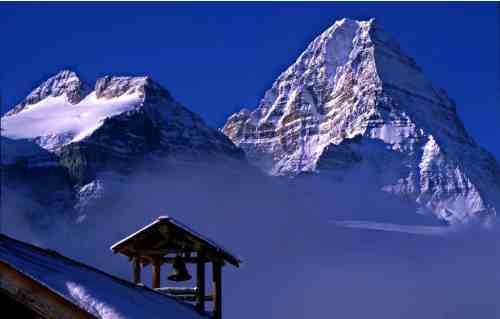
view of Assiniboine from the Lodge – Assiniboine Lodge Photo Gallery
 besthike.com