
hiking Earth Impact craters

Last year I hiked Syncline Loop in Canyonlands, Island in the Sky, Arizona. Awesome. (My trip report.)

Upheaval Dome, the crater there, is only one of 174 such structures as listed on the Earth Impact Database. I wonder how many others have good hikes.

250px-meteor.jpgThis year I MISSED the chance to see Meteor Crater though it was only 35mi (55km) east of my hostel in Flagstaff, Arizona. (The weather was terrible in January.)

The site was formerly known as the Canyon Diablo Crater, and scientists generally refer to it as Barringer Crater in honor of Daniel Barringer who was first to suggest that it was produced by meteorite impact.

Meteor Crater lies at an elevation of about 1740 m (5709 ft) above sea level. It is about 1,200 m (4,000 ft) in diameter, some 170 m deep (570 ft), and is surrounded by a rim that rises 45 m (150 ft) above the surrounding plains. The center of the crater is filled with 210-240 m (700-800 ft) of rubble lying above crater bedrock.

Surprisingly, the site is privately owned with an entrance fee for tourists.

official website – Barringer Crater

The most interesting anecdote for visitors:

On August 8, 1964, a pair of commercial pilots in a Cessna 150 flew into the crater for a closer look but were unable to climb out due to downdrafts. They ended up circling the interior until their fuel was exhausted and crash-landed. They survived their ordeal and continued to fly while the remaining wreckage is pointed out to visitors.

Wikipedia

Leave a comment if you have an impact crater hike to recommend.

the thing to do in Phoenix …

… is cycle the canals.

canal-phoenix.png

They’re part of the Central Arizona Project (CAP), a 336mi (541km) diversion of water from the Colorado River through to southern Arizona. The largest and most expensive aqueduct system ever constructed in the United States.

In Phoenix I rented a mountain bike from the hostel ($15/day) and rode the flat desert until I got close to one of the many “mountain parks”.

bieke-phoenix.jpg

Locking up my ride, I then ran up rough trails to the summit.

Great training for Adventure Racing, was my thinking.

My best day was a ride to South Mountain Park (not on canals this time) and a trail run from Holbert trailhead up to Dobbin’s Lookout.

guided hikes in Israel

Israel Hiking offers guided walks “stressing landscapes, nature and historic sites.”

Sounds like a great way to visit the Holy Land.

… Israel is not a big country, but the range of landscapes is diverse. You can experience steep mountains, the Jordan River and the Sea of Galilee, the Judean Desert, the Arava and the Negev, and of course, Jerusalem. The stories of the bible and the antiquities from various periods can be seen wherever you go. We will do our utmost to produce a trip filled with experiences that you will talk about long after you return home. …

Our guides are English speakers, who are certified guides and have experience in the regions of the trip. If you are interested in a tour in a language other than English, we will make every effort to find a guide who speaks the language and masters the professional terms so that you will be able to enjoy the trip.

About

I greatly enjoyed hiking in the Sinai and even more so in Jordan. But I’ve never been to Israel myself.

The first trip that jumps out at me is a 7-day section of the much longer Israel National Trail:

From Tel Hay to Meron on the The Israel National Trail crosses Israel from the very north to Eilat through the Country‘s principal, most beautiful sites. …

The hike ends at the Amoud River as it approaches Lake Kinnereth. From there, we will travel by car to the youth hostel on Lake Kinnereth.

The difficulty level of the hike on the Israel National Trail is medium. …

Full price: 600 Euro. See the map.

ramon-crater.jpg
Makhtesh Ramon (Ramon Crater) – Wikipedia

Other more difficult treks that appeal are Ramon Crater to the Arava valley and the Eilat Hike from Timnah.

I assume security is not much of an issue when hiking in Israel. But it might be a good idea for a first time visitor to go with experts and learn the ropes.

israel-hiking.gif

homepage –hikes and trecks in israel

Leave a message if you know more about hiking in Israel.

revealed – besthike editor LOVES desert off-road vehicles

by Rick McCharles

I was critical of off-road enthusiasts out of Moab, Utah. Clearly they do a lot of damage to the environment.

Related post: motorized vehicles ruin the Utah desert

But I’ve driven off-road myself in Huacachina, Peru. In the highest sand dunes in the world.

Click PLAY or watch it on YouTube:

That’s not me in the video. But we did exactly the same things there as do all tourists.

It was fantastic fun.

But there is a difference. Those vehicles do very little damage to the dunes or to the plant and animal life of the dunes. Next morning after a windy night, you’d never know a human had been there.

I still want to restrict off-road vehicles in the deserts of the SW USA.

photo-credit-george-novak.jpg
besthike editor Rick McCharles

Huacachina, Peru – Wikipedia

(via Think or Thwim)

where will you hike in 2008?

You hate that question. Right?

On Two-Heel Drive Tom Mangan just asked me: What do you want to do this year?

And something similar from Tom Chandler on The Trout Underground: where are you planning to fish over the next 12 months?

Like those two esteemed bloggers, I am not yet confirmed on any trekking adventures. Our list of best hikes is long. My own next adventure, I hope, will have me climbing off the train above Copper Canyon, Mexico. And descending into that big ditch.

What about you?

Leave a comment if you are decided on any hikes for 2008.

off-road motor vehicles vs hikers in Utah

I spent 2wks last year hiking out of Moab, Utah. Then got grief after criticizing the ethos of the “adventure destination” in this post: Moab, Utah – living a lie?

Comments like this offended:

Moab reminds me more of Mad Max than a desert oasis.

That town is a hub and a flash point for the off-road vehicle debate.
Two rangers are charged with policing 1.8 million acres of Utah wilderness. How well is that working, do you think?

off-road-vehicle-utah.jpg

This issue has finally hit the popular media. Most importantly in a series of New York Times articles including this one: Surge in Off-Roading Stirs Dust and Debate in West

Now in an accompanying video. Click here to watch it.

Personally, I vote to confine motor vehicles to the smallest geographic area possible. And to restrict jeeps and Hummers foremost as they cause far more damage than, by comparison, snowmobiles.

AND I would start in Moab, Utah. That town has it’s priorities wrong. It’s time to force the issue.

(via GOAT)

Related post: motorized vehicles ruin the Utah desert

motorized vehicles ruin the Utah desert

WildeBeat audio journal did a great piece this Fall on the problems of off road vehicles in the Utah desert.

This wild places program examines the problems of trying to designate new wilderness areas in the central Utah desert. If it gets overrun by off road vehicles, can it still become new wilderness?

This story was provided to us by guest reporter Kurt Repanshek, creator of the National Parks Traveler web magazine. Kurt tells this story of the struggle for wilderness designations in the desert canyonlands of central Utah with the help of:

* Heidi McIntosh, conservation director for the Southern Utah Wilderness Alliance
* Wayne Ludington, assistant field manager for the Price district of the Bureau of Land Management
* Liz Thomas, attorney for the Moab office of the Southern Utah Wilderness Alliance

(A spokesman for the Blue Ribbon Coalition, the dominant advocacy group for off road vehicle enthusiasts, didn’t respond to our e-mailed requests for an interview.)

The WildeBeat: The audio journal about getting into the wilderness.

off-road-vehicles-utah.jpg
Southern Utah Wilderness Alliance

What a shame.

We named the SW USA the #2 best region in the world for hikers. But seeing motorized vehicles welcomed into Canyonlands National Park is a huge downer.

#2 best hiking region in the world is the …

South West USA

Capitol Reef, Zion, Bryce, the Grand Canyon, Monument Valley, Glen Canyon, White Sands National Monument, Canyonlands and Arches National Parks. This part of the world is awesome.

We hike the SW USA every year and have yet to be disappointed.

Fascinating, diverse and mind-boggling. The best WOW geological zone we’ve seen anywhere.

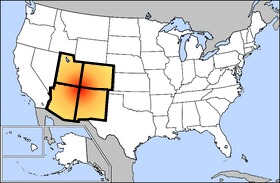
More correct would be to call this region the Four Corners.

The high desert plateau intersection of the four U.S. states of Utah, Colorado, New Mexico, and Arizona.

The Grand Canyon of the Colorado Plateau is not the deepest nor largest, but it’s by far the most stunningly beautiful on Earth.

Most of the best slot canyons and natural stone arches in the world are here. A desert, your views are unobstructed. The light is perfect for photography.

The best weather is Oct-Nov, Mar-May. Summers are too hot for most hikers.

Most of the hikes in the Four Corners are short due to lack of water and the real risk of getting lost. People die in this wilderness every year.

Our favourite hike in the Four Corners region is Paria Canyon on the border of Arizona and Utah. You enjoy many days beneath huge walls in a slot canyon.

more from our Paria photo set

if you hike Paria you’ll certainly add on a nearby day hike called The Wave.

more Wave photos

More information on on dozens more great adventures on our new SW USA information page.

#8 best hiking region in the world is …

Australia

We love Australia. Who doesn’t? What’s not to like? It’s paradise Down Under.

What an exotic treat to have kangaroos and wallabies hanging about your campsite!

“Stunning rocky headlands and perfect beaches, lush rainforests, sun-sharpened deserts and the muted beauty of the bush — taking to the trail in Australia offers a kaleidoscope of colours, terrains and adventures for walkers of all levels.” – LP

You have such a wealth of choices: the Blue Mountains (NSW), Whitsunday Islands (QLD), dense subtropical rainforest in Lamington National Park (QLD), Larapinta Trail (NT) out of Alice Springs, wild Kakadu National Park (NT), the rugged Cape-to-Cape (WA) or pretty Wine Glass Bay in Freycinet National Park (TAS).

Those are just a few! Our favourite Aussie hiking guru John Chapman helps you choose by clicking on the map:

More information on our new Australia information page.

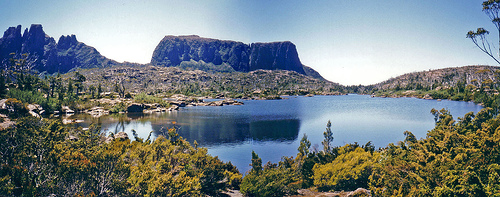
Our favourite hike in Australia is The Overland Track in Tasmania.

View from the Labyrinth – flickr – Andrew Purdam

See our Overland Track Information page.

best hikes in Arizona

With 50,754 Photos and almost 800 hikes, HikeArizona.com is an incredible resource. It’s run by Joe Bartels.

Contributor Al_hikesAZ posted in 2005 a list of The 20 Most Popular hikes in Arizona:

Flatiron
West Fork of Oak Creek
Peralta Trail
Humphreys Summit Trail
Brown’s Peak
Havasu Canyon
Fossil Springs Trail
Camelback Summit via Echo
Horton Creek Trail
Piestewa Peak Summit Trail
Bright Angel
Barnhardt Trail
Rogers Canyon
West Clear Creek Trail
Hunter Trail
Kaibab – South Rim
Boynton Canyon
Bell Trail
Inner Basin Trail
Tonto Narrows

This isn’t necessarily the 20 best hikes in AZ, just the 20 Most Popular hikes.

He also recommends:

Bright Angel Trail
South Kaibab Trail

Thunder River/Deer Creek (photos)
Nankoweap Trail (photos)
Ribbon Falls (photos) just west of the North Kaibab Trail
Superstition Ridgeline

Al_hikesAZ also recommends 2 other sites for AZ Hikes:

  • Arizona Hikers
  • Todd’s Desert Hiking Guide
  • I am now planning on hiking Arizona in 2008! (There is a lot of research to be done.)

    459434669_8cde9b8250.jpg
    Early morning at Carney springs – Superstition Wilderness – larger original

    991385453_514aad7bca.jpg
    Arizona Black Rattlesnake – larger original

    See all of Al_hikesAZ photos sets on Flickr. They are excellent.