Carol gives a shout out for Alpine Exploratory, a company specializing in walking and trekking holidays in the Alps.
They did the “self-guided” version of the tour.
I think self-guided is a nice compromise. You don’t need to follow behind your group (like sheep). But you have experts who speak the local languages setting your itinerary for you.
+ Trek all the stages, completing the whole route
+ Start on any day you choose
+ Expert, unlimited advice on all the options
The Tour du Mont Blanc is a trek of superlatives: the most famous trek in Europe, forming a circuit of Western Europe’s highest mountain Mont Blanc (4,808m). Our circuit takes the standard 11 days, starting and finishing in the Chamonix valley. …
Included
Accommodation and itinerary
Breakfasts and 6 evening meals
Expert and unlimited advice
Routecards, maps, local info
Emergency card, language card
Dates
July to mid-Sept 2010 …
Prices
£860 per person
(Single supplement £140)
£860 = US$1,410
===
UberFit is blogging their TMB from this past summer. Great photos. (Especially food pics.)
The days of foreigners being “covered” for health costs in nations with socialized medicine are ending. In Switzerland you would pay the full cost of helicopter rescue if you are not a citizen.
Even in the developing world, hospital costs could crush you:
… Aussie tourist took an unlucky fall off a steep mountain track in India and ended up paralyzed in a hospital in New Delhi. And yes, you guessed it, this guy was traveling without any insurance, even though he was 64 years old and should have known better.
The result of this stumble is that his family back in Oz have maxed out their credit cards to pay the hospital bills and so far can’t afford to get him on a plane and home. …
You must buy travel insurance if hiking out-of-country. Most policies allow trekking, but do not cover climbing nor mountaineering. Double check your coverage.
====
On a related issue, posted in Gadling – Should a medical exam be required before a major trek?
Physicians and politicians in Australia are calling for mandatory physicals for any trekkers preparing to hike the Kokoda Track according to Aussie newspaper The Age. The Kokoda is a difficult and remote trail in Papua New Guinea, which has claimed the lives of three hikers this year alone. …
My gut feeling is that regulation is going too far. The normal “release” form should be enough.
Adults must be responsible to make their own decisions in so far as adventure sport is concerned.
If a company voluntarily requires a medical, no problem. But a government should not impose this requirement.
For example, A Sierra Club Upper Dolpo Trek in Nepal requires a full medical and approval by the trip leader, but not because the government requires it.
… I’m personally shopping for travel insurance right now. Leave a comment if you have a recommendation.
After many, many hours trying to find a good deal on airfare. And rent-a-car. I finally gave up on trying to hike the island nation this summer.
I’ll start months in advance next time. And travel off-season.
Here’s what I missed …
Landmannalaugar
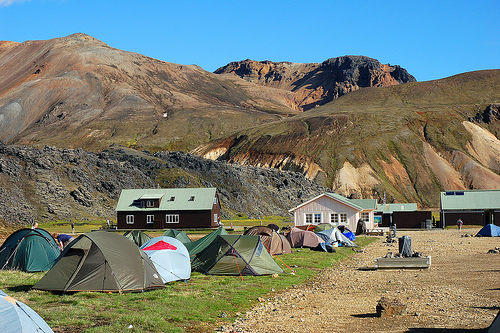
… Arguably the most famous hiking tour in Iceland is the Laugavegur Tour. Traditionally done north to south, the trek begins at a drop off point called Landmannalaugar. This tiny launch pad is a destination in its own right, in fact I would argue that it is the single most beautiful place I have ever been.
The area consists of one small hut (sleeps 80), a large campground for trekkers, a small building with sinks, toilets and showers, a covered eating area, an old school bus turned store, and the most coveted of all… a large natural hot spring that serves as swimming pool, meeting place, bath, warming room and of course bar. …
This turned out to be the most memorable day of many amazing days.
The weather was terrible. All day. Terrible.
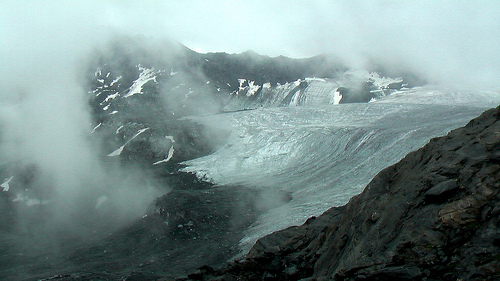
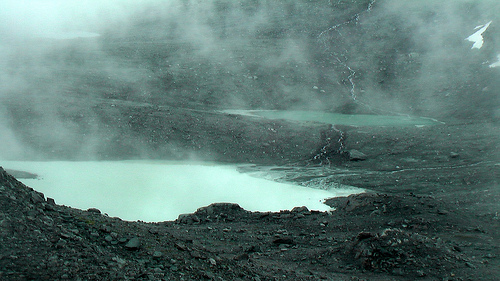
The most remote and wild terrain of the entire route.
intensely glaciatedsurreal glacial tarn
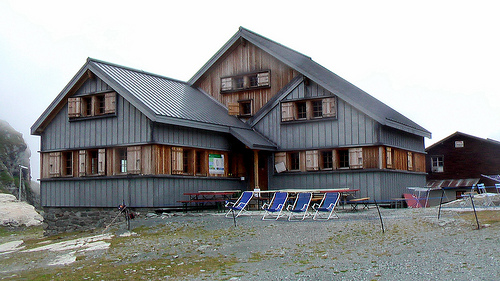
I was quite happy to finally arrive at Cabane de Prafleuri.
alpine hut
These refuges offer accommodation as well as food. Nice.
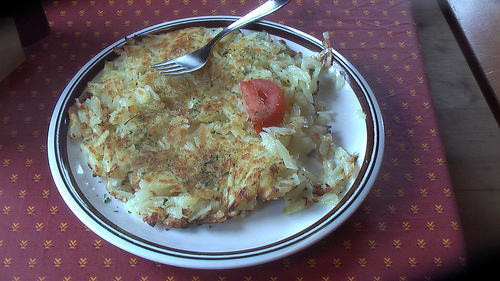
Rosti
I got a chance to dry out. And warm up. Then walked on when the rain slowed.
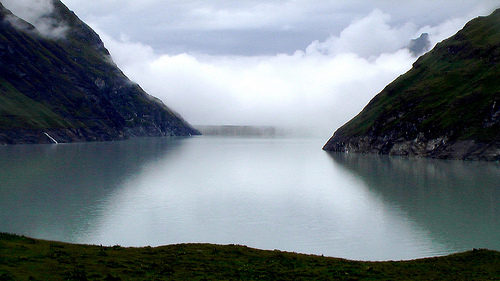
Very impressive this day was Lac Dix, man made, created by one of the highest dams in the world.
Lac Dix (Lake 10)
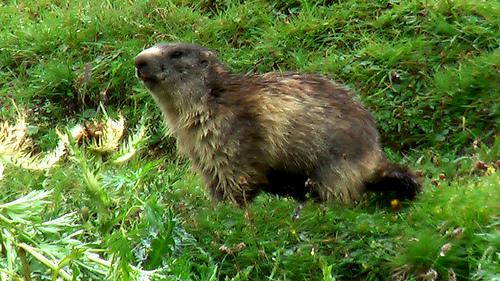
The wildflowers and wildlife this day, were the best of the entire Haute Route. It’s an animal reserve.
marmot
In the early evening the weather worsened. Again.
I decided to stay at an alpine hut rather than try to climb out of the valley.
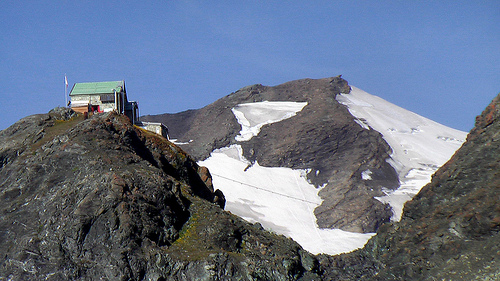
A long, impressive ridge would take me up to Cabine Dix.
That photo I shot the following morning. The night before, in the rain and dark. I thought I’d never get there. It’s very high. Nearly 3000m. Higher than the pass I would cross next day.
Cost for dinner, bunk bed and breakfast was US$65.
The dinner was excellent. The bed very comfortable. The breakfast the worst I had in Europe.
I was the only Anglophone that night. Ordered about like a German soldier.
Overall, I’d rather sleep in my tent and cook my own food.
I drove down the highway and stayed at the hostel. … The hostel that costs $25 / person. Hot shower. Kitchen. WiFi.
Charging $23 for a solo tenter is far too high, Nova Scotia.
… I like how tenting at a campground is billed in Europe. There’s are separate charges for each tent, each vehicle and each hiker. A very fair system, I find.
… In just the last year, the Northern Virginia Regional Park Authority has seen a jump in camping of 10 percent increase over last summer, and an astonishing 75 percent increase since 2004. …
… Tom Doyle, Vice President of Information and Research at the National Sporting Good Association, says the increase in visitation is no fluke. “In our last national survey, we found that camping has dramatically increased, from 46 million campers (nationally) in 2005 to 49.4 million last summer.”
Those figures show no sign of slowing either. Camping, hiking, kayaking – all three areas remain on the rise according to Doyle. Meanwhile, tent sales nationally have been trending up the last few years.
“I fully expect the increase in camping to continue,” Doyle said. “People are foregoing expensive travel.” …
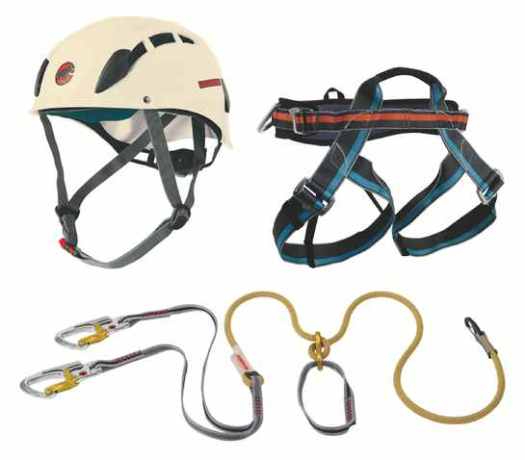
Via Ferrata are, in effect, a range of protected scrambling routes, comprised of skilfully installed fixed cables, ladders and gorge-spanning bridges, which assist ascents to high levels, from which you walk on, often to a nearby rifugio, or back to the starting point via a path.
The scenery in the Dolomites may be just as good. And there are far, far more stunning jagged peaks in Italy than in all of South America.
click for larger version
Many, many Europeans get out hiking during the Summer. Trails are crowded everywhere throughout the Dolomites and the Alps. There’s a great shared sense of community here.
Instant gratification. You can ride chair lifts up to the very tops of some of these peaks. How convenient is that? Almost anyone can find a best hike for themselves in this range.
WW I history in the Dolomites is sobering. German, Austrian and Italian soldiers were stuck digging tunnels through these mountains through several winters. This was the “Front”. Needless to say, far more young men died from the elements and falls than by fire fights. There are reminders of the Great War everywhere.
Here is the home of via ferrata (Italian for “iron road”). (In fact, our next trip to the Dolomites will be dedicated to doing some of the best of those assisted climbing routes.)
click for larger version
Not everything is perfect in the Dolomites. I prefer the Sierra Nevada mountains in California, overall.
In the Sierras I can put up a tent anywhere I want. Fantastic.
Unfortunately, in the Dolomites you are required to sleep in alpine buildings called Refuges. (Refugios – Italian). Their locations are stunning. Many people love them. But – personally – I prefer my tent over sleeping on the floor. Or in bunk beds.
Happily you can reach almost any place in the Dolomites by day hike. Public transportation in the valleys below is good!
The two regions – the Sierras and the Dolomites – are similar in that everywhere is a best hike.
Rifugio Locatelli - click for larger version
I do like the food and drink at Refugios. Prices are regulated.
The main reason I had not hiked in Europe in 30yrs is cost. Italy can be expensive.
It’s possible to hike on the cheap. Putting up my tent in a campground in Cortina only cost 9€ (US$12.80) / night in 2009. Bread, chocolate, soft cheese and wine are inexpensive. What more do you need?
They have a tent in Berlin, Germany, as well. A real party “scene” at both places.
I’ve always felt there’s a market for low cost accommodation. You could make money offering cheap sleeps in many parts of the world where hostels are over-priced.
Iceland? The closest European land to North American shores is more like Halfpriceland these days. Its krona has plummeted against the dollar, bringing what was one of the most-expensive spots on Earth back down to affordable levels, and with travel deals ramping up for the summer season this is the best time in at least five years to take the short flight over to Reykjavik. …