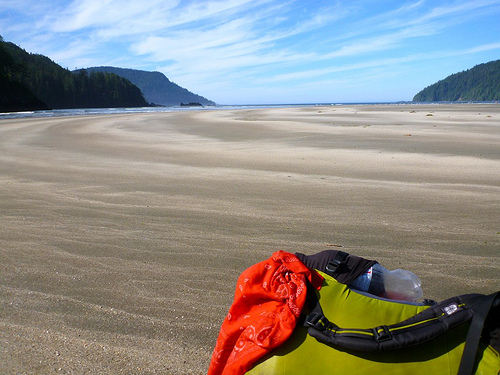
Perfect weather on the beach … yet I had to be at the trailhead by 1pm to catch my (prescheduled) Trail Shuttle out.
I tried to enjoy the final few hours, as best I could.
It was time to go.
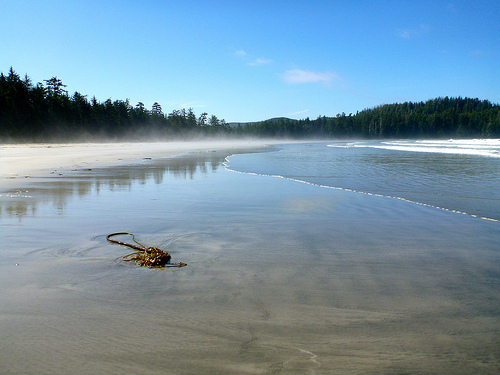
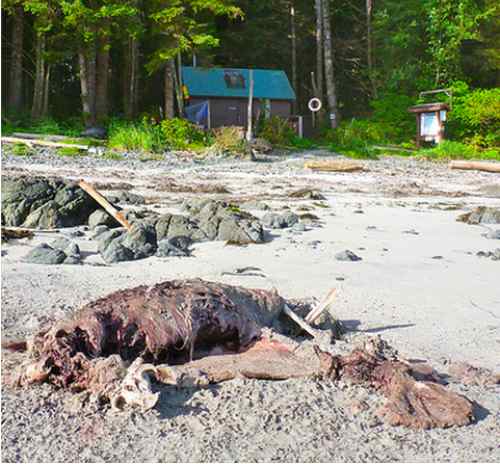
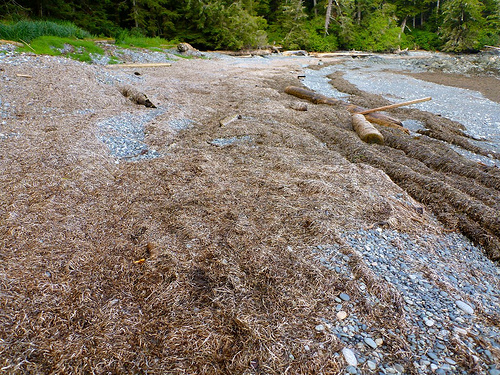
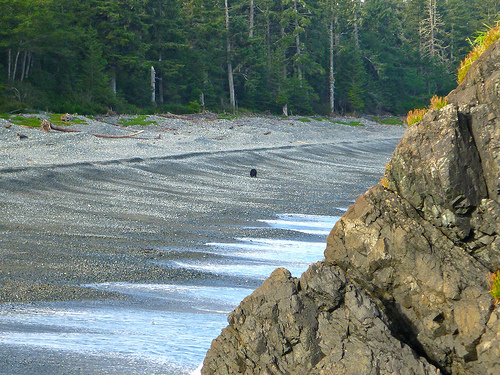
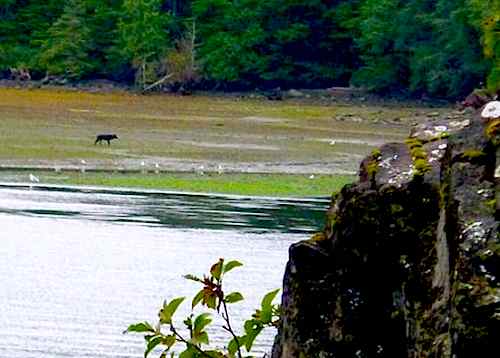
This had just been left ashore. Is it a Salmon Shark?
Given time, I would have hidden myself above and taken video of whatever scavenger arrived first.
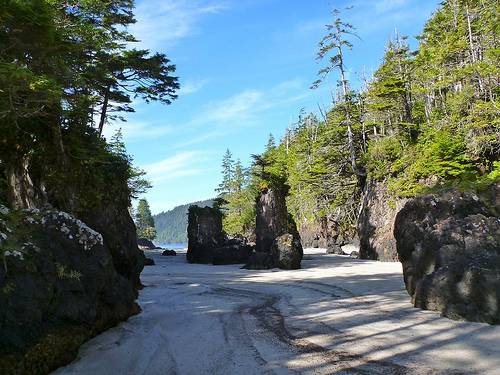
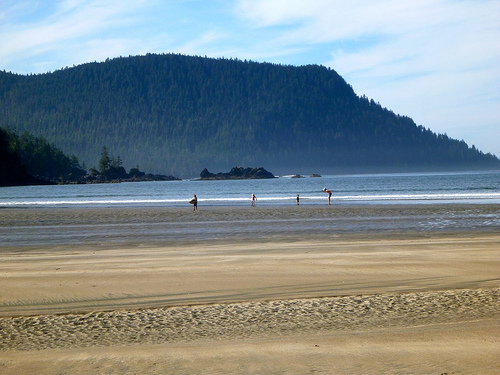
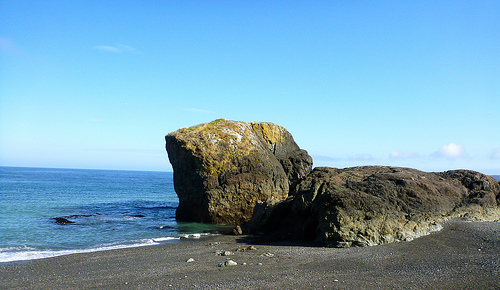
At exactly low tide, the sea stacks were dry. And very pretty.
Accessible by car, families with kids were day tripping to Josef.
I sent them running to see the “shark”. 🙂
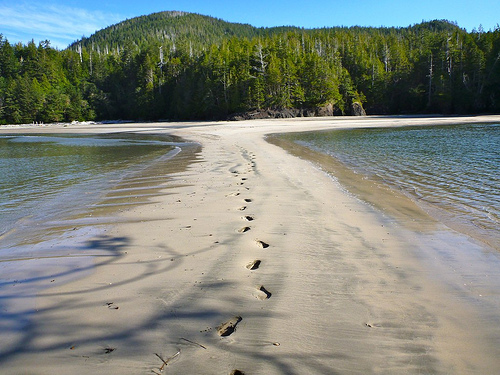
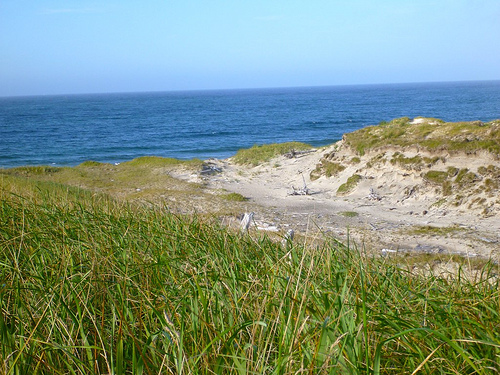
I washed up in the estuary. And left the beach.
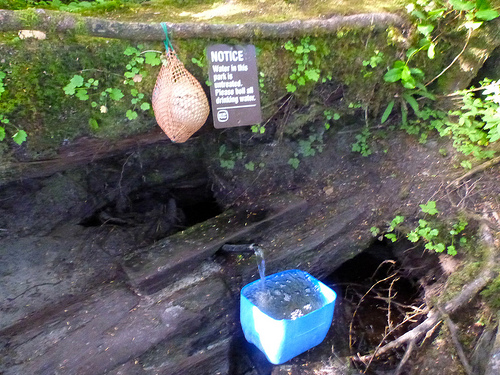
The signage is great on this adventure. No GPS or compass needed, really. But it would have saved time to have all water sources listed by GPS coordinates .
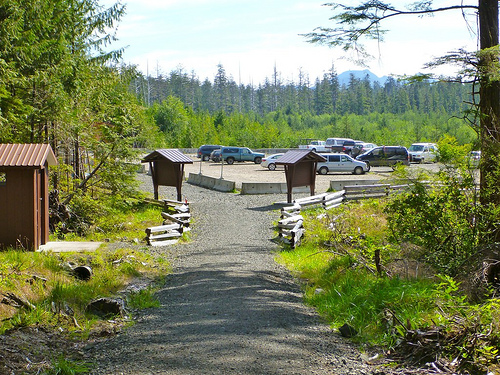
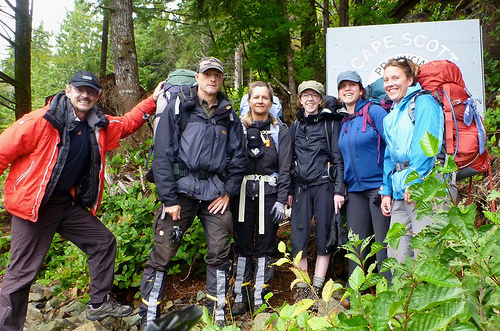
Cape Scott Trail parking lot.
Obviously, the girls had arrived before me.
We were somewhat stinky after 7days in the wilderness. The girls had swum in Eric Lake, however. Respect.
Unsurprisingly — for me — I found there was no water at the parking area. 😦
… It was another km walk to wash up in a creek. And change clothes.
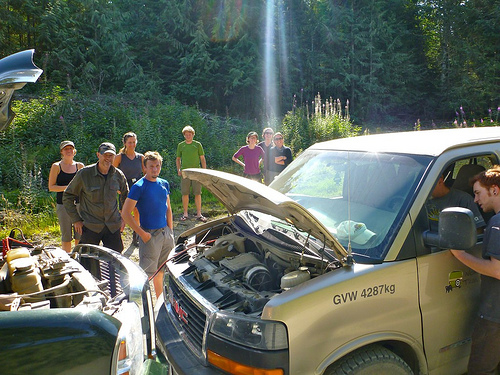
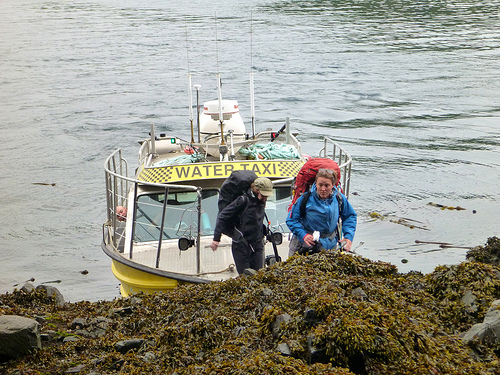
Our Shuttle arrived, right on schedule. We were only 64km away from civilization!
Doh! We broke down, half way.
Our rescuer was paid in Halibut!
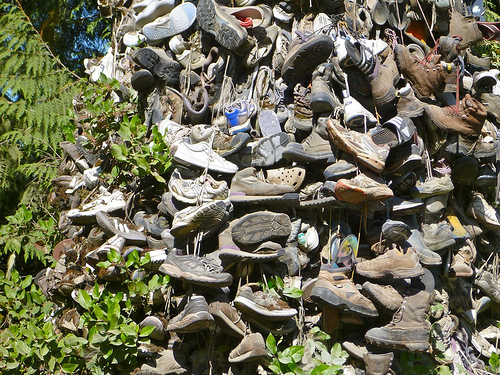
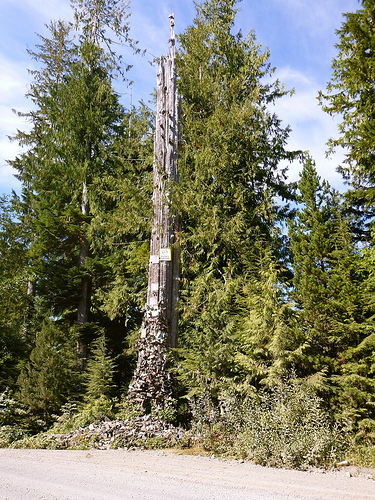
We did make time to visit the famous Shoe Tree.
One of the girls donated some sandals.
Elated to be finished, we chowed down in Port Hardy. I had Halibut & Chips and big waffle cone ice cream.
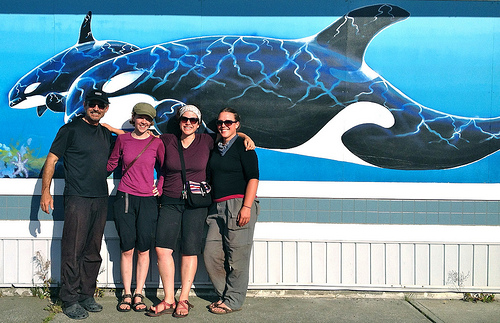
The girls and I said our farewells.
In bed at the hostel by 7:30pm. Somewhat sick in the stomach. (bad water?) Somewhat exhausted.
Despite the werewolf attack of the previous night, I was reluctant to leave my ideal campsite in perfect weather.
(Moma wolf had swung by early morning, to make sure I wasn’t still angry.)
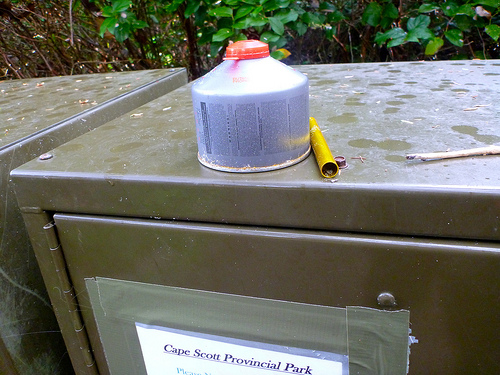
I left one of my partial stove fuel canisters for the next desperate hiking group. Beside it is a tent pole repair splint I’d found. Actually I found two over the week, leaving both at Nel’s for future emergencies.
Often I dislike and avoid pit toilets on hikes. But I have to admit those in Cape Scott Provincial Park are pretty good. Kept clean. Many with toilet paper.
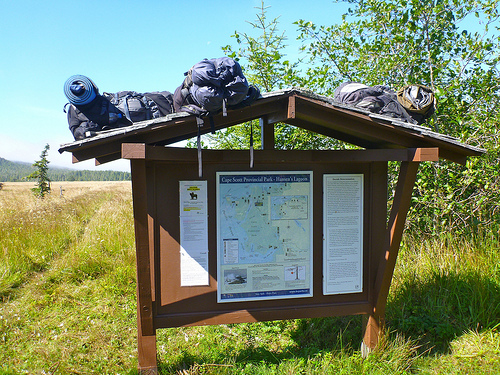
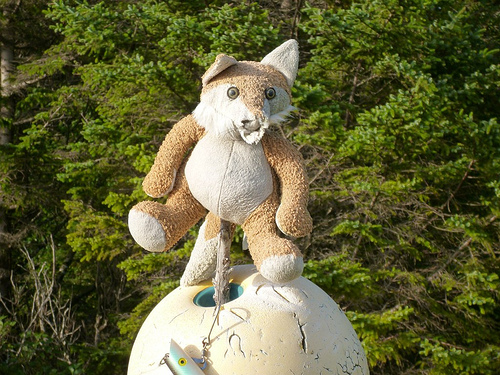
To sidetrip to Hansen lagoon, we threw out packs up atop this sign. To deter wolves. 🙂
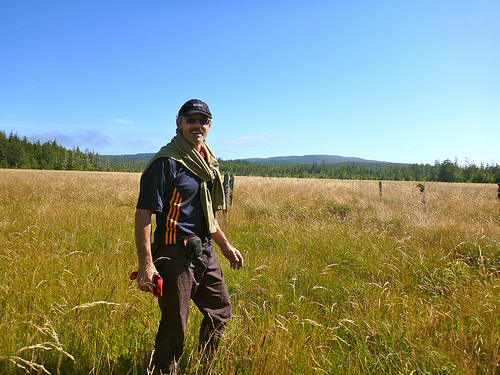
Unbelievable. Flat fields reclaimed from tidal flats look like prairies.
The sad history of failed Danish settlements here is fascinating. One of the highlights of my trip.
Here’s the abandoned settlement telegraph wire.
This final long day is much different. Tranquil. Change is as good as a rest.
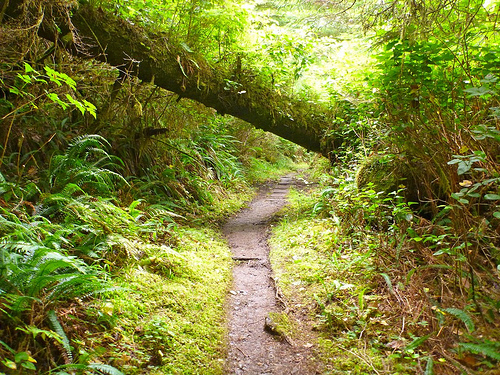
On the longer established Cape Scott Trail, the walking is mostly easy.
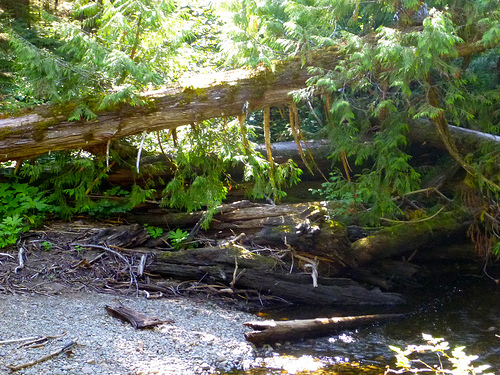
This fallen tree on Fisherman’s River impressed. Though nearly horizontal, it is thriving.
There are banana slugs on this part of the island, but far fewer and smaller than on the WCT.
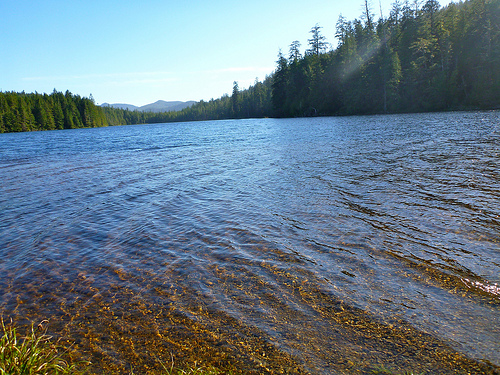
Eric Lake is BIG. And a bit of a surprise after all that coastal scenery.
The girls had leapfrogged me. I found them set-up in the sprawling Eric Lake campsite. Have you ever seen tent platforms this elaborate?
It seemed I’d arrived San Josef at low enough tide to skirt the headland and reach the far side of the beach — the side with water.
Nope. I ended up doing the Spiderman traverse above crashing waves at dusk. … Kind of fun actually. At this point I knew I was going to survive the trip. 🙂
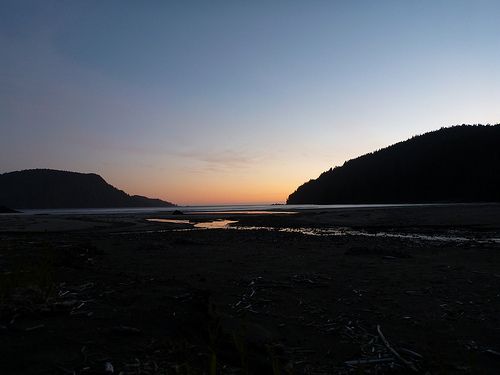
I had dinner with the only two other hikers on the beach. And enjoyed my last, wonderful sunset.
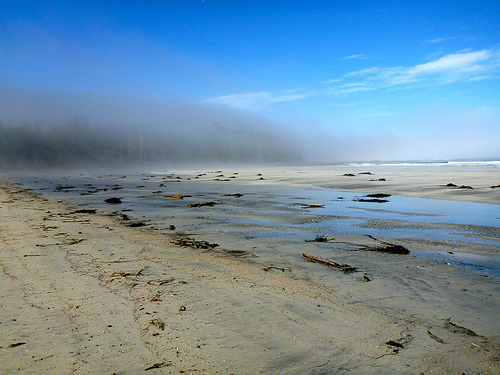
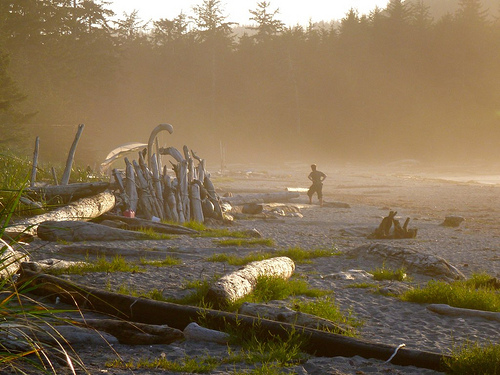
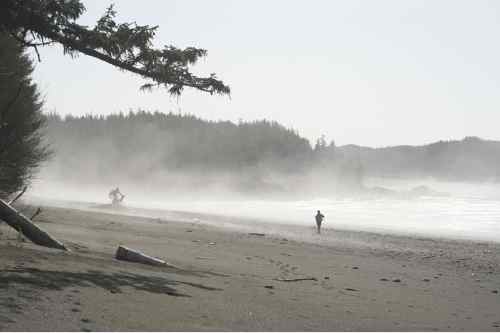
Mornings are often foggy on this coast. It burns off after a couple of hours on a sunny day.
Here’s a fog bank, for comparison, dissipating later in the day at Nel’s Bight.
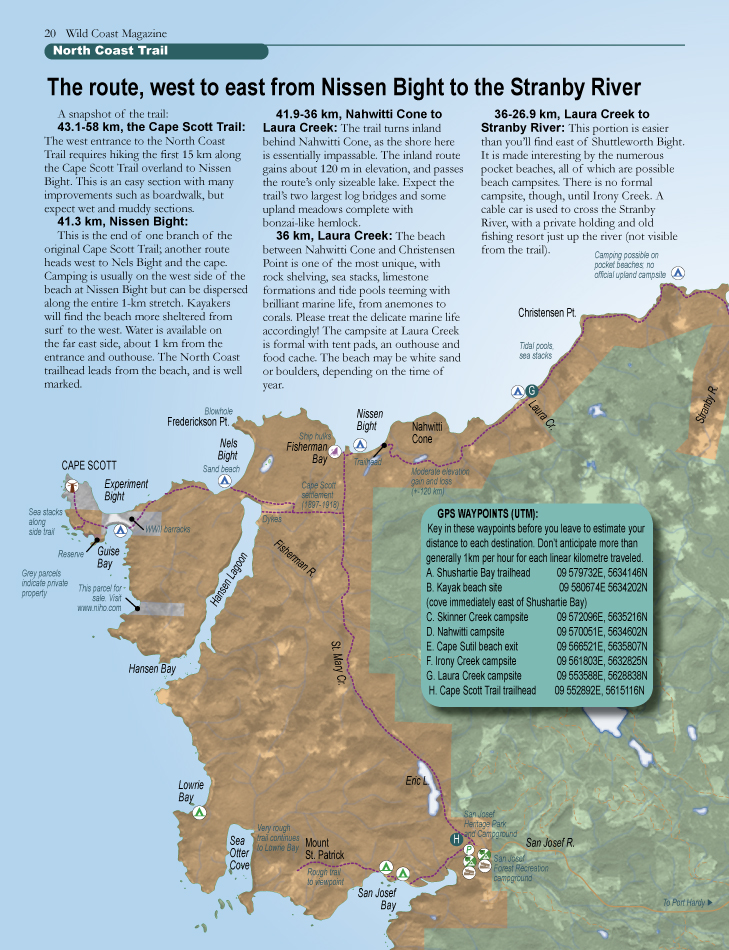
Departing Nissen, you find that your North Coast Trail is now also the older (1973) Cape Scott Trail. In much better condition.
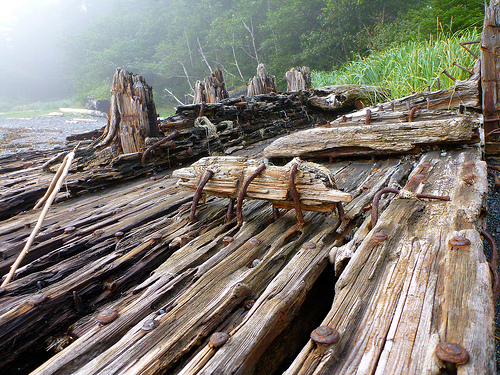
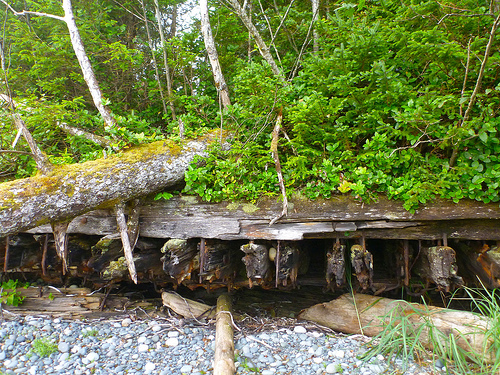
Very cool. Unique, so far as I’ve seen, is this broken up wooden ship hulk, sunk as a breakwater, slowly being overgrown by vegetation.
The Earth reclaiming. 🙂
From 1897 until 1910, Danish settlers tried to establish a fishing community near San Josef Bay. Due to the harsh climate and lack of governmental support, the community failed …
… another attempt was made at Hansen Lagoon, similarly failing by 1917. Alfred Spencer, the last resident, left in 1956.
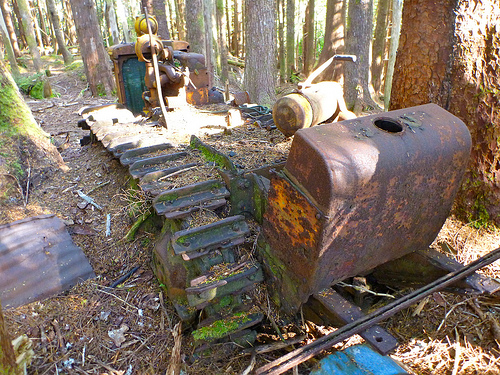
Some artifacts can still be seen in the park, including a three-metre-tall granite tombstone, several corduroy roads, many ruins (that look like anonymous mossy mounds), and rusty farming implements. …
Of those relics, the most impressive to me is this crude tractor abandoned jammed between trees near Hansen Lagoon.
Nel’s Bight is gorgeous. My favourite stop. The most popular beach in the Park is reasonably easy to access from the parking lot. No need to hike the NCT to get here.
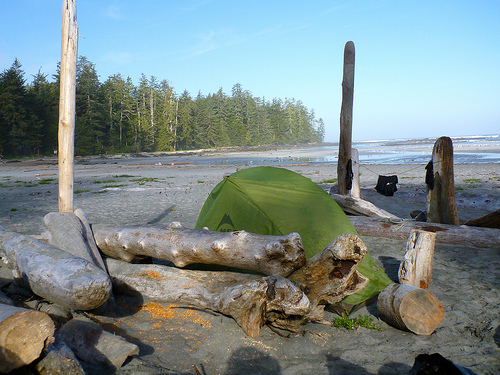
I set up my tent early in the day, for the first time. And walked the 2km long beach barefoot in bright sunshine.
I’d pushed to get here early to have time to side trip to the Cape Scott lighthouse. (minimum 13.6km)
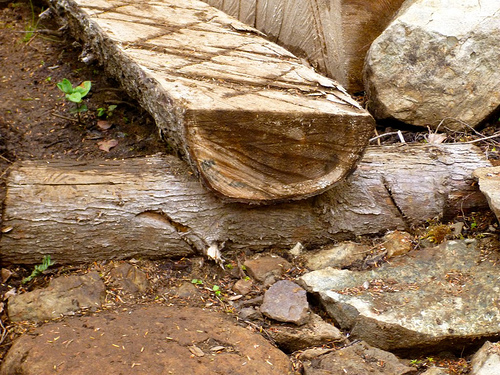
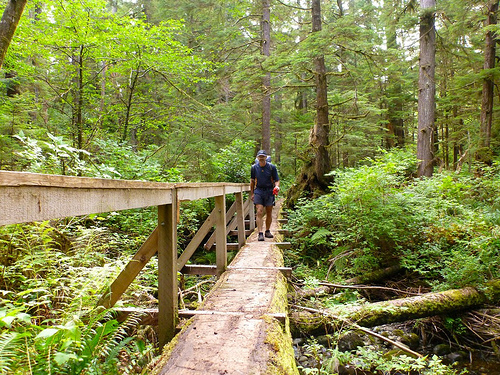
It’s a pretty, varied and well maintained trail. I love log bridges made of materials available on site, this style in particular.
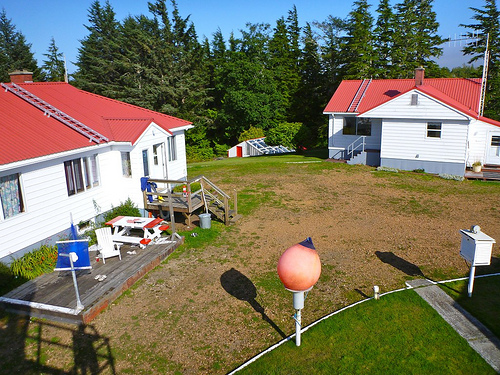
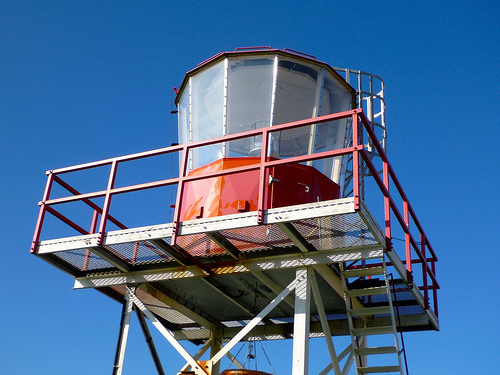
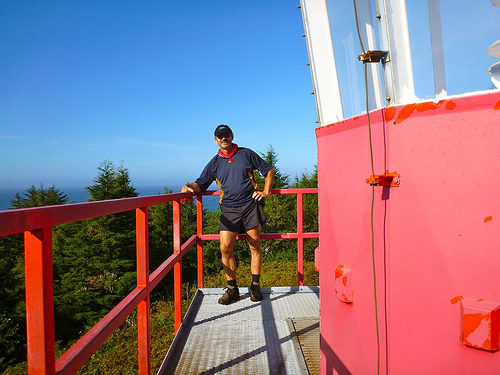
Some find the manned light house a bit of a let down. It’s immaculate, however.
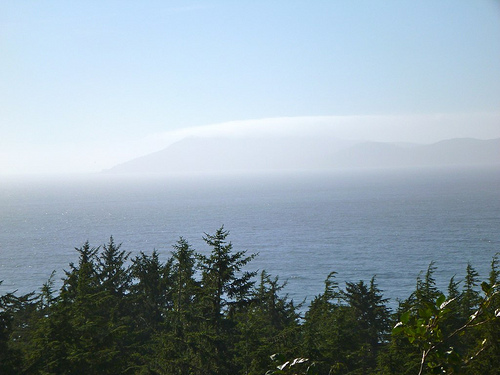
The weather was marvelous. With views over to the island north of the north tip of Vancouver Island.
The letdown is the location of the light station, far from shore atop a hill. Somehow it’s not as exciting as those on the West Coast Trail.
Locals love grass fringed Guise Bay en route.
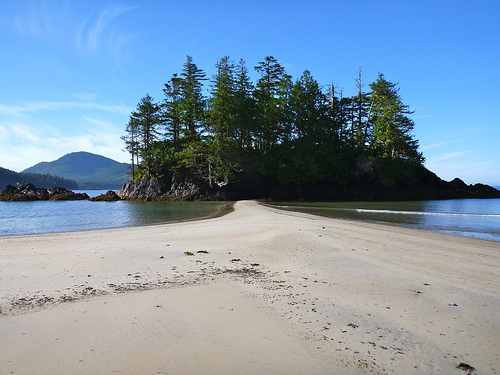
And unique Dune Neck to Experiment Bight.
Natives formerly dragged their boats across this sandy stretch rather than risk the circumnavigation of Cape Scott in dangerous seas.
FEAR the WOLVES
By the time I got back to the tent, it was late. I was tired.
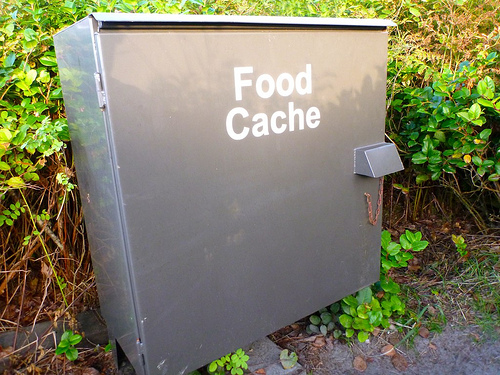
My food, as always, was carefully locked away in the campsite cache.
🙂 Fortunately, I’d found stove fuel left behind by departing hikers.
😦 Unfortunately …, there was a pack of wolves close to the water source at Nel’s beach.
Why?
They were feasting dawn and dusk on a sea lion carcass dead directly in front of the Ranger’s cabin. Here a photo I took the next day.
The water — however — was close to the Ranger’s cabin, as well.
So wolves, be damned. I marched directly to get water. The beasts dissolved into the trees.
…
It was quite dark by the time I finished dinner. Instead of cleaning the pot, I used an old trick — filling it with sand and sea water. That prevents critters from coming to visit during the night.
But the tide was low. I had a long walk barefoot to reach the surf.
When I turned around, there was the alpha wolf, about 25ft away. They’d trapped me!
I SHOUTED. I raved. I waved (my pot).
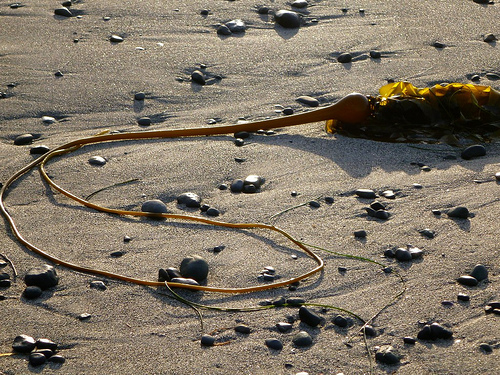
I grabbed KELP and snapped it like a WHIP.
The wolf mother finally realized I was some madman. And finally trotted off with her brood. … At least my THEORY is that this is a mother with young ones. Some speculated the leader is the Alpha Male with 3 or 4 followers.
Here’s a wolf, perhaps the same wolf, on the same beach Aug 10th, 2012, a month before I was there.
It was much, much later before I realized she was only coming out to see where I dumped leftovers in the sea.
Wolves almost NEVER attack humans. The are among the least threatening beasts anywhere for their size and strength.
The Vancouver Island Wolf is a subspecies of grey. They will attack dogs and, indeed, there were at least two dog encounters this season in the Park. Don’t bring your dog here.
Their main prey on this Island are Columbian black-tailed deer and Roosevelt elk. While I was on the Trail, one hiker captured video of a wolf chasing a deer through the surf.
A short day planned, still I packed up early. Left my backpack with the kayakers. And headed out to explore Cape Sutil off-trail.
From high vantage I saw the girls finally arriving.
Sutil Cape is impressive. I got far enough to see this bird rock.
Bird life?
You spend a lot of time with seagulls. I did see a few distant bald eagles. And visited with a few ravens. But not as many as on other west coast hikes.
I was surprised to see two loons on the ocean at one Bay. I thought they were exclusively fresh water.
The flying highlight for me was the Steller’s Jay, Provincial bird of B.C.
There are entertaining to watch.
Walking is easiest on the rugged coasts of Vancouver Island at low tide.
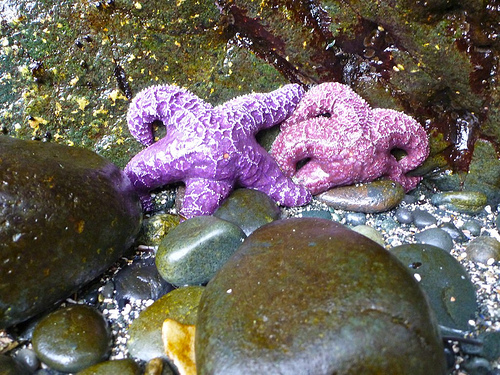
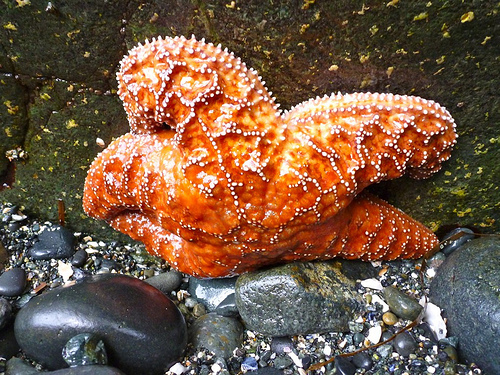
Tidal pools on my trip were good, but not as good as I’d seen on the WCT or Juan de Fuca. Nor are there as many. The highlight for me was colourful starfish.
There are dozens of assistance ropes hung to assist on steep sections. But the ones everyone remembers best are these.
At times the grade ranges from 70 degrees to vertical. And they are LONG.
This excellent video — shot by another group earlier this Summer — at 3min 8sec gives you a good idea of what the ropes are like. That’s the worst the trail throws up to challenge those afraid of heights.
Ropes are mainly needed for descent. I tended to avoid them on the climbs. Roots are better and more stable.
Those folks were crazy to take dogs out there, by the way. 😦 A really bad idea with so much wildlife here. At least 2 dogs have fought with wolves this summer.
We were tremendously LUCKY with the WEATHER. Seven days, no real rain. Coastal hiking is paradise when the sun is shining.
This helicopter fly-over Shuttleworth Bight gives you a good idea of the wonderful terrain.
I’ve always thought that a person needs to do one thing every year that scares the crap out of them. I’m very happy to have checked that item off my to do list for this year!
Helen and I arrived at the Gordon river by 5:45 am on Sunday morning, and I quietly slipped the cheap $29 inflatable dingy into the dead-calm Gordon river in pitch darkness by the light of the rental car head lights, and my triple A battery powered head lamp. …
… “What the hell am I doing here?” was the question I was asking myself as I started to struggle up the extremely technical trail at 6:15 am by the light of my little headlamp. It was so dark, and I could only see a few feet in front of me – and, it was TOUGH going! The first section is a 600 foot climb through roots, mud, fallen tress, jagged rocks, boulders, puddles – yikes! …
The west coast trail either runs inland through the forest, or along the beach, or both. By both, I mean either, as in the hiker or runner must choose. Sometimes a beach section is faster if the forest trail is muddy, or log strewn, or excessively hilly, or requires climbing up huge ravines by a system of numerous ladders …
… all of which are exhausting and time consuming. Sometimes the beach sections are difficult due to soft, unrunnable sand, sea weed covered slippery rock shelves, impassable headlands due to high tides, or just downright dangerous with evil surge channels that must be vaulted over. Each time I was faced with the forest or beach option, I had to weigh the pros and cons, dangers and advantages, then commit to my decision and go. …
It IS possible to hike along the beach from Skinner Creek to Nahwitti River at low tide. (Start a couple of hours before low tide, if you can.)
Another day. Another BEAR.
Stumbling out of the trees at this beach — there was a bear. Studiously ignoring me.
I quietly scrambled atop this rocky outcropping. No bear could get up there.
I read my book. And then left a Summit Stone in a crack on top. 🙂
Many feel the Nahwitti Stretch is even more difficult than day 1 Shushartie Overland, but I liked it much better. There’s plenty of variety. Plenty of entertainment.
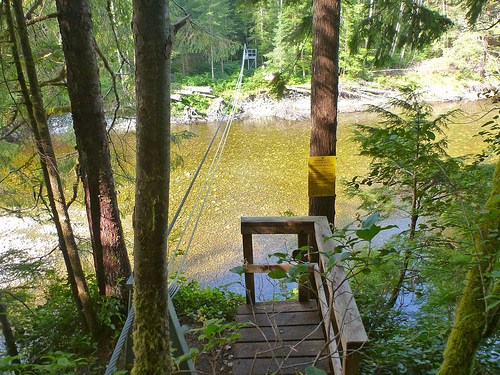
For example, the Nahwitti River Cable Car.
Now that’s FUN. I did not see any sign of spawning salmon, however. Perhaps it’s too early in the season.
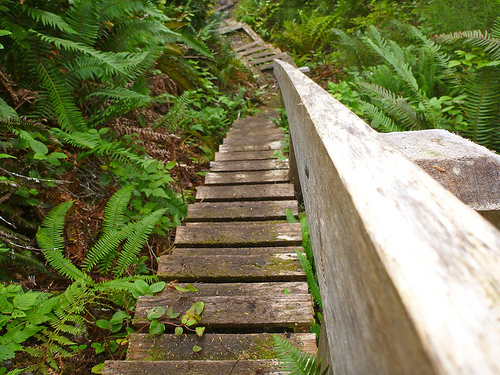
FUN too are the longest stairs on the Trail — “Long Leg Hill”.
Hikers praise aloud those who built these, let me tell you. 🙂
So far as I saw, there’s only one truly impassable headland on the official North Coast Trail — at km 43.2.
Late, I arrived at high tide, and was obliged to lie down for a nap.
At some point later the girls arrived, needing to wait as well. They were more than mildly surprised when I popped up out-of-nowhere from my sleep.
As we found out the following day, the girls never actually made it to Sutil that night. Due to knee pain and failing light, they decided to wild camp in one of the pocket coves just short of Sutil, having to “hang” their food from bears, wolves and (perhaps) hyenas. 🙂
If the ladies had known in advance they were too late to get through, they could have stopped at Nahwitti River campsite.
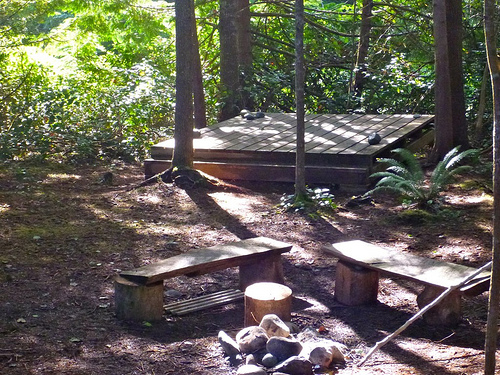
The tent platforms on the NCT are fantastic. If it’s raining, you definitely try to set-up on these.
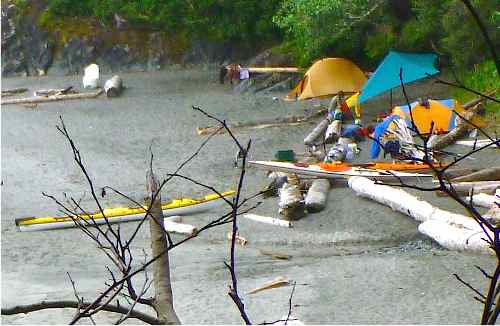
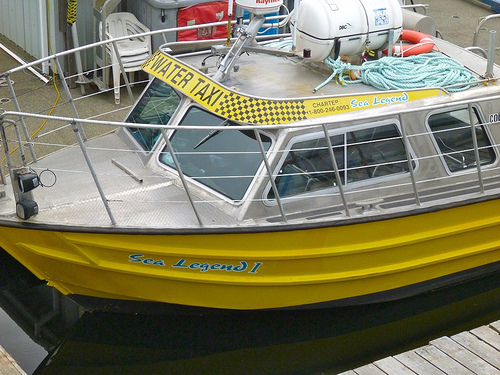
On arriving at the beautiful big beach at Sutil, I was astonished to find 3 kayaks and 4 kayakers, just dropped by the water taxi, starting a 2wk adventure. (I wished I’d come in with them to start hiking here.)
It was a birthday party. I felt obliged to finish off the leftovers from their heavy dinner. And to drink their heavy wine. And warm myself at their friendly fire.
As dusk fell we sipped wine, … and wondered whatever happened to the girls.
I assume the wolf was hoping to nab one of the cubs.
Skipper’s spent a lot of time in these wilds, but he’d never seen anything like that before.
So here we are. Still clean and healthy.
3 young ladies from Calgary & Victoria. A couple from Germany who had done this same hike in 2011 — and returned in 2012 because they enjoyed it so much. And one hiking blogger, already out of line.
Most on this trail are from BC, Alberta and Germany. As we were.
We did the “standard” North Coast Trail — starting at km 58.1 and working backwards. … Yes — counter-intuitive for a Trail officially opened in only 2008.
Enjoy the view at km 57. That’s the last time you’ll see the Ocean for many hours.
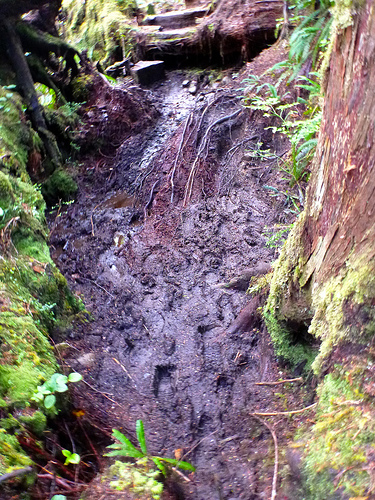
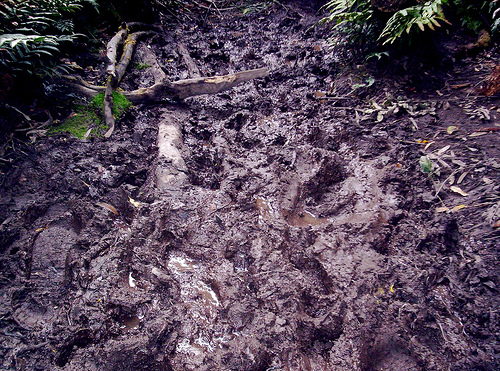
Enthusiastic to get started, I was quickly depressed by MUD.
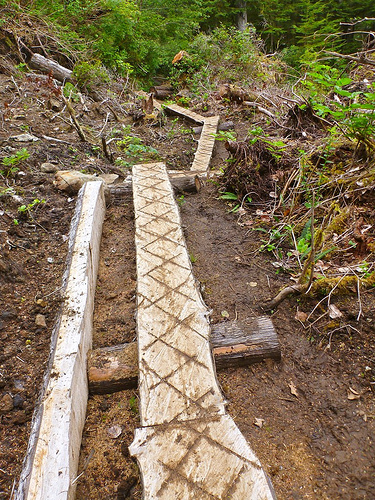
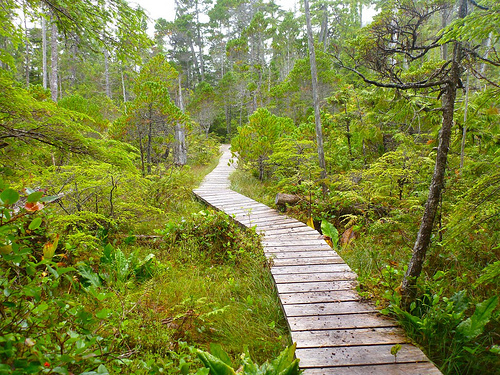
The only fun sections this day are new boardwalk, this being one of the best.
Plenty more construction material has been helicoptered in — with which to build more boardwalk. But I heard the budget had run out. Even with cash I’m not sure this stretch of trail will ever be worth hiking.
No sea views, a mud slog of 8.7km from Shushartie to Skinner Creek has little to commend itself. Avoid it if you can. It can take 9hrs or more for some groups!
… Yep. An hour / km. That’s dead slow.
That photo’s actually from the infamous South Coast Track in Tasmania. This hike rivals for infamy.
I’ll finish at Cape Scott Provincial Park, San Josef River trailhead. Returning to Port Hardy over 64km of logging roads by North Coast Trail Shuttle van.
… This is a very challenging route and is not recommended for inexperienced hikers. Many sections require hikers to climb over or along fallen trees, to cross through deep mud, and to use fixed ropes to climb up and over steep sections. It is not recommended for those with a fear of heights. …
… a wilderness area with minimal supplies or equipment of any kind. It is not regularly patrolled, so hikers should be completely self sufficient. …
























 besthike.com