Kraig Becker linked to a great contest for hikers:
Most hikers, trekkers, and backpackers have a particular trail that sticks out to them as being their favorite for one reason or another. Sometimes it’s the scenery or the wildlife they encounter along the way. Perhaps it’s the challenge or the solitude it provides. No matter what reason your favorite trail keeps you coming back, National Geographic Adventure wants to know about it.
The editors over at Adventure are compiling a list of their reader’s favorite trails for a feature on “America’s Best Hikes” which will be the cover story for the April issue that hits newsstands on March 18th. …
A review by Jeffrey Hunter convinced me to add a book to my “to read in 2008” list.
Let me start by saying that The Ordinary Adventurer” Hiking Vermont’s Long Trail; A Primer for Baby Adventurers and Other Musings on the Nature of Journey, is no ordinary book. It is a gem!
What makes this book such a fun read is Jan’s ability to capture the subtleties of the hiking experience. As an experienced backpacker, I could totally relate to the mental aspect of Jan’s hike. The frustration that can arise from poor weather, a stiff climb, or from a recalcitrant hiking partner (sorry Clyde). The splendor of being alone in the woods, lost in your thoughts, or listening to the ethereal song of the Hermit Thrush. The joy felt when the sun emerges from behind a cloud, or when a stranger offers you a cold beverage or a much needed ride to town. The satisfaction from realizing that you have accomplished a goal, such as climbing Mt. Mansfield, even though that goal seemed insurmountable only hours earlier.
…
When I finished the book last night, I was saddened to put it down.
The Curious Cat posted an excellent Photo Travelogue of his holiday. I love this succinct format for a trip report. One page with photo sets linked to thumbnails.
We’re always raving about the best multi-day hikes in Glacier. But most people prefer to hit the best day hikes, covering more territory by starting at a new trailhead each day.
I planned my hikes largely using Best Easy Day Hikes: Glacier National Park (which I recommend) and by talking to the rangers.
The first night I slept in the main lodge. I spent my first day in the Two Medicine Lake area and settled into the Swift Motor Lodge for 3 nights. I enjoyed ranger talks each evening in the Many Glaciers lodge. The second day I hiked in the Saint Mary Lake area (Piegen Pass). Day three I hiked Apikuni Falls. Day four I walked the Swiftcurrent Lake Trail and then a ranger lead hike to Redrock Falls.
Day five was a magical day. I started with a great ranger led hike to Iceberg Lake (I kept waiting for good weather which we finally got). Then I drove up to Waterton International Peace Park in Canada. The scenery at several overlooks on that drive were amazing. I then hiked the Bear’s Hump trail and stayed at the Prince of Wales Hotel which was quite nice.
Day six was great also. I drove back and hiked the Hidden Lake trail. Several days earlier I had driven to Logan Pass (where the trailhead is) and literally you could not see 15 feet in any direction. I ended up at the Lake McDonald Lodge (which is “just” a motel but with a view that is amazing. I read American Gods sitting on the balcony looking at at this view – incredible. A great way to end my stay.
Just learned that contributor Dave Hayley (who organized our Tombstone, Yukon hike last summer) is proposing to honeymoon on the JMT.
The ideal wedding present:
Jeff Alt convinced his wife (Beth), a woman raised with the belief that vacations include hot showers, beaches, and warm beds, to chuck her domesticated amenities and “Take a Hike†to help her overcome the loss of her brother.
Jeff had to spend quite a bit of time convincing Beth that the hike would be romantic, skillfully leaving out some minor details about the journey.
They walked the 218-mile John Muir Trail across California’s Sierra Nevada mountain range as a depression awareness campaign, carrying all their supplies on their backs and sleeping on the ground for weeks on end.
Istvan Hernadi has travelled over 30,000 kilometers in Northern BC, Yukon, NWT and Alaska during the last 3 years to the most remote and desolate places of the Far North in search of the Masters, in order to meet them and to learn their teachings.
He sought out mountains, trails, rivers and lakes for hiking, biking, and paddling his small Alpacka packraft. He met strange characters during his wild adventures, people who live amazing lives in these remote places.
Hiking holidays in Peru are hot right now. More popular than ever. Political stability since the leader of the Shining Path terrorist group was captured in 1992 resulted in a booming tourist industry.
The second highest mountain range on Earth is fantastic. Broad valleys and endless vistas. You are always above the tree line. Arid desert to the west, Amazon jungle to the east.
Our contributors have hiked most of the major treks in Peru the past few years. The peaks, glaciers and canyons are outrageous. Everyone is thrilled with the Andes.
Unfortunately, management of treks is atrocious, the Peruvian government seemingly bent on ruining their fantastic tourist draw. Do your homework before booking a flight to Lima. Or sign on with a trekking company with which you have had a strong, recent recommendation.
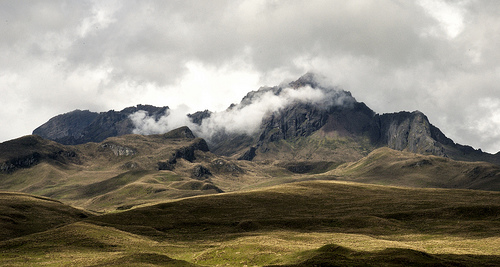
Ruminahui in Cotopaxi National Park, Ecuador
The weather in the Andes can be deadly, of course, but sometimes you get weeks of sunny blue skies, especially in the Cordillera Blanca out of Huaraz, Peru. The best weather for the high peaks out of Huaraz (the best jumping off point for hikers in the Central Andes) is the drier “Andean summer”: May-Sept.
In fact, there are good hikes somewhere in this region year round.
Our favourite hike in the Central Andes is the little known Ausangate Circuit in Peru, our #4 best hike in the world. Quite a few trekkers have decided on Ausangate (instead of the over-hyped Inca Trail) based on our recommendation. And all have been happy with that decision.
Note that Bolivia is not nearly as popular as it should be due to lack of infrastructure for tourism, security concerns and political instability. Honestly, unless you know the language and culture well, it’s better to hike Peru. Or much neglected Ecuador.
Patagonia is massive and bleak. Yet we love the Patagonian Andes, 2000km (1243mi) in length, but averaging less than 100km (62mi) in width. You could take years exploring just the eastward (drier) side of the mountains.
Towering granite peaks, untouched lakes, massive glaciers, huge volcano trekking peaks. This land is phenomenal.
Trekkers target five areas:
The Araucania
Lakes District
Central Patagonia
Southern Patagonia
Tierra del Fuego
Start in Mendoza, Argentina and visit the highest mountain outside Asia, Aconcagua. Next bus to the Switzerland of South America (Lake District). Some of the highest volcanoes of the world are here. Finally, work your way south by air and ferry to the granite spires at the south tip of the continent.
Trekking season here is Nov-Apr. (Feb-Mar often the best weather) That said, the wind and weather in Patagonia is notorious. Independent hikers need be prepared for anything and everything.
Conversational Spanish highly recommended for those travelling independently.
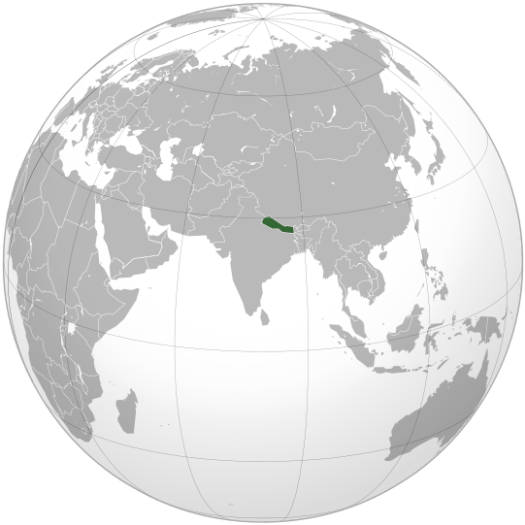
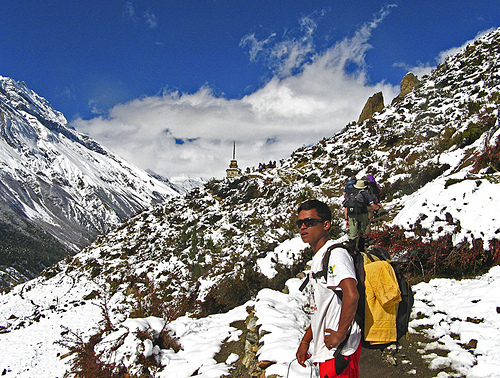
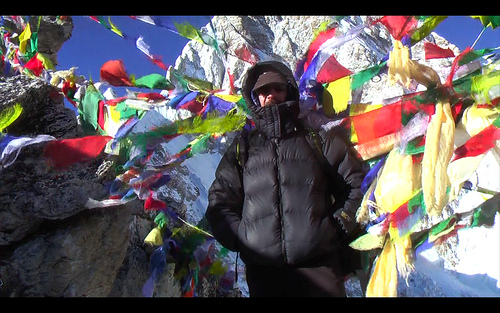
A trip to The Kingdom of Nepal may well be the best hiking holiday of your life.
It’s the abode of the Gods.
The exotic Buddhist and Hiindu culture is as fascinating as are the world’s highest peaks.
Most trekkers are set on Everest or Annapurna, but there are many other great choices, especially if you sign on with a trekking company that can get you into restricted areas like Mustang.
Tourism is important to the Nepalis. Foreign hikers feel welcome as soon as they arrive. And hiking in the world’s highest mountains can be “easy” on “tea house” treks where you stroll with just a day pack.
Or, if you want the full mountaineering experience, sidetrip up, up, up towards the clouds.
The weather and conditions are much milder than you might expect. Best months to trek are Oct-Nov (post-monsoon) and April-May (pre-monsoon).
Some feel Annapurna is in decline as roads and motor vehicles are degrading the Circuit. That won’t happen to the Mt. Everest region. Check out the Nov. 2009 16-day Everest trip report by besthike editor Rick McCharles.





 besthike.com