When I gave Dave my expedition hiking pack, I had no idea he was planning to become the next insane high altitude mountaineer.
Here’s his (lengthy) Mt Ranier trip report from this past weekend:
If I live to be 100, I may never see a better day to climb, especially on the fickle Mt. Rainier.
I had been looking forward to this weekend for a while – everyone normally “do stuff with” was out of town, and so i had noted this date on my calendar as a possibility for getting over and doing a “real” mountain. I had had no luck finding a climbing partner, and so, with a little bit of trepidation, I made the 6.5 hour drive toward Rainier on my own, with ever increasing clouds as I got closer.
Once at the Paradise visitor’s center/trailhead, I was amazed at how deserted it was… normally, on weekends and in the summer, this place is packed, but the climbing/hiking season didn’t actually open until the next day. …
The only folks in the lot were a group of back country skiers just finishing up their day, so I resigned myself to a solo climb, just as another car pulled in and parked two spaces over from me. The driver was a young man – Mark – originally from Columbia, who was also planning on heading up alone, so we joined forces, as the weather was looking sketchy at best – yes, I had stopped and asked at the ranger station, but Rainier is so big it creates its own weather, and as evening was falling, the clouds and snow were descending down from the summit, making the top invisible.We left Paradise and it’s 20 feet of snow at 4:40, headed toward Camp Muir, 4788 feet up the hill. The temp at Paradise was a balmy 34 degrees, but as the sun started setting, the temps dropped a bit… it was 4 degrees at Muir at 10,180 feet when we arrived.
The walk up was excellent, though difficult, and within a few hundred meters, we wished we had taken our snowshoes, as the snow at the bottom was both plentiful and soft, causing for more than 1 thigh deep posthole. To top off the start, the main buckle on my pack broke, and I was carrying 67 pounds, partly as I had team gear plus my own gear, and am training for a possible Denali bid next May…
Needless to say, my shoulders were beat up when we arrived at 9:30ish. We took a bit more of a difficult route up, through the Nisqually snowfield for the first half of the way. We had to deal with some patches of whiteout – about 15 feet visibility – before we joined back up with the main “highway” to Muir at the Muir snowfield, but luckily, the snow had consolidated only a mile above paradise, so walking was quite a bit easier from that point on.
The mountain is really just opening up for the season, so there was hardly anyone on the mountain, except a group of guides training out of Muir for next week’s opening, and a mother/son team descending from Muir. We made the almost 5000 feet in a little under five hours, despite weather and bad pack, so not bad time, really. Sunset on the way up was a bit ethereal, and a different look than other times I had seen it in the Cascades because of the clouds.
Now, Mark is only 29, compared to my 48, and a very lean, 145 pound (compared to my 185) 2:46 marathoner to boot. He also was going “light,” carrying more than 20 pounds less than I was, so the challenge bar had been set for me, and with the busted pack, the deep snow and his speed, it was all I had to sort of keep up.
With the temps being so low, we set up camp pretty quickly, cooked a quick meal and hit the sack around 11:00 pm, with the temps right around zero. It sounds cold, but with only two chemical warmers in my mittens, I was actually warm through the night, having tossed my space blanket over my regular bag, which was a bit crowded, with three water bottled, fuel canister, food bag etc. in there with me.
By 5:00 am the temp was a brisk minus 4, but as we got up a couple of things offset it: the sun was already up, the sky was completely clear as only a mountain sky can be, and most importantly, there wasn’t a single breath of wind, which for those of you who know the Cascades, is NOT an everyday thing… we were off to a promising start, though the weather can change in minutes, leaving you in a whiteout, so we still took precautions in our summit gear.
A jet-boiled oatmeal-and-craisins and liter of Crystallited water later, we were ready to head up the hill by just after 7:00. We opted for visibility for route finding over a normal “alpine” (Swiss for Bloody Early) start, and the temp was already up to 8 degrees, though it felt much warmer – we actually started out in short sleeves!
The guides were off somewhere (we didn’t see them up the hill at all – as a matter of fact, we didn’t see a single climber higher than Muir all day. They may have been over on the Ingraham Direct route, which is the most common and easiest route to the summit for most of the recreational climbers who will make a go at the 14,410 over the next few months).
Opting for fast and light, we went up with only the essentials, cutting our pack weight down to 30-35 pounds or so for summit day, so the trek was pretty manageable, even with a lot of snow and elevation.
The standard “easy” routes from Muir are the Ingraham Direct or Disappointment Cleaver routes, which don’t require any real climbing ability, though you will likely be roped up over the glacier, as crevasses are common, even early in the season. As a note, there are no real “easy” routes, as there are still 4,000 feet to climb – it’s more the level of technicality you want to embrace… this was NOT the easiest of routes/options, BTW, but we went with what we had, and with what the mountain gave us that day… summitting is optional, getting back down is mandatory, life insurance not withstanding.
Mark was a good climber, with a couple of other solo summits of Rainier on the ID/DC routes, and lots of playing on other approaches. Being up for a challenge (or just blissfully ignorant), after looking at the climbing guide – coincidentally, we were each carrying the same one – “Mt. Rainier – a climbing guide, by Mike Gauthier” – we decided on trying the Gibraltar Ledges route out of Muir, a fairly demanding test early in the season, and reasonably technical on its own. We opted for a standard ice axe, one trekking pole and one ice tool each, as well as crampons from the start, two pickets and a fair amount (we thought) of webbing, Purlon nylon cord and carabiners, though “enough” isn’t always enough, as it turned out…
From Camp Muir, instead of heading toward the Ingraham Flats, we turned west and basically climbed up the Cowlitz Cleaver – the long ridge of rocks in the picture – to the nose of Gibraltar Rock – the BIG rock near the top of the picture.
We took turns leading the various sections, with him leading the more technical rocky ascents, and me doing a lot of the kicking steps on the awesome snowfields.
After reaching the spire at the top, the guide book calls for heading left into what is called the Gibraltar Chute, and from there, up a 50 degree headwall to the summit plateau. Once we got to the top of the cleaver, we decided against heading into the Gib Chute, because the Nisqually glacier was calving off huge chunks every couple of minutes, and the Gib Chute passes within a few yards of the edge of the icefall. The avalanches were pretty spectacular, but when the guide book says “a quick traverse is essential for safety,” and we can see the house-sized ice blocks falling feet from where we would be, we had to come up with another plan… only problem was we were stuck on top of a ridge with a BIG drop to one side (say, 2000 feet onto the Nisqually), and a slightly more manageable one to the other, though it would be taking us in the wrong direction, still on the wrong – read “downhill” – side of the massive Gibraltar Rock.
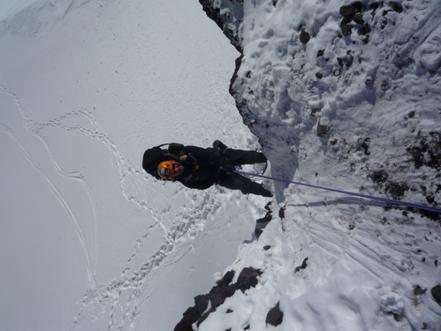
With no real option, we rappelled off the Spire at the top of Cowlitz Cleaver …
… made a fairly technical traverse over to Gibraltar itself, and descended maybe 300 feet down to a small gap (“small” is deceptive here, as the scale of things is so big… Rainier is a BIG hunk of rock!) where we were able to free climb over the 75 foot high gap, fashioning anchors from slings and carabiners, as we hadn’t brought any trad gear.
Hauling the packs was a challenge, especially since Mark led the climb with me belaying him through our makeshift anchors, and left his pack. Now I had my 35 pound pack, his 35 pound pack, and all of our ice tools and axes. FYI, free climbing raw, semi-icy rock isn’t my strongest ability. Luckily I had brought a BD ascender “on spec,” and was able to attach myself – and his pack – to the ascender, so every time I gained a few feet, I could haul his pack up beside/below me, and not lose it (other than the once before I figured this out, and only barely stopped it from sliding 1500 feet down a near-vertical snow face). Once I reached the last anchor, I was able to tie it to the loose end of our climbing rope and Mark hauled it the last 25 feet or so, leaving me to finish with just my own pack. There are advantages to being the bigger “pack mule” on the team, but this wasn’t one of them. 🙂
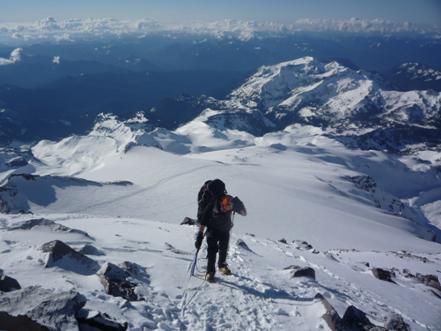
Once on top of Gibraltar, we were once again perched on a fairly thin plateau, with only one way to proceed. We set up our second rappel and descended off the big rock in 2 stages (it was longer than our 60 meter rope). Once on solid-though-really-slanted-ground, we traversed across the top of the glacier past Cadaver Gap, where we were able to join the standard route of the Ingraham Direct/Disappointment Cleaver route for the (relatively) easy hike to the summit at Columbia Crest – 14,410 feet. To be honest, after the journey, summitting was almost an after-thought – we were already thinking about trying something cool on the way back down…
So, on the way back down, with still a few extra hours of crystal clear, windless daylight left, and still feeling our oats, so to speak, instead of taking the recommended, standard route down the ID/DC route, we retraced our steps back to the top of Gibraltar, and then did five 60 meter running rappels off Gibraltar and down the 65 degree glacier/snowfield between Gibraltar and Cadaver Gap before walking it back out to Camp Muir – almost 1000 feet of rappelling/controled descent was a great way to finish up! After that, it was simply a matter of packing up camp and making the 4.5 mile descent back to Paradise.
If you don’t think Mountain School is worth it, we used literally every piece of equipment we had brought up, and ended up having to leave a few pieces of purlon and a picket on the hill as deadman anchors, but it was well worth it. More importantly, I used a TON of skills I learned through the Spokane Mountaineers, and, in all likelihood, couldn’t have completed this trip on the route we had chosen without them. We even ended up using a modified ice axe/boot belay at one point!
The sun was blazing all day, the temps were a perfect 28 degrees, so we were able to climb in short sleeves and light gloves. The biggest blessing was that for the entire day, there was NO wind, until we got almost all the way back down to Paradise, where the katabatic wind off the glacier helped push us the last couple of miles. I don’t know of anyway it could have been a better day to spend 11 hours on one of the world’s prettiest mountains.
We didn’t see a soul above Muir, though the trail from Paradise to Muir was now a super-highway of back country skiers/skinners, snowshoers, and hikers of all sorts. Muir really divides the mountain up – you need a climbing permit and gear if you’re really going to climb above Muir on the upper mountain, so many folks just do the Paradise-Muir hike as a day trip, with 99 out of 100 turning back there.
A few notes/equipment endorsements:
For the first time, I think I managed my food perfectly, finishing with just an emergency amount of food left. I was about one liter of fluid short, but that was manageable. Clothing/layering/temp control was spot on – never too hot, and, except for my hands on the initial walk into Muir, never too cold.
Some people are too “cool” to climb with helmets, even on the upper mountain. On the way out, I got hit in the head by a 6″ x 6″ by 2″ thick rock about 500 feet below Gib… the rock had rolled far enough to have picked up a bit of a covering of snow, but still hit me hard enough to BREAK my Black Diamond helmet and almost knock me off my anchor! Eyes were definitely watering for a few minutes, but the BD helmet literally saved my life. Don’t climb without a helmet!
My Rab shell and new Rab down jacket were AMAZING on the hike in and at camp, as were my Merrell pants. The Rab down is 800 weight, and yet fits inside its own breast pocket, and weighs perhaps 8 oz (!). Of course the Outdoor Research gaiters/gloves combo worked perfectly as always, and the BD “Serac” crampons were flawless on the snow, the ice and even on the rotten pumice and volcanic rock of the cleaver and Gib rock.
I used my Northface 4 season tent with fly at camp, and was WAY more comfortable than my climbing partner in his little one man bivvie tent, despite the extra couple of pounds… his was like climbing out of a wet cardboard box in the morning. The Jet boil worked well, especially since I kept the fuel warm, though I had my new 1.9 oz mini stove as a backup.
The only real sad note/disaster is that somewhere between the top of Gibraltar and Camp Muir on the way back, I lost my Garmin wrist GPS, as well as all the data on it. Boo. If anyone is heading up there in the next couple of weeks keep an eye out for it, will you? Better yet, call me and I’ll go with you!
The only other negative, as I mentioned, was that my Northface pack buckle broke just a few hundred meters from the parking lot, making the hike in rough, but I was able to MacGyver up something that worked for the summit day and the descent with duct tape and an extra buckle from another strap. Not ideal, but choices are slim at the top of the mountain until they open the REI/Starbucks up there…
In all, I would have to say that this was perhaps the best outdoor day I have ever had, and for those who know me, that’s saying something! The weather was PERFECT, the conditions of the snow were excellent, my new partner and I made a great team, and there were as many adrenaline-filled challenges and satisfying rushes of accomplishment as I could want… when we finally hit the parking lot and took our packs off for the last time, the feeling was almost ecstatic – exhausted but not spent, but mostly filled with the knowledge that we had done something that most wouldn’t/couldn’t… we had truly earned our merit badges for Rainier today… we agreed that it was a climb we would never forget, and left the mountain as more than friends.
Thanks for reading, and I hope you’ll want to get out and do your own adventure! And hey, if you need a partner…
Leave a comment if you want to contact Dave Adlard.
 besthike.com
Pretty damn amazing!!!!
Way to go Dave……
It is amazing….Dave adlard is climbing from mountains..But So exciting at down hills…May be it was good try for Dave adlard…