Best was The Adventure Blogger, Kraig Becker, giving us a nice shout out on his Gadling travel blog:
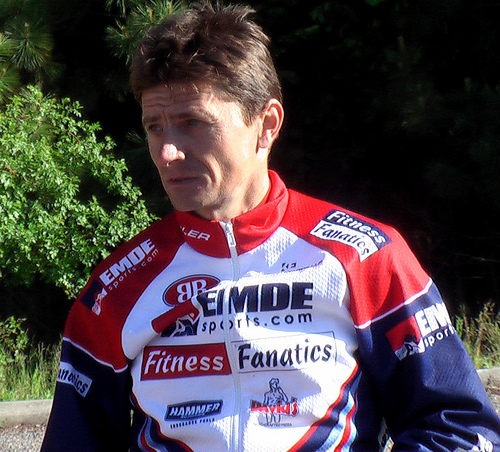
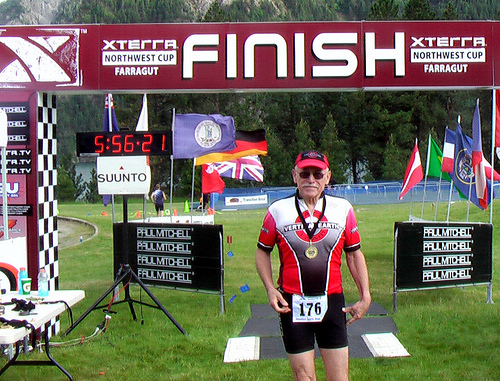
Coeur d’Alene, Idaho plays host to Adventure Sports Week 2009 , which got underway this past weekend in beautiful Farragut State Park, located just outside the mountain community. Hundreds of endurance athletes descended on the region to take part in the first time event, which is already becoming one of the premiere outdoor sporting competitions of the year.
Billed as “10 days, 24 races, 1 big party”, Adventure Sports Weekly has something to offer just about anyone who enjoys an outdoor athletic challenge. For instance, things kicked off this weekend with a triathlon clinic, and ramped up from there with two orienteering competitions, a pair of duathalons, and three triathalons, including an official XTERRA series event, which was won by Dan Hugo and Melanie McQuaid in the men’s and women’s categories respectively.
Things don’t slow down any next weekend either, when the adventure racers take center stage for the Crux and the Crucible races, both of which combine mountain biking, trekking/trail running, and kayaking, amongst other discplines. There will aslo be marathon and half-marathon length trail runs, a paddling race, and more. …
Want to see the highest and lowest elevations in the continental USA from one vantage?
Telescope Peak is the highest point within Death Valley National Park, in the US state of California. It is also the highest point of the Panamint Range, and lies in Inyo County. From atop this desert mountain one can see for over one hundred miles in many directions, including west to Mount Whitney, and east to Charleston Peak. The mountain was named for the great distance visible from the summit.
Telescope Peak is also notable for having one of the greatest vertical rises above local terrain of any mountain in the contiguous United States. Its summit rises 11,331 feet (3,478 m) above the floor of Death Valley (Badwater, -282 ft/-86 m) in about 15 miles (24 km), and about 10,000 feet (3,050 m) above the floor of Panamint Valley in about 8 miles (13 km). …
Hiking Telescope Peak by the normal route involves a 14 mile (23 km) round trip hike. The trail starts in the cool western part of Death Valley National Park at Mahogany Flat campground. The trail slowly winds itself up to the summit 7 miles (11 km) later at a steady gradient of roughly 8%. …
This superb, popular hike starts a few miles past the famed Charcoal Kilns.
The beehive shaped kilns were built in the 1870s to make charcoal for local mines. Here is the start of the Wildrose Peak Trail, a good alternative to Telescope.
Though often called “challenging”, I found this hike surprisingly easy. Weather is a big factor. And I tented one night rather than doing the entire big trip in one day as most do.
There are some pretty, rolling miles along a ridge walk. Some hikers do not make it to the top due to feeling ill effects from the 3000ft climb.
The lush high alpine contrasts starkly with bleak Death Valley below.
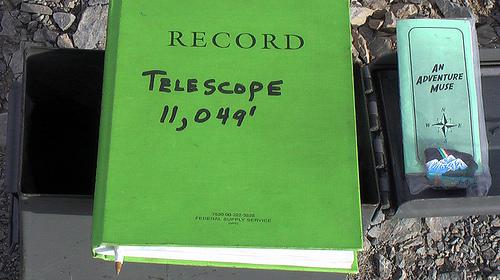
At the peak I found an impressive summit box. To the many souvenirs and prizes that had been contributed, I added a Summit Stone on behalf of artist DSD.
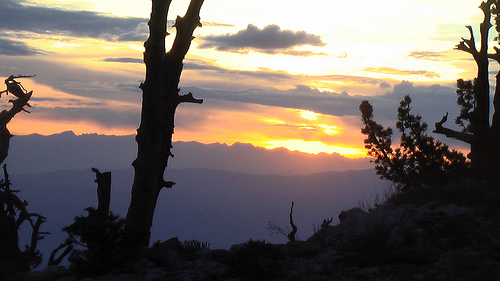
Here’s the sunset view from my campsite.
Mt Whitney and the Sierras
It’s normally snowed in between November and May. You can still hike, but bring crampons.
No hiking permit required. In fact, if driving in from Lone Pine, California in the Sierras, you won’t even be able to buy a Park Pass ($20 for 7-days) which is supposedly required to hike Telescope. This mountain is on the very edge of the Park.
Tom Harrison Maps are available. And several good guidebooks. But this hike is very straight forward. If you can find your way to the trailhead by personal vehicle, you won’t get lost on the trail.
=== Sound too easy? Consider this extreme alternative:
… An established, but more advanced, climbing route is from Shorty’s Well (elevation around -250′) to Telescope Peak. This provides a net gain of elevation of roughly 11,300 ft (3,400 m) The route follows Hanaupah Canyon for over 10 miles (16 km) until Hanaupah Springs is reached. This route can be done in one day by experienced hikers, and has one of the largest elevation gains that can be gained up a single summit. …
A few weeks ago – on my first day of mountain biking in the Rockies – I nearly rode into a big black bear on the main trail at Canmore Nordic Centre.
In 2009 are there more bears in the Rockies? Closer to people?
Or am I simply hearing about more bears? And more cougar encounters?
trailex.org tracks encounters and information about trail safety in the Bow Valley (from Banff to Bragg Creek).
That site was set up by the husband of Isabelle Dube who was killed by a grizzly near Canmore.
… Dube, 36, was jogging with two friends when they ran into a grizzly. She scrambled up a tree, but the bear chased after her and mauled the young mother, leading to her death.
She was the first person to be killed by a bear in Alberta since 1998. Since then, two more Albertans have been killed.
Robin Kochorek, a 31-year-old Calgarian, was killed by a male grizzly last July as she was mountain biking on a trail in the Panorama area near Invermere, B.C.
Don Allan Peters, 51, a father of two daughters, was mauled to death by a grizzly last November while he was hunting about 150 kilometres northwest of Calgary. …
Having grown up in bear country, I still sleep well in a tent in the Rockies. I really don’t worry about them.
Cougars are a greater danger. But those encounters much rarer.
My prediction: there will soon be a public backlash against bears near people areas in the Canadian Rockies.
UPDATE: 60-year-old trail runner, Thomas Nerison, of Kalispell, Montana, narrowly avoided serious damage when he was bitten by a Grizzly in Glacier National Park last Sunday.
The Outdoorzy Blog is now The Outpost. You can reach the site through the same url – blog.outdoorzy.com. We just gave the site a much needed face lift. The new format is organized way better and allows for more fun features such as polls and ratings.
We’re pretty stoked about the new layout and branding …
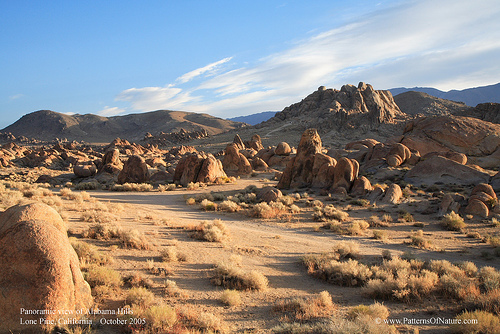
… The Alabama Hills are a popular location for television and movie productions (especially Westerns) set in an archetypical “rugged” environment. Since the early 1920s, 150 movies and about a dozen television shows have been filmed here … Gunga Din, Springfield Rifle, and How the West Was Won, as well as more recent productions such as Tremors and Joshua Tree…. In Gladiator, actor Russell Crowe rides a horse in front of the Alabamas, with Mount Whitney in the background, for a scene presumably set in Spain. Star Trek Generations was filmed here …. More recently, many parts of the film Ironman (film) were filmed here. …
I went to scramble the boulders at dusk. Gorgeous.
… There are two main types of rock exposed at Alabama Hills. One is an orange, drab weathered metamorphosed volcanic rock that is 150-200 million years old. The other type of rock exposed here is 90 million year old granite which weathers to potato-shaped large boulders, many of which stand on end due to spheroidal weathering acting on many nearly vertical joints in the rock. …
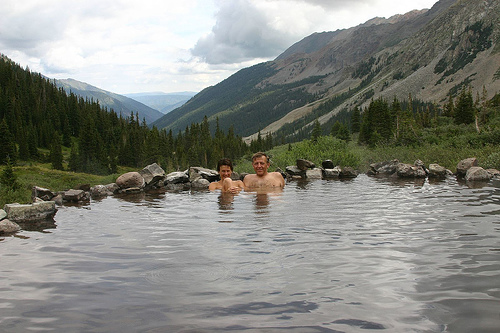
… Conundrum Hot Springs near Aspen is the type of place that spawns rumors. I had heard hippies clog the nine-mile trail to the springs.
I had been told the pools attract cliquey nudes who make fun of people in bathing suits.
Was the gossip true?
For nearly a year, I had been looking forward to finding out. I had visited several other hot springs in the area, but Conundrum was the Holy Grail of hot pots — a secluded bath in the Maroon Bells, reachable only by an 18-mile roundtrip backpacking trek. …
Most hikers feel it is too hot in June to do valley hikes safely.
Actually, 100 degrees in the shade and zero humidity is not all that uncomfortable. I took plenty of water. And I love these slot canyons.
Fall Canyon is one of many colorful ravines in the hills surrounding Death Valley in California; shaped by occasional flash floods that flow from the higher mountains beyond, the canyon is remote and little-visited; deep and moderately narrow for many miles, with occasional shaded, cave-like passageways of great beauty. Some of these narrow, twisting sections are enclosed by smooth granitic walls with an unusual bluish tint. As with most other Southwest canyons, the rocks are layered, but quite differently to the orderly slot canyons of Utah – here the strata are multi-colored, buckled, twisted and eroded, the result of ancient geological forces. Fall Canyon is easily reached and offers a perfect wilderness experience, though it should be avoided during the summer months when the weather becomes too extreme.
The highlight comes 2.8mi in when you reach this 20ft wall.
Actually, you’d be crazy to scale this wall without ropes.
Instead look for cairns on the right hand side of the cliff. They lead up to a relatively easy path up and over the obstacle.
The next half mile is the best section.
Location: Fall Canyon is located in the Grapevine Mountains, towards the less-traveled north end of Death Valley National Park. It is close to Titus Canyon, another colorful ravine that is popular because of the rough one-way track that extends through it – this is a 4WD route …
Iceland? The closest European land to North American shores is more like Halfpriceland these days. Its krona has plummeted against the dollar, bringing what was one of the most-expensive spots on Earth back down to affordable levels, and with travel deals ramping up for the summer season this is the best time in at least five years to take the short flight over to Reykjavik. …
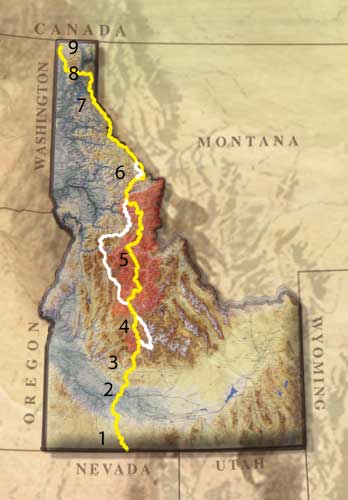
… Idaho Centennial Trail (ICT) is a scenic trail through Idaho. It winds its way through various ecosystems from high desert canyonlands in southern Idaho to wet mountain forests in Northern Idaho. ICT travelers will cross many mountains, streams and rivers in between. …
Depending on exact route, it could be anywhere from 900-1200mi long.
click for more maps
… The ICT was designated as the official state trail during Idaho’s Centennial year in 1990 by the Lasting Legacy Committee of the Idaho Centennial Commission. Since then the number of hikers completing the trail have remained low. …
On recommendation from Andy Howell, I listened to an audiocast on Practical Backpacking, an interview with Brian Frankle of ULA Packs. Brian described his own ICT from North to South.
He was happy to see few people on the Trail.
… In 1998 Stephen Stuebner’s Idaho Centennial Trail Guidebook was published. This guidebook, although well written is considered to be out of date by the Idaho Centennial Trail coordinator, Leo Hennessey. …
Idaho’s Centennial Trail is a work in progress. There are very few trail markings in the middle of the State. Route finding is essential.








 besthike.com