
Expect delays approving comments.
Bibbulmun Track trip report
Only about 500 people have completed the Bibbulmun Track, nearly 1000kms (620mi) from Kalamunda in the Perth Hills to Albany on the south coast of Western Australia.
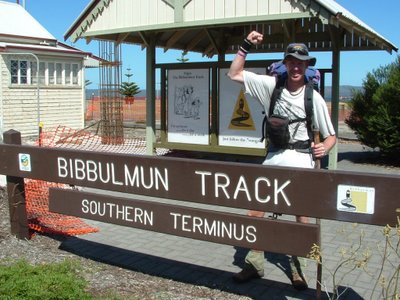
One of those is Dave Tomlinson who posted his 2007 trip report on Our Hiking Blog.
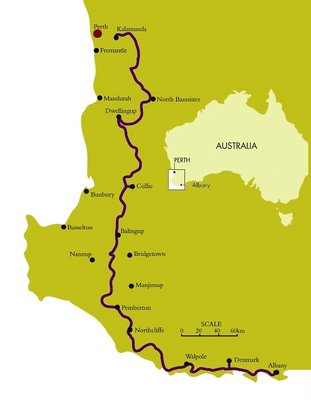
… When I reflect on the entire time I spent hiking the track, I think the first few days were the toughest of all. There is nothing quite like the challenge of carrying a heavy pack over difficult terrain in 40 degree heat. Although the track goes through eight towns, the first one is ten days from Perth. So, my pack was very heavy with supplies and I was stiff and sore during those initial stages. But as I progressed, my muscles began to get attuned to what was expected, my pack gradually lightened and things became easier. …

… Amazingly, I completed the whole distance without even a blister. Apart from some general soreness when I first started, I didn’t have any problems at all. There wasn’t a single day when I didn’t wake up and feel excited by what I was doing. Even on the most physically demanding days I embraced the challenge and never felt any doubt about reaching Albany in good health. The weather was generally very good and my Goretex jacket was often nothing more than my pillow at night. I only had rain on four days in the entire seven weeks. …
To learn more about this amazing tramp, here are the most important links:
» The Bibbulmun Track – a long distance hike – Trip Report – Part One
» Bibbulman Track – Southern Section – Trip Report – Part Two
» official website – Bibbulmun Track
Travels to the edge with Art Wolfe – Patagonia
GreatOutdoors.com recommended a PBS TV show called Travels to the edge with Art Wolfe.
Art Wolfe, an internationally acclaimed photographer, invites you to experience the world with him as he travels and photographs Patagonia, Peru, Bolivia, Alaska, Ethiopia, Madagascar, India and South Georgia Island. Watch in HD (high definition) as Art captures images of majestic glaciers, expansive deserts, teeming rainforests, remote mountain peaks, and exotic tribal gatherings right on location.
A wonderful sample of the program takes you to the rarely photographed North Face of Mt. Fitz Roy:
Click PLAY or watch a 7min introduction on YouTube.
more videos in higher resolution – Travels to the edge
research – health benefits of hiking
From an excellent article by hiking author John McKinney:
“Walk out the door and find good health. There is no fever that a 10-mile hike can’t cure,” suggests Garrison Keillor, the wry host of National Public Radio’s Prairie Home Companion.
Millions of Americans who like to hike believe that hiking contributes to good physical and mental health. And yet, until recently, nearly all evidence offered for the benefits of taking a hike was anecdotal, and very little hiking-specific scientific research supported that belief.

In 2004, Austrian researchers announced the results of an intriguing study demonstrating that different types of hiking have different influences on the fats and sugars in the blood. For the study, one group hiked up a ski resort mountain in the Alps and descended by cable car, while the other group rode the cable car up and hiked down. After two months of hiking, the groups switched hiking programs and repeated the experiment.
As expected, hiking uphill proved to be a great workout and provided measurable health benefits. Unexpectedly, researchers from the Vorarlberg Institute for Vascular Investigation and Treatment discovered that hiking downhill also has unique benefits.
Both uphill and downhill hiking reduced LDL (“bad”) cholesterol. Only hiking uphill reduced triglyceride levels. The study’s surprise finding was that hiking downhill was nearly twice as effective as uphill hiking at removing blood sugars and improving glucose tolerance. A second study of uphill/downhill hiking was conducted this summer, but results have yet to be announced.
… read more – Miller-McCune – For Good Health: Take a Hike!
(via Backpacker)
South Coast Track, Tasmania photos
No question. The South Coast Track is one of the best, most adventurous treks in the world.
Anne Stockley posted a comprehensive set of photos that lay out the highlights and challenges.

She was lucky to get some sunshine. Some blue sky!
The weather in Tasmania is the great concern. You can get stuck in mud like this.

To see her photos in higher resolution, click through to Pbase – Flight to Melaleuca and follow the links. Click SLIDESHOW on each page.

Want to plan a trip to Tas for yourself?
Check the besthike South Coast Track information page.
Alternative Treks to the Inca Trail
That’s the title of a post by Kraig Becker on my favourite travel site, Gadling.

The Inca Trail, one of the best known and most popular treks anywhere in the world, culminating with hikers arriving at Machu Picchu following a stunning four day journey through the Andes. Unfortunately the popularity of the trail is also one of its drawbacks, with literally hundreds flocking to it on a daily basis during the high season. Those crowds can deminish the experience for those who prefer solitude on their adventures.
Fortunately, there are some excellent alternatives to the Inca Trail that offer more challenging hikes, little to no traffic, and scenery seen by only a select few. Here are three of the very best of those alternatives:
Salcantay Trail Choquequiro Cordillera Huayhuash Gadling – Alternative Treks to the Inca Trail
Click through for details on each.
Our own list of best hikes in Peru:
* Ausangate Circuit
* Huayhuash Circuit
* Alpamayo
* Santa Cruz Trek
* Inca Trail
* Salcantay to Machu Picchu
* Choquiquirao to Machu Picchu
* Ticlla Circuit
* Colca Canyon
* Misti
* Gran Vilaya (Kuelap)
our best hikes in the Central Andes page
Ausangate and Huayhuash are the best for hard core hikers willing to trek at high altitude. The Inca Trail is often a disappointment to serious hikers.

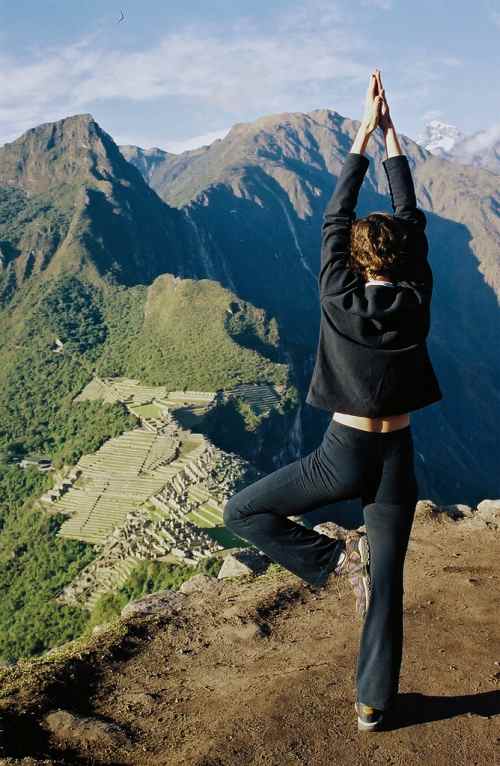
You can always visit the famous ruins by train, a wonderful trip on its own.
testing …
I am experimenting with moving my besthike.com/blog/ website from Bluehost to WordPress.com
If it works, this will be the new home of the blog. Bluehost will continue to host the besthike site.
hiking popular in Norway
I keep hearing that hiking is getting less popular in North America.
Not so in Norway:
… the Norwegian Trekking Association has 222,291 members. Around 7000 of these joined this year, an increase of 3.6 percent compared to last year.
A trend?
Head of communications at DNT, Merete Habberstad speculates as to why membership keeps increasing:
“It may have something to do with the current situation, I don’t know. However, in the past we’ve seen that times of financial troubles have given our organisation more members,†Habbarstad says.

All-time growth for Trekking Association
related article: When the going gets tough, Norway’s ‘tough’ go hiking
what is Paddle Surfing?
Stand Up Paddle Surfing A.K.A. Beach Boy Style Surfing.
It was amazing to me how many people were carrying paddles on their surfboards in Kauai, Hawaii.
Sadly I did not meet Crystal when I was there.

(via wicked outdoorsy)
pine beetle infestation
A mountain pine beetle infestation has already killed off billions of trees in British Columbia, Canada.
The mountain pine beetle epidemic in British Columbia is coming to a close, but only because the pests are running out of food, a forestry representative says.
The latest figures from the B.C. government and the Council of Forest Industries estimate the beetles have infested more than half of B.C.’s marketable pine forest. …
In 1998 there were only a few infected trees in my Province, Alberta. It’s a big problem here today as the beetles move in from BC.
The beetles kill the trees by boring through the bark into the phloem layer on which they feed and in which eggs are laid. Pioneer female beetles initiate attacks, and produce pheromones which attract other beetles and results in mass attack.
The trees respond to attack by increasing their resin output in order to discourage or kill the beetles, but the beetles carry blue stain fungi which, if established, will block the tree resin response. Over time (usually within 2 weeks of attack), the trees are overwhelmed as the phloem layer is damaged enough to cut off the flow of water and nutrients.
In the end, the trees starve to death, and the damage can be easily seen even from the air in the form of reddened needles. Entire groves of trees after an outbreak will appear reddish for this reason. Usually older trees die faster. After particularly long and hot summers mountain pine beetle population can get out of hand and that’s when there starts to be a problem. There are too many beetles and they start killing off big areas of trees.

Prince George, British Columbia – dead and dying trees – flickr – D&J Huber
Is there any hope?
I don’t know. I would think some predator would take an advantage of the infestation.
Cold winters can stifle infestations. But we’ve had record warm winters of late where I live. (A cold snap we had in 2008 might help.)
Rocky Mountain National Park in Colorado used selective burning to try to stem the beetles.
Alberta is trying some preemptive prescribed burns. Others regions are clear cutting though there’s very little demand for the wood.

