
The High Coast (Swedish: Höga kusten) is a part of the coast of Sweden on the Gulf of Bothnia …
… since the last ice age the land has risen 800m, which accounts for the unusual landscape with tall cliff formations. The High Coast is part of the Swedish/Finnish High Coast/Kvarken Archipelago world heritage site (the High Coast was extended with Finnish Kvarken areas in 2006). …
The Höga Kustenleden is a 128 kilometer long trail along the High Coast. …
Hiking in Finland has a superb trip report of a late Autumn adventure:
The scenic trail passes through villages & towns, along the coast, through the forest and a beautiful National Park and if you have a free week makes for a great walk along the Swedish coastal hills. …
Högakustenleden – the High Coast Trail
Beautiful photos. 🙂
Click PLAY or watch a 3min clip taken during milder weather on YouTube.
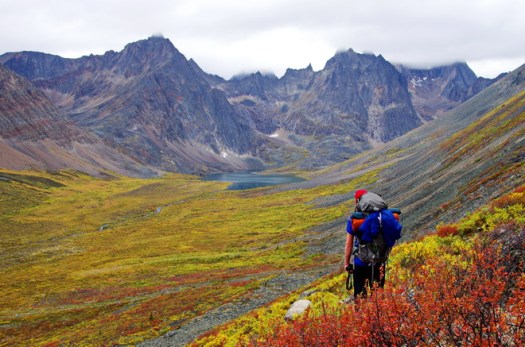
If you’re looking for world-class mountain scenery, in an area that doesn’t get a lot of attention, then head to the Tombstone Mountain Range in the Yukon Territory. Starting at KM 58.5 on the Dempster Highway, the three to five day backpacking trip takes you first to Grizzly Lake, and then to Divide and Talus Lakes. It’s a wild, desolate, truly memorable landscape. …
The landscape though, is extraordinary – and I can safely say like nowhere else you’ve seen.
Try to arrange your trip for late August when the boreal forest and alpine meadows combine to deliver a rainbow of fall colours. But go prepared for cold temperatures and snow. I had both. …
Photographers know that some of the BEST photos from the developing World are of local people.
I’m always reluctant to ask to take these kinds of photos, but Joshua and Nadine have been living in rural Africa the past two years. They have a good feel for whom to ask, whom to leave alone. Here are a few of their photos from our hike in the Ethiopian highlands.
There seems to be some invisible line off the hiking trail behind which the kids must stay.
I hiked the Simien mountains in northern Ethiopia with Joshua and Nadine from Edmonton. They are nurses living in Africa for the past 2 years, putting together a rural Health Clinic in Burundi.
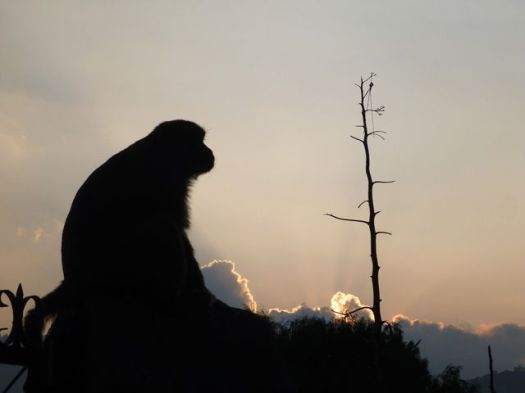
The biggest highlight was hanging out with Geladas, the friendliest simians anywhere.
Geladas are found only in the high grassland of the deep gorges of the central Ethiopian plateau. They live in elevations 1,800–4,400 m above sea level, using the cliffs for sleeping and montane grasslands for foraging. …
Geladas are the only primates that are primarily graminivores and grazers – grass blades make up to 90% of their diet. They eat both the blades and the seeds of grasses. …
Geladas are primarily diurnal. At night, they sleep on the ledges of cliffs. At sunrise, they leave the cliffs and travel to the tops of the plateaus to feed and socialize …
The gelada is large and robust. It is covered with buff to dark brown, coarse hair and has a dark face with pale eyelids. Its arms and feet are nearly black. Its short tail ends in a tuft of hair …
… males average 18.5 kg (40.8 lb) while females are smaller, averaging 11 kg (24.3 lb). …
The gelada has a unique gait, known as the shuffle gait, that it uses when feeding. It squats bipedally and moves by sliding its feet without changing its posture. …
Protected and not endangered, these grass eaters are comfortable with people coming close. A few of the curious babies reached out and almost touched us.
In 2008, the IUCN assessed the gelada as Least Concern, although their population had reduced from an estimated 440,000 in the 1970s to around 200,000 in 2008.
Most hikers approach from the Taylor Meadows campground to the south near Garibaldi Lake, although there is a second route from the north that travels by way of Helm Lake. …
Locals advised me to avoid the crowded trailhead off the highway, and hike via the Helm Creek Trail instead. That’s the Cheakamus Lake trailhead, closer to Whistler.
I bought my $10 / person / night camping permitonline from BC Parks. You can pay cash at a machine only at the Diamond Head and Garibaldi Lake parking lots, not at the Cheakamus Lake parking lot.
Why doesn’t BC Parks have an office somewhere near Whistler?
Cheakamus Lake to Black Tusk Meadows via Helm Creek:
• Length, 14.5 km; suggested time, 6 to 7 hours one way;
• elevation change, 600 metres.
• 1.5 km along the Cheakamus Lake trail, drop down to a bridge across the Cheakamus River.
On the other side of the river the trail switchbacks upward steeply to the Helm Creek Campground.
I carried on to gorgeous Black Tusk Meadows.
Hikers coming down from the south summit told me it was too late in the day for me to start up.
After weighing my options (I was carrying a head lamp) I finally decided to wander the meadows, instead.
It turned out to be a leisurely night.
Next morning I turned my back on Black Tusk and headed back down to my car.
I had time for a sidetrip to pretty Cheakamus Lake via lush temperate rain forest.
Black Tusk is off limits to mountain bikes, but the ride to this lake is superb.
All in all, a wonderful 2-day hike.
If I had one more day I would have done the 34km route Helm Creek, Panorama Ridge and Black Tusk shoulder detailed in this 9min video.