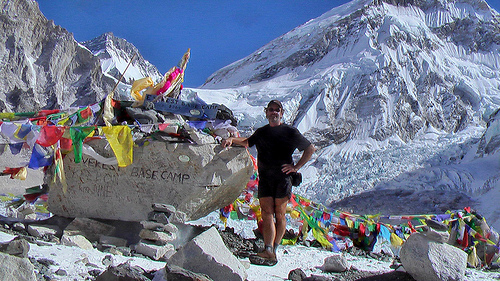
Sadly, there were very few tents at Base Camp 5360m (17,600 ft). But they set up as close as they can get to the Khumbu Ice Fall.
As I’d often heard, it’s a God Awful place to camp. It must take forever to build new tent platforms each season.
The weather was superb. Above freezing, the glacier collapsing upon itself with melt.
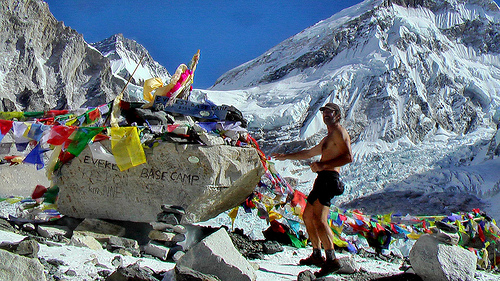
Some hiker goofing at the entrance sign …
Later I learned that nudity is not allowed near sacred mountains. Israelis who hiked nude over the Thorong La on the Annapurna Circuit were fined $100ea and had their camera SD cards confiscated.
I didn’t linger long as I proposed to backtrack same day all the way to Dingboche. For the first time I could hike as far as I wanted as I would finally be losing elevation.
hiking counter clockwise
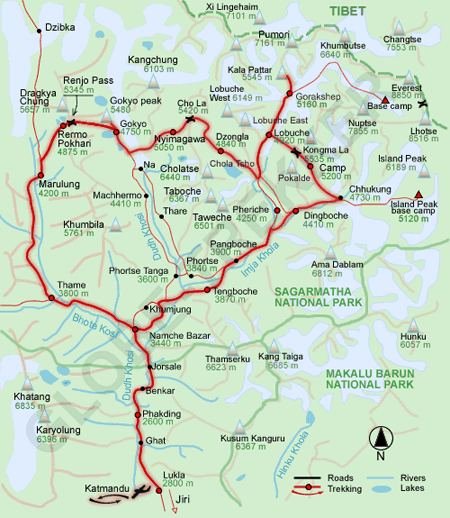
From Dingboche I could resume the Three Passes of Everest itinerary, via Kongma La. This perfect weather was an incentive to hurry.
The only sidetrip on the decent was to checkout the “Italian Pyramid“, a high altitude scientific research station.
It was dark by the time I reached Dingboche. But with every step I felt, psychologically, that the air was more oxygen rich!
It might have been a mistake to tent at 4800m (15,750ft). I was 12hrs huddling, full clothed, in the sleeping bag with my electronics. (Freezing the batteries would kill them.)
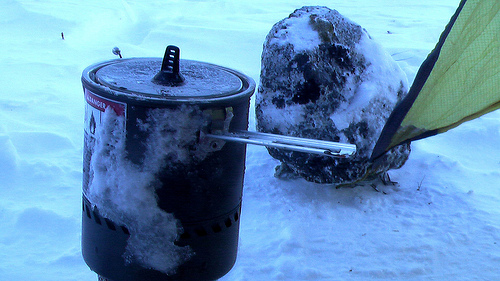
Next morning neither of my lighters wanted to function. My boots and stove were frozen solid.
After much fussing, I finally managed to light the stove … to unthaw my boots enough to get my feet into them. Yeesh!
Fact is, I’m one of the only independent hikers carrying a tent. (People thought I was crazy to carry the weight when rooms cost less than $3 and restaurants are available every hour along the main trails.)
But I enjoy sleeping in a tent. You feel much more connected with the mountains.
Happily the morning dawned sunny, cold and clear.
Everyone had the same idea … RUSH to Everest to see the summit in good weather. The world’s highest mountain’s notoriously hostile microclimate oft has the peak in cloud. It had been shrouded for at least the past week.
But for me that would mean over 800m elevation gain in one day. Risky.
hmmm … I decided to go for it.
Gorak Shep 5164m (translation Dead Ravens) is the last village before Mt Everest.
I’d heard some bad things about these remote guest houses. But I loved the outpost. One of my favourite stops on the entire trek.
After lunch I psyched up for the 2hr climb up this deceptively easy looking “hill”, Kala Patthar. 5643m (18,513ft). It has a couple of false summits.
Kala Patthar as seen from Gorek Shep
The intimidating mountain in the background is Pumori 7161m (23,494 ft).
Most agree that the best viewpoint of Mt Everest from the south is from the brown top of that lump. That said, there truly are no great hiking trail vistas of Everest from the south. All it’s neighbours look higher and more impressive.
As usual, it was very windy at the top of Kala Patthar.
But I was thrilled to have made it here with such good visibility.
Rick and Mt. Everest
Everyone was thankful we had been so “lucky” with the weather.
At this point I felt my trek had already been a “success”. The rest would be bonus.
At first light, outside my window, I saw white stuff piled up on the Yaks. An early snowfall, not all that unusual in November.
Instantly I thought of the November 1995 freak snow storm where dozens (46 some say) of hikers, porters and guides were killed throughout the Himalaya, most by avalanche.
At breakfast that morning, after consulting with guides and hikers who had been there, I decided it might be too dangerous to cross the Kongma La 5535m (18,159ft) after a new snowfall. Instead I would head directly to Mt. Everest base camp skipping the recommended acclimatization day. I felt good aside from the lack of sleep.
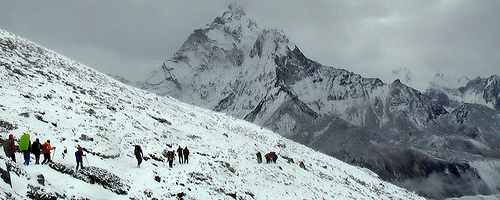
As a Canadian, I had no fear of this light snowfall. In fact, it turned out to be the most beautiful day of the trek.
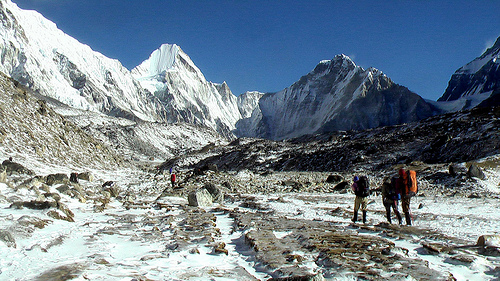
The bleak, dry terrain was suddenly magical.
The highlight of a wonderfully scenic day was the shrine of Babu Chiri Sherpa at what some call Dughla Pass.
… With ten Everest Summits (including 4 North Side summits), many considered Babu Chiri Sherpa the strongest climber on Everest. …
Babu Chiri Sherpa passed away after unexpectedly falling into a crevasse at Camp II at 1600 hrs on 29 April 2001. …
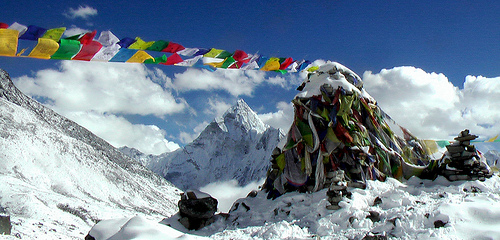
I left a Summit Stone there in tribute to him and all the Sherpas who have died over the years.
I was very happy to finally catch up with Ping and Shirley from New York.
Ping and RickShirley
We had flown in and walked together the first day. Due to my altitude sickness I fell behind day 2. Ping and Shirley had only a 2 week holiday to try for Everest and Gokyo. (Short holidays is one of the reasons there are surprisingly few Americans trekking Nepal. You’ll meet more Canadians though Canada has one tenth the population.)
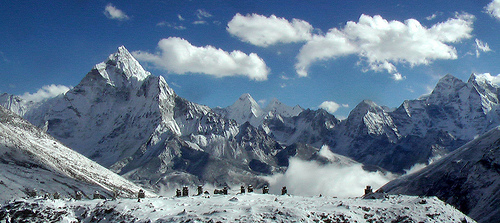
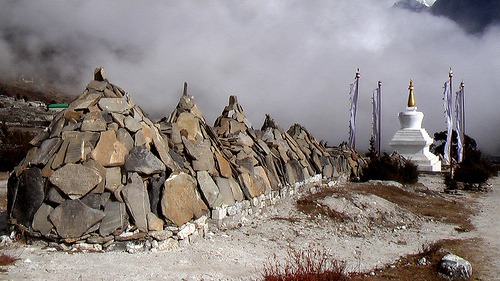
I was so inspired by this beautiful and spiritual place that I decided to pitch my tent right there in the snow amongst the hundreds of shrines to fallen climbers.
I wanted to see sunset from this vantage. Here’s last light as seen from my tent.
Just before dark, the previous evening, I found a perfect tent site by a waterfall just above this bridge.
Wild camping is not illegal in the National Park. But it’s best to be discrete.
Feeling good, I decided to climb all the way to Dingboche at about 4,530m (14,800 ft). Likely I’d need a rest day there doing one or the other of a couple of different side trip options.
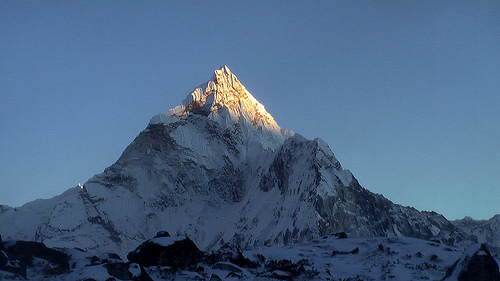
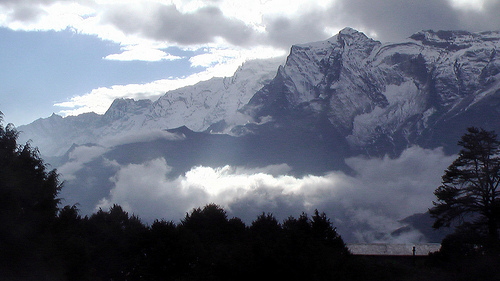
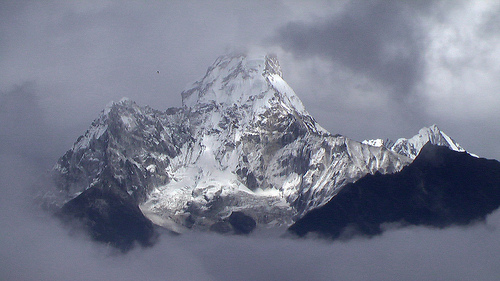
Ama Dablam began to loom large.
The trees were gone. Increasingly the scenery became bleaker.
Though nobody ever seemed to mention it, we were disappointed with the weather. In November it should be sunny, clear and cold.
I was psyched, however, upon reaching Dingboche, a memorable village. This is the jumping off point for the excellent Island Peak climb, by far the most popular of the trekking peaks.
The biggest change I found from my last trip to Nepal 11ys ago is mobile phones. All guides and lodges have them. Some European hikers had phones. And phones seem to work almost anywhere.
At first put off by telephone contact in the “wilderness”, I quickly realized what a life saver they must be. Literally. Lives have been saved, I’m sure, by communication.
The second biggest change is that internet has arrived over the past few years. Here is the highest internet cafe in the world.
Actually it was the highest in the world. The owner recently put one laptop and a connection at Gorak Shep 5,164m, right on the doorstep of Mt. Everest.
I took every opportunity to post online my exact whereabouts, as a safety precaution.
Here are the Yaks coming home to my Guest House after a day of grazing barren hills late in the season. I ate much better than the Yaks that day. In fact, I took the ultimate Himalayan culinary challenge … I ordered Yak steak. (Eating meat is strongly discouraged by every guidebook.)
I turned out to be fine. … But I never ordered meat again for the rest of the trip.
Namche Bazaar is the last village of (comparative) civilization before the high Himalaya. My batteries were literally and figuratively recharged after a rest day there.
Almost all hikers leaving Namche head towards Tengboche 3,867m (12,687 ft).
hiking counter clockwise
I did, as well, intending to do the Three Passes of Everest trek, a relatively new itinerary. It’s basically a big lollypop loop hike as shown in red above.
Tengboche is not all that difficult a hiking day as the gain in altitude is reasonable. But the scenery quickly becomes more dramatic. Meet Ama Dablam, soon to become my favourite mountain in the region.
Many guest houses sell “hot showers” for about $3. That gets you 20 liters of solar heated luke warm water. I washed, instead, as do the Nepalis, in a freezing mountain spring or from a standing tap.
The mountain women all have lovely, thick long hair. But washing it and staving off lice is challenging.
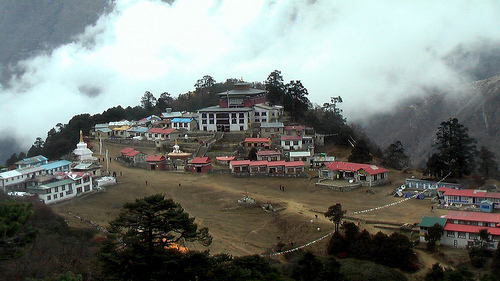
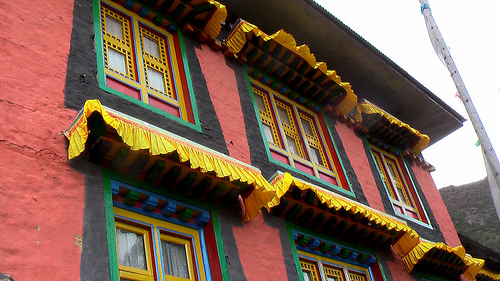
Tengboche is a popular stop because of the famed Buddhist monastery, the largest in the Khumbu region. It was rebuilt after a fire in 1989.
I love these colourful monasteries having visited dozens in Tibet 11yrs ago.
But the highlight for me that day was meeting a Sherpa who had 5 times been to the summit of Everest working for Russell Brice of Chamonix Experience. He shared great stories with tourists and monks, there as a guest for a big Puja. High altitude Sherpas are wealthy celebrities in the Khumbu.
Rarely can I pass by any bakery. The one in Tengboche is particularly good.
I was tempted to set up the tent. It’s a charming place.
… But with a couple of hours of daylight remaining, I decided to gain another couple of hundred metres. Altitude and attitude are everything when trekking up to Everest.
If you feel ill, stop. If you feel good, climb higher. As an independent hiker, I had this option. I was not bound by the itinerary of any group. In fact, most hikers stricken with altitude sickness are in groups, denying illness, trying to keep up.
Acclimatization day trekking around Namche Bazaar.
Gorgeous.
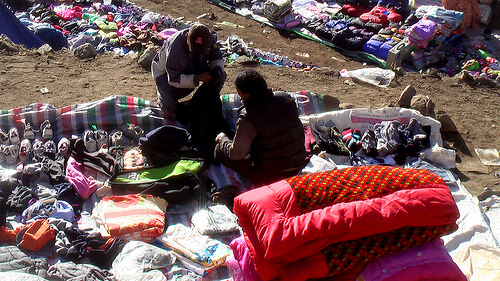
I was there for the famed Saturday Market. Cheap goods from China were being hawked by colourful Tibetan traders in the main market ground.
… But it seemed to me that there was no difference between Saturday and every other day of the week. The Tibetans were camped out semi-permanently while I was there. (They did a lot of drinking on the Friday night.)
A secondary local market was open Saturday morning, mainly Nepalis selling food stuffs.
I toured fascinating Namche town first. The small Buddhist gompa is lovely.
Next I did an acclimatization hike called Sherpa Villages of Khumbu. (4hrs)
It started with an off-trail scramble up to the quarries of Zarok. Weird and beautiful.
I was keen to see the seldom used airfield above town built specifically for the ill-fated Everest View Hotel. This Japanese project proposed to fly guests into this airstrip at 3800m directly from Kathmandu, using pressurised rooms and piped oxygen to combat altitude sickness. The Hotel was open, but I didn’t see many guests.
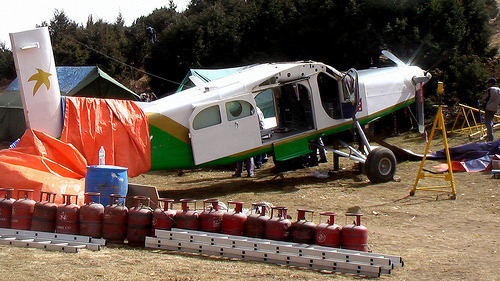
Surprisingly, a plane flew in to the Shyangboche airstrip. It unloaded everything, even the wings.
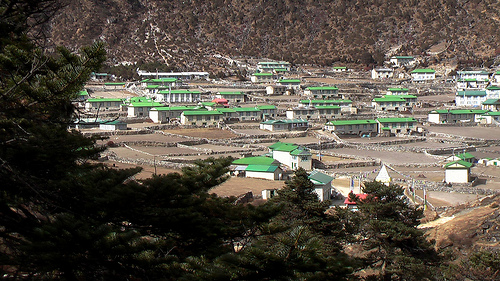
Climbing over a ridge I came upon one of the cleanest, best organized villages in the Khumbu.
Khunde and neighbouring Khumjung were by far the least littered towns I saw. Perhaps it’s the influence of Sir Edmund’s school.
All-in-all this rest day was one of the very best of the entire trip.
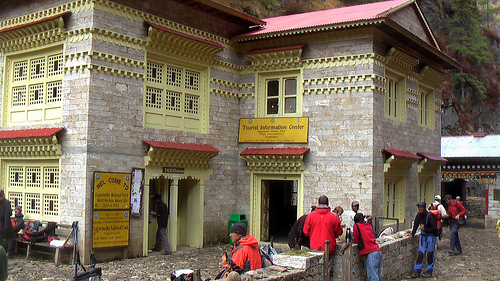
Here you must sign-in if you are hiking independently, showing your TIMS (Trekking Information Management System) card. And also your (US$13.50) Park entry fee.
I got mine in Kathmandu in advance. But you could get both at the Park entrance, as well. (So long as you remembered to bring 2 passport size photos with you.)
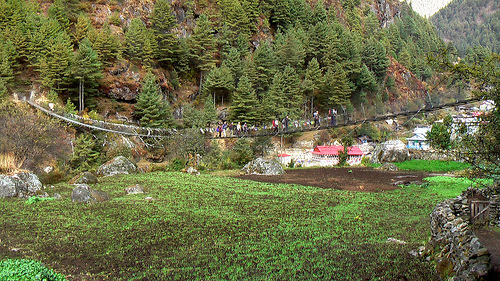
At the Park entrance begins a series of suspension bridges, the topography much more rugged.
It was explained to me that the Maoists never have bothered trekkers much in the Everest region because this one entrance can be so easily policed.
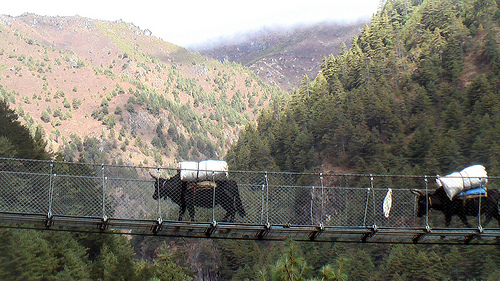
This section of the trail is crowded and dusty. Best not cross a bridge if you see pack animals coming from the other direction.
Actually, the porters can knock you to the ground, as well. They have limited visibility.
Despite bridge delays, I was psyched to get to Namche. And it did not disappoint. One of the great hiker’s towns in the world.
Here’s the vista from my $3 room.
Finally I felt I was on the way to Mt. Everest. Namche is “the gateway to the high Himalaya”.
On the other hand, while I was there posters were up for a missing Russian trekker. And a missing Chinese trekker.
The majority of hikers in the Everest region hire a guide, porter(s) and/or pack animals.
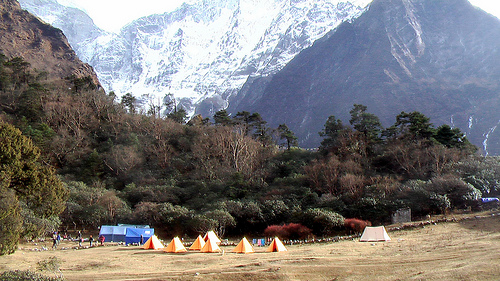
group tent camp
But there are many, many hiking independently. And solo. I feel Nepal is one of the safest places to hike solo anywhere in the world. I met many women traveling solo.
The trails are packed with people! It’s difficult to ever find yourself alone on a trail.
Certainly independent hikers are experienced. They know what they are doing. Have proper gear. And carry a good guidebook.
… No independent hiker takes a suitcase with wheels to Mt. Everest.
Still feeling fatigued, I didn’t go far day 2. I set up camp early afternoon on a sand bank on a side stream, the Monjo Khola. And enjoyed a day hike up the side valley away from the crowds on the main trail. A rough trail leads to Kusum Kangru base camp, the most difficult of the Nepal trekking peaks.
It was an early night reading the one novel I carried up to the mountains. (And later listening to audio books on my two iPods.)
By late evening my stomach was feeling better. I was getting acclimatized.
Trip Report – Picos de Europa Circuit – by site editor Rick McCharles
By morning I had no water. Looking up, my prospects for H2O did not look good.
Though my guidebook said I could find water in two places in the next few hours, I was not confident. This late in the season I might need to climb up high enough to melt snow.
I passed one trickle. Then – finally – saw a sign that I might find a spring.
Before I found the man-made spigot, I was approached by an exhausted looking Spanish mountain climber. He and his partner had gotten lost the previous day near the summit. And were forced to bivouac overnight. They had just gotten back to their tent.
He showed me the water source (about 1hr to fill a 1 litre bottle) and gave me detailed advice on how not to get lost on the next section.
Very quickly I was lost. His advice was all wrong.
Having climbed far too high, I arrived at another of the mountaineering base camps. Instead of retreating, however, I waited for a climber who was descending rapidly from the summit.
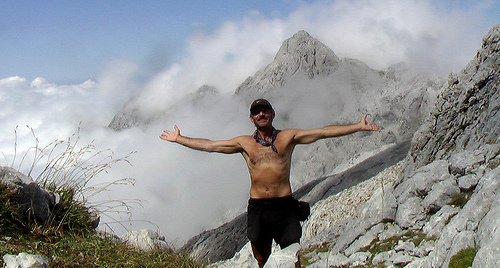
lost but elated
It was Constant, an adventurer from France. He was just as lost as I, … but had a vague idea of how to exit the base camp. And a wonderfully relaxed world view. His topo map did us no good at all. You need a topo and a GPS in these mountains.
I followed him directly to “civilization”.
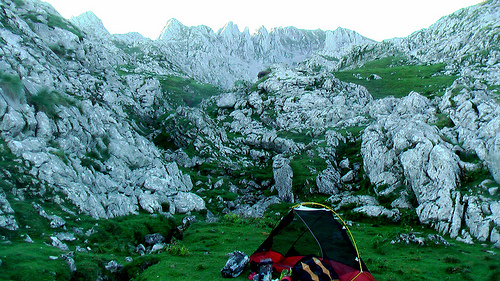
Because of the water supply, I decided to camp (for once) close to the Vegarredonada refugio.
Here’s the bizarre old refugio, no longer used.
Everyone takes an obligatory 7.5km side trip to the old, old refugio at Mirador de Ordiales, guarded by this calf when I visited.
Here is Pedro Pidal’s (1870-1933) final resting place. He founded this, the first National Park in Spain and was named Commissioner General of National Parks.
…. Eight years after his death, his final wish – to be buried at this natural balcony – was fullfilled at last. Engraved in a nearlby rock are words he wrote:
Lover of the Picos, I would love to live, die and eternally rest here in Ordiales. In the enchanted kingdom of the chamois and the eagles.
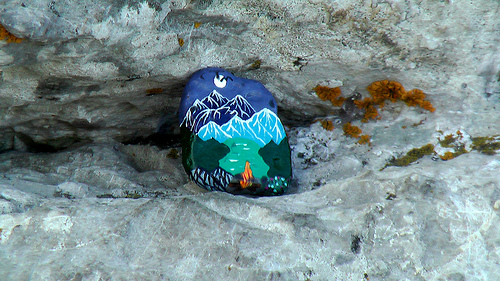
I left a Summit Stone with Pedro, placing it carefully between the stones close to the ground.
Somehow Pedro grabbed it from my fingers, pulling it deep into a crack. I guess he wants to keep it for himself.
My view of the famous vista was obscured. Again. By cloud.
My last night in the wonderful Picos de Europa.
I was truly sorry to leave these mountains. This is a brilliant hike, one of the very best in the world.






















 besthike.com