Bookings are now open for a guided hike of the first 11 days of the proposed route, one that will eventually require 48 days, 650km.
4 October – 15 October 2010
11 October – 22 October 2010
18 October – 29 October 2010
Be a trail blazer.
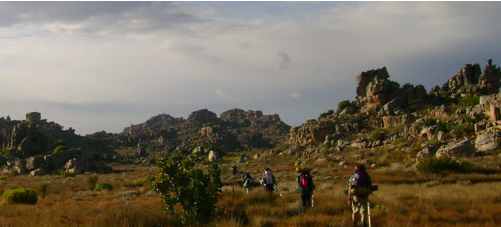
… We have opened the first stage of the hike, consisting of 11 days. You will be hiking through mountain wilderness from Pakhuis Pass in the Cederberg to the remarkable Turret Peak in the Koue Bokkeveld, following the length of the Cederberg and the Skurfteberg. …
In association with the Cape Leopard Trust, the Rim of Africa traverses the territory of the icon of freedom – the Cape Leopard. As the trail’s choice of totem, the Cape Leopard asks us to walk with personal integrity and impeccability. How do we approach our lives with compassion and where do we find within ourselves our individual human potential and act accordingly.
I was looking for a decent long distance walk in Scotland. The West Highland Way didn’t really appeal, but I found a book describing a route called the Highland High Way which was a high level version of the WHW, and looked a lot more interesting. The book itself described the route as “a magnificent high-level route through some of Scotland’s most dramatic scenery and across some of its finest hills”.
It started in Drymen and finished at Fort William, going in the same direction as the WHW, and sharing many of the overnight stops, but instead of sticking to the valley bottoms it took in high level traverses and summits, including 23 munros. There were 8 one day-stages from start to finish, plus 4 optional ‘day-excursions’ which came back to the same place so could be done without carrying all the camping gear. It all sounded ideal, and I booked a week and a half vacation at the end of May, on the basis that the weather might be OK then, and it would hopefully be too early for the midges. …
This looks far more appealing than the “regular” West Highland Way:
* Final munro total: 23 munros (of which I actually saw 13 of them)
* Total Distance: 235 km (146 miles)
* Total Ascent: 18000m (59055 ft)
* Average ascent per day: 1636m (5369 ft)
* Average walking time per day: 9 hrs 40 mins
* Hilliest day: Rowardenan to Ben Vorlich – 2505m (8218 ft)
The 1996 book he used may be hard to find.
The Highland High Way: A High-level Walking Route from Loch Lomond to Fort William by Heather Connon (Author), Paul Roper (Author).
… We hope to develop a walking trail network of some 2,000 kilometres (about 1,250 miles), which will pass along the Eastern Cape York Peninsula.
This is one of the last pristine tropical regions in the world. It is wild, beautiful and presently largely trackless and inaccessible. The coast has many stunning tropical beaches lapped by the azure blue Coral Sea, with the Great Barrier Reef running the closest it gets to the Queensland Coastline. ….
You can help with this project by filling out a short, fairly painless survey linked from the home page. (click the survey START button)
Eventually the network of trails could be connected into one of the greatest long hikes anywhere.
Fjällräven, a Swedish company specialising in outdoor clothing, sponsors an annual hiking race.
Hiking race?
I’ve never heard of this concept before. And 2000+ partipants attended this year!
The competition element is downplayed, however. It’s not in the same category as most other trail races. In this event, you must carry a pack. And sleep in a tent. Most people do it for FUN.
photographer: Kikki Brink
Under the RULES, it seems littering is the biggest breach – immediate disqualification! (I do like that.)
Participants walk from Nikkaluokta 110km to Abisko. (This is the first section of the famed Kungsleden trail. Of the 2000 racers, some no doubt continue to the end of that 440km (270mi) through hike.)
Medals are awarded: Gold if you finish in less than 72hrs, Silver less than 96hrs, Bronze under 120hrs.
#1 New Zealand
#2 Southwest USA
#3 The Rockies
#4 Sierra Nevada
National Public Radio has an interesting podcast called – On The Appalachian, Some Hike Off The Recession:
… For Rusty Towery, taking this much time away isn’t difficult at all. Nicknamed “Wheeler,” he was laid off in November from construction equipment manufacturer Caterpillar. He sees this as an amazing opportunity.
“I have no major responsibilities yet in life so [I] might as well do something like this while I can, instead of having to wait like the other half of the population on the trail,” he says.
Wheeler is 26 years old. After being laid off last year, he worked a series of odd jobs to save up a little money. He also ran each day to build his endurance. He says his friends were a little jealous the day he left, even joking that they wished they’d been laid off, too. …
The blissful couple at 17,768-foot Thorung La in Nepal.
… The 128-mile horseshoe-shaped route circles Nepal’s heaven-high Annapurna range, and it’s been hailed as the holy grail of trekking since it was first opened to foreigners in the early 1980s. Travel writers and hikers everywhere gush about the trail …
Season
October is the most popular, thanks to reliably pleasant weather (80°F and humid at 2,000 feet; 20°F and dry at 17,000 feet) and clear skies. …
Map and Books
The best trail guide is Annapurna Trekking Map and Complete Guide, by Partha S. Banerjee (Milestone Guidebooks, $10); it can be found at every bookstore in Kathmandu. Use Trails Illustrated map Annapurna #3003 (natgeomaps.com, $17) and Nepal (Lonely Planet, $25) for pre-trip planning.
Permit
Every trekker needs a permit ($25), but no reservations are necessary. Just pick one up in Kathmandu at the Annapurna Conservation Area Project office on Tridevi Marg (open 8 a.m. to 5 p.m. daily). ntnc.org.np/trekking.php
Trailhead
The trek starts in Besisahar (catch a bus at Kathmandu’s Gongabu Bus Park; they leave regularly) and ends in Pokhara (return on a Greenline Tours bus, greenline.com.np).
Cost (Less Airfare & Rental Car) DIY: Less than $500 // Guided: $1,000-$1,499
Cheap and Easy
Annapurna’s teahouses beat the huts on other classic treks in terms of convenience, cost, and local color. Teahouses charge about $12 per day for a room and meals, and they’re never more than three hours apart, making is easy to keep a flexible itinerary. But that’s not to say there aren’t rules. Here are six: Choose a teahouse before 3 p.m. to beat large guided groups to the nicest places; choose a smaller one for better meal service; take showers immediately after arriving (most hot water is solar heated); order breakfast before going to bed to speed your morning departure; and bring a padlock for your room and a ground pad for the beds, which may be foam, straw, or just blankets.
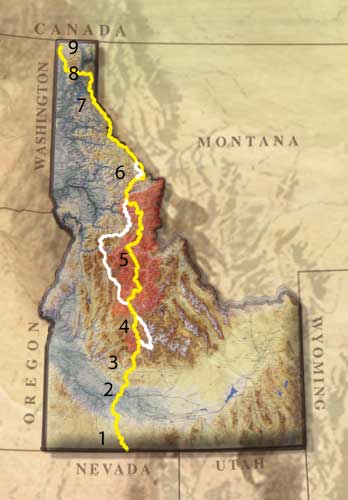
… Idaho Centennial Trail (ICT) is a scenic trail through Idaho. It winds its way through various ecosystems from high desert canyonlands in southern Idaho to wet mountain forests in Northern Idaho. ICT travelers will cross many mountains, streams and rivers in between. …
Depending on exact route, it could be anywhere from 900-1200mi long.
click for more maps
… The ICT was designated as the official state trail during Idaho’s Centennial year in 1990 by the Lasting Legacy Committee of the Idaho Centennial Commission. Since then the number of hikers completing the trail have remained low. …
On recommendation from Andy Howell, I listened to an audiocast on Practical Backpacking, an interview with Brian Frankle of ULA Packs. Brian described his own ICT from North to South.
He was happy to see few people on the Trail.
… In 1998 Stephen Stuebner’s Idaho Centennial Trail Guidebook was published. This guidebook, although well written is considered to be out of date by the Idaho Centennial Trail coordinator, Leo Hennessey. …
Idaho’s Centennial Trail is a work in progress. There are very few trail markings in the middle of the State. Route finding is essential.
Surely you must have heard of the Cougar Traverse:
• Location: Pasayten Wilderness of northern Washington
• Length: 242 miles
• Best season: Mid-July to mid-October
• Features: The longest wilderness route in the lower 48 states. A loop. No road crossings, no resupply, no backtracking.
====
Why haven’t I heard of it?
… Ah. Here’s why:
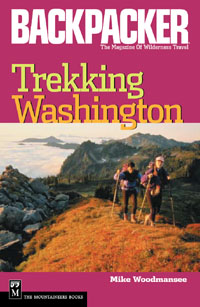
… In fact this isn’t an official trail in any sense. Mike and Kristy Woodmansee created it and dropped it into their 2003 book “Trekking Washington” as a long challenge, far from anywhere else. Their difficulty rating is “toughest”, as it would be if done in the recommended 10 days. …
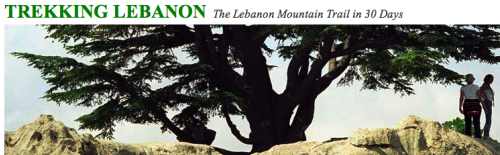
The Lebanon Mountain trail is the first long distance hiking trail in Lebanon and the Arab world (www.lebanontrail.org). It extends 440km. from Qbaiyat in the north to Marjeyoun in the south. It traverses 75 towns and villages at altitudes from 600m to 1900m. The LMT showcases the natural beauty and cultural wealth of Lebanon’s mountains.
The Lebanon Mountain Trail Association organized the first complete thru-walk of the LMT during the month of April 2009. The core group of 7 hikers explored history and culture, as well as the natural beauty of Lebanon.
They blogged the journey, an interesting read with plenty of photos.
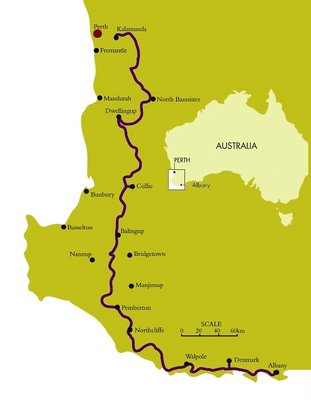
Only about 500 people have completed the Bibbulmun Track, nearly 1000kms (620mi) from Kalamunda in the Perth Hills to Albany on the south coast of Western Australia.
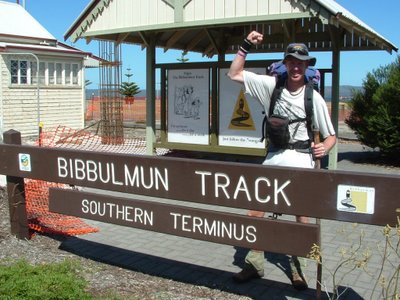
One of those is Dave Tomlinson who posted his 2007 trip report on Our Hiking Blog.
… When I reflect on the entire time I spent hiking the track, I think the first few days were the toughest of all. There is nothing quite like the challenge of carrying a heavy pack over difficult terrain in 40 degree heat. Although the track goes through eight towns, the first one is ten days from Perth. So, my pack was very heavy with supplies and I was stiff and sore during those initial stages. But as I progressed, my muscles began to get attuned to what was expected, my pack gradually lightened and things became easier. …
… Amazingly, I completed the whole distance without even a blister. Apart from some general soreness when I first started, I didn’t have any problems at all. There wasn’t a single day when I didn’t wake up and feel excited by what I was doing. Even on the most physically demanding days I embraced the challenge and never felt any doubt about reaching Albany in good health. The weather was generally very good and my Goretex jacket was often nothing more than my pillow at night. I only had rain on four days in the entire seven weeks. …
To learn more about this amazing tramp, here are the most important links:




 … In fact this isn’t an official trail in any sense. Mike and Kristy Woodmansee created it and dropped it into their 2003 book “Trekking Washington” as a long challenge, far from anywhere else. Their difficulty rating is “toughest”, as it would be if done in the recommended 10 days. …

 besthike.com