Jetboil vs MSR vs Primus stoves

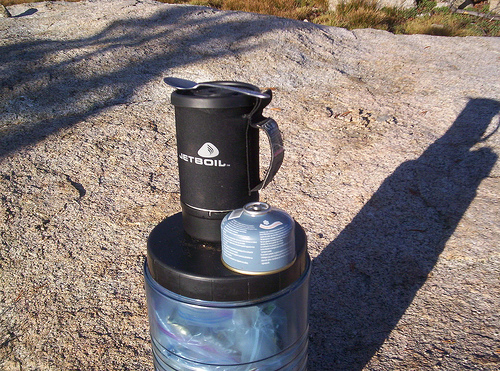
I have been quite happy with my Jetboil stove, after learning the quirks.

Last year Ryan Jordan on the Backpacking Light Magazine podcast did a detailed review of the Jetboil and two copycat competitors.

stoves.jpg

When you next comparison shop for a new camping stove, be sure to include those three on your list.

“Backpacking Light Trends (Audio Program): Integrated Canister Stove Systems,” by Ryan Jordan. BackpackingLight.com (ISSN 1537-0364).

Leave a comment if you have a recommendation.

All-in-one Map Tool review

It’s very rare for me to add any item to my “base” hiking kit. (It’s too heavy already.)

The new essential must be very valuable. Or very light.

The All-in-one Map Tool is both. I carry it with my map and compass.

th_maptool.jpg

Bob Moseley from Brooks-Range Mountaineering Equipment Co. asked me to test this award winning product.

I took it with me on a solo kayak hiking trip out of Bamfield, British Columbia on the west coast of Canada. Since the weather was good, I was able to paddle directly to the Deer Island group, the closest to town.

bamfield-map.jpg

It was a great, relaxing trip. I saw bear, seals, sea lions and nearly stepped on a baby puffin.

Normally mornings on this, the “Shipwreck Coast” are fogged in. On a previous trip to the nearby Broken Group Islands we were a number of times confused in the fog. It’s essential to know where you are on the map, have an exact compass bearing, and a good estimate of your speed and distance to the next island.

The All-in-one Map Tool is ideal in this situation as it has 6 different, easy-to-read map scale rulers to help estimate distance.

586269879_7a1bc34cf1.jpg

More photos from this trip – flickr

Sadly I had atypically excellent weather and did not need to do any dead reckoning in the morning.

So I’ll take it heli-hiking into the Tombstone Mountains in the Yukon in August. Certainly I should have a good chance to get lost there, having to rely on Topo, compass and map tool for survival.

All-in-one Map Tool – US$18 – Brooks Range Mountaineering Equipment Co.

review – Jetboil coffee maker

Some were underwhelmed with my “preferred coffee system”.

jet-boil.jpgPerhaps I need to step up.

Since I’m already using the JetBoil stove / pot combo, I’ll pick up a JetBoil coffee press based on this good review:

Here’s the basics of how the Jetboil French Press works.

1. Get some water and fill up the cup
2. Light up the micro burner
3. Boil the water
4. Scoop in the coffee
5. Stir the coffee into the boiling water
6. Press it on down
7. Drink some amazing coffee on the side of the mountain you’re currently on.

Review: Jetboil French Press Hiking and Camping Personal Coffee Maker | Single Serve Coffee – SingleServeCoffee.com

jet-boil-coffee.jpg

PCT – Mountain Hardwear Sponsorship?

Just so you know, Mountain Hardwear, if you kit me out completely, I’ll be happy to do the PCT and report back on the extended field test.

From the Mountain Hardwear blog:

Our industry professionals have compiled a list of recommended gear which should get you through the Pacific Crest Trail in high spirits. …

* Sleeping Bag/Bivy
* Tent
* Baselayer
* Shells
* Backpacks
* Gaiters
What gear should I bring on the Pacific Crest Trail?

If they deny me that sponsorship, I’ll need to try their Mission Project Challenge (video). Post my trip report on their Mission Project blog.

mission-project.jpg

How do you like my chances?

Mont-Bell lightweight gear

It’s been years since I heard the name Mont-Bell.

The company withdrew from the U.S. market for a long while.

Then I heard Dr. Ryan Jordan of BackpackingLight.com call Mont-Bell one of the top 3 manufacturers of interest to ultra-light hikers. (He did not name the other two.)

I’d love to get to their mothership store in Boulder, Colorado to try the high end gear for myself. It’s difficult to shop over the internet.

Mont-Bell America – official website

mont-bell.jpg

lost overnight – Syncline Loop, Utah

Things can go wrong, fast.

A series of decisions, all which seemed reasonable at the time. Even experienced hikers can get lost in canyon country.

Three friends, planning on a challenging day hike on the standard Syncline Loop in Canyonlands National Park, Utah, got stuck overnight without provisions. One suffered some hypothermia.

Rich posted a detailed account of how it happened:

Now, we didn’t really have much in the way of food. I had brought a few slices of bread, some saltines, a jar of peanut butter and, of course, plenty of water. We each had a similiar supply.

We planned on stopping at the grocery store on our way to Moab but, somehow that slipped our minds. …

So, we figure … we’d probably find a bit of trail food at the visitor center.

Well, we soon found out there was nothing at all in the way of trail food at the visitor center. The Island of the Sky Visitor Center is a little more than a Ranger Station. In fact, I really like Canyonlands because it doesnt have any amenities.

The desert is one place your really do need the 10 essentials. And extra water. Even if setting out only for an hour or two.

They made one last urgent scramble to get up and out.

… we saw … a potential exit. It was crazy and we were all really uncertain but, we pushed on. Every second getting closer to darkness.

Of course, as they do in the desert, temperatures plunged with the setting sun. Thankfully, we still had clear skies and little to no wind. We climbed higher and higher.

… It is endless!!!

For certain, that mile or so was the most intense and rugged hiking I have ever done in my life. Naturally, I loved every minute of it but, my lungs would argue otherwise. We had been on the trail for nearly 10 hours.

No pretty pictures on this post. Just three wiser hikers the following morning when the sun finally came up. Cold, but never in any real danger.

survivors.jpg

Canyonlands National Park – WikiTravel

lost and hypothermic in the Andes

Non-hikers assume that what I do is “dangerous”.

I always pooh-pooh the notion: “It’s more dangerous driving to the trailhead than hiking the trail.”

The only time I really got in trouble was in Venezuela. I learned important lessons the HARD way.

From my 1997 photo travelogue:

9_3.jpg

Mérida boasts the world’s highest (4765m) and longest (12.5km) cable car. Unfortunately, in the 1980s a car on the top crashed killing an undisclosed number of tourists. The last section of the ride up was never repaired. …

Still, I could ride to 4000m and hike from there. Overnight camping is technically illegal so almost no one knew where I was going as I headed up the mountain.

I climbed a ridge. The vista was magic with clouds blowing in and out. I dropped my pack at the first possible tent site & continued up looking for a better spot. The terrain was steep, exposed & rugged. Not many options for a tent.

I knew that at the top of the mountain was The Virgin of the Snows, a statue of the Virgin Mary. She led me on.

On a whim I decided to kiss the Virgin — once the dayhiking tourists had departed for the day.

I was careful to note landmarks on my way up so I could return to the pack. Unfortunately they all disappeared in the clouds.

Blast.

Lost in the Andes above 4000m.
I vainly searched for the ridge back down to my tent, pack and sleeping bag. Finally, as night fell, I resolved to take refuge in a grotto beneath an overhanging rock. I had water but no food.

For 10 hours I huddled shivering, calculating the probability of death from hypothermia in just a t-shirt and fleece pants. I’d like to tell you I learned something from this experience — but I didn’t. It was a drag.

At first light I tried another long route down. What a relief when, four hours later, I bumped into an elderly Swiss couple on the trail! They gave me a cookie & directions. I had been hopelessly lost.

To add insult to injury, officials on the cable car wanted to arrest me for camping illegally.

Lesson learned? Never leave your pack.

Click through my annotated photos from that adventure

OK — hypothermia is no joke:

Early warning symptoms include intense shivering, fumbling hands and poor coordination. Shivering is the body’s attempt to generate heat. A simply field test for mild hypothermia is to try touching your thumb to your little finger on the same hand. If you have difficulty doing this, it’s time to seek shelter and warmth.

Later hypothermia symptoms include slurred speech, mental confusion and unconsciousness. Often victims do not recognize the symptoms and fully understand the dangerous situation they face. The victim needs warmth immediately and protection from further body heat loss. Hypothermia is a medical emergency that requires immediate attention.

Wilderness Survival – Hypothermia symptoms

(via My Outdoor Gear)

Honestly, I estimated that I could survive one more night of hypothermia. But not two.

I’ll never leave my pack again.

You won’t be surprised to learn that I want to return to Mérida, to hike La Travesia Mucuy – Mérida.

map_venezuela1.gif

iPod not recommended above 10,000 feet

Apple 4 GB iPod Nano AAC/MP3 Player Blue (2nd Generation)

This can’t be right:

Maximum operating altitude: 3,000 metres (10,000 feet)

Apple iPod specifications page

My Rio Cali flash drive MP3 player worked perfectly up to 5000m.

Leave a comment if you know of an iPod Nano on Everest or other high peaks.

Likely Apple is being overcautious.

via Around the world(ish)

UPDATE: Consensus of opinion is that flash drive Nano iPods should be OK at altitude. But that spinning disk drive iPods are at risk.

Fedak pointed me to a pilot’s blog: He had problems at 19,000ft unpressurized.

Hard drives work by levitating a head a very small distance from the media; unlike floppy or tape, where the media actually touches the head. The distance between the rotating media and the head is regulated using a very small wing on the head. The head literally ‘flys’ above the media.

When the pressure inside the drive is reduced, the wing will need a higher angle of attack, until finally the wing stalls, and the head impacts the media. The term in the industry for this behavior is called a ‘head crash’. Very apropos, no?

Blogarithms

New Balance 902 – Outside shoe of the year

I’ll be trying the New Balance Men’s 902LW running shoe for hiking.

(The top ranked trail runner is the adidas Men’s J S3 M Trail Shoe. And adidas always fit narrow.)

Since I have bunions, New Balance and Dunham are my preferred brands as they offer wider versions.

New Balance 902 (10.1 oz)

1. A handful of shoes boast construction this light, but most are minimalist racing flats without much structure. Not so with the 902. Thanks to new-tech, lightweight materials—in the cushioning, foam, and even the breathable mesh of the upper—the 902 supports your foot better than many midweight shoes. …

Outside Online – gear of the year – Road Runners

New Balance Men's 902LW

New Balance Men’s 902LW