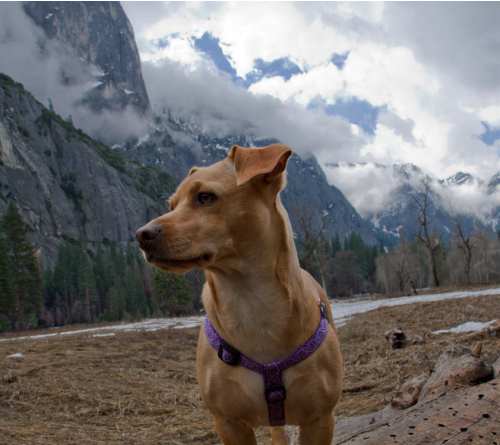
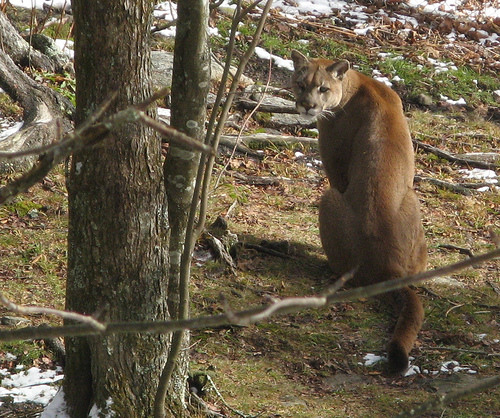
This photo of Munch by Jill Goodell generated some discussion on the Yosemite Blog.
A commenter named Tom suggested he’d be within his rights to shoot a loose dog in Yosemite National Park. It’s illegal to be off-leash.
Seems to me Tom’s not actually threatening to shoot Jill’s dog, but rather was using exaggeration to make a point. Off leash dogs can wreak havoc with wildlife.
Click through to that post if you’ve an opinion to add: Yosemite Blog – The Last Straw
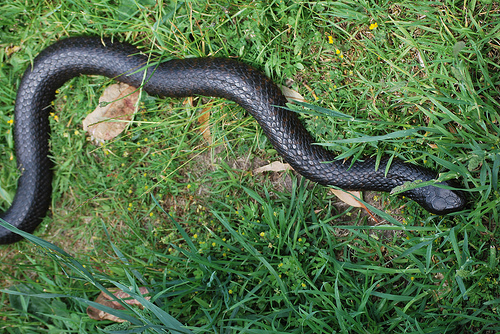
I was on Tasmania for only 2wks yet saw many poisonous snakes. I’m interested in how a Tassie vet like Frank assesses that risk:
Can you share any unique encounters with wild animals?
We don’t really have “wild” animals like bears in Australia. We do have lots of tiger snakes that can kill you. In Tasmania they are quite common and you learn to keep an eye out for them. They love to lie along the side of trail and bask in the sun. I always keep my eyes out for them and wear gaiters to at least protect my legs. The snakes, fortunately, are more scared of us then we are of them and usually disappear quickly. Bites are usually caused when someone (i.e. an idiot) tries to catch or kill one, which is illegal as they are protected species. …
Tourism Newfoundland and Labrador launched another ad in its already very successful ad campaign. This latest ad features Torngat Mountains National Park in northern Nunatsiavut. …
… The park, 9,700 sq.km, is probably one of the most difficult parks in Canada to reach. Even the parks in Nunavut are easier to get to. It’s not only the remoteness, but especially the weather and ferocious winds that make getting here an adventure in itself.
If the weather is good, then the park is about 1 hours’ flying or up to two days by fishing boat north of Nain, Labrador’s northernmost community. There are no scheduled flights or boats to the park, and once you arrive, there are no facilities.
Safety is a real concern, as polar bears roam throughout the park. Since only Inuit are allowed to carry arms, visitors should always be accompanied by an Inuit guide. A good idea in any case, as the area is also infamous for its quickly changing weather and strong “ghost” winds that can appear out of nowhere. …
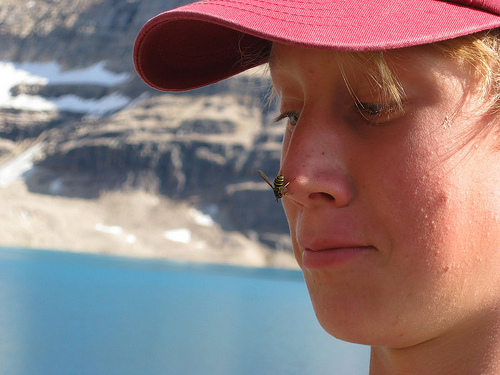
They can be found at altitude on trails most everywhere around the world.
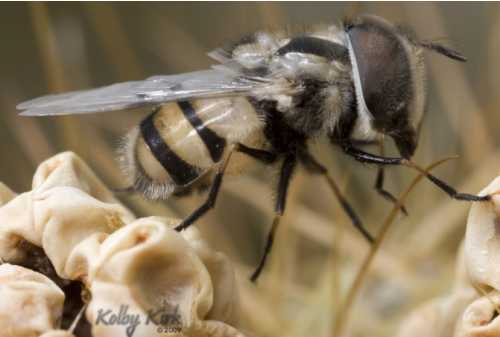
… About 6,000 species in 200 genera have been described. Hoverflies are common throughout the world and can be found on every continent except Antarctica. Hoverflies are harmless to most other animals despite their mimicry of the black and yellow stripes of wasps, which serves to ward off predators. …
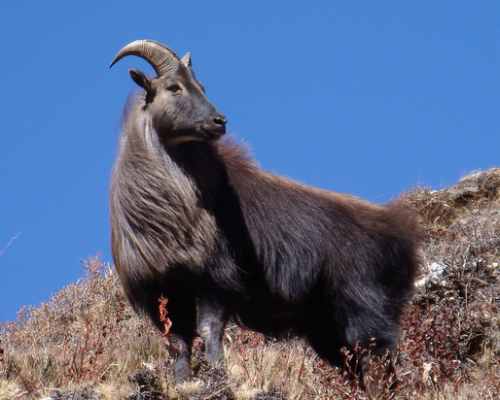
I was disappointed not to see this beautiful animal in Nepal on my recent Everest trek.
The Himalayan Tahr (Hemitragus jemlahicus) (or Himalayan Thar) is a large ungulate related to the wild goat. Its native habitat is in the rugged wooded hills and mountain slopes of the Himalaya from Central Asia in northern Kashmir to China. …
… Adult Himalayan Tahrs range from 135 to 180 kg (300 to 400 lb) in weight, 120 to 170 cm in length, and 60 to 90 cm in height. They are herbivores, subsisting on grass, shrubs, and trees. …
Feral Himalayan Tahr are an introduced species in the South Island of New Zealand, with herds forming in the Southern Alps. In large numbers tahr are regarded as a pest because their browsing has an impact on native vegetation. Tahr hunting is a recreational sport and commercial activity. It has also been introduced to New Mexico, California, South Africa, and Ontario.
The new North Coast Trail is close to the top of my MUST HIKE BEFORE I DIE list.
The North Coast Trail is a 43.1 km wilderness hiking trail in Cape Scott Provincial Park on northern Vancouver Island, British Columbia, Canada.
… in Cape Scott Provincial Park runs along beaches and in forest around the northern tip of Vancouver Island from Shushartie Bay to Nissen Bight. At Nissen Bight it links up with an existing 15 km trail which leads to the trailhead at San Josef River. The total distance for hikers between the trailheads is 61 km. The trail is in a wilderness area and hikers may see deer, elk, black bears, cougars, wolves, sea birds, seals, sea lions, grey whales and sea otters. In two failed attempts, Danish pioneers tried to settle the area at the turn of the twentieth century and the trail incorporates some of their original routes.
Detailed route information is available on the BC Parks – Cape Scott hiking page.