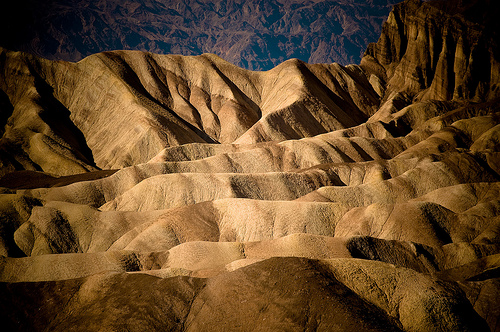

My favourite vista in Death Valley is one of the most popular.
As well as being a curious film by Antonioni (1970), Zabriskie Point is an elevated overlook of a colorful, undulating landscape of gullies and mud hills at the edge of the Funeral Mountains, a few miles from the edge of Death Valley …
Want to see the highest and lowest elevations in the continental USA from one vantage?
Telescope Peak is the highest point within Death Valley National Park, in the US state of California. It is also the highest point of the Panamint Range, and lies in Inyo County. From atop this desert mountain one can see for over one hundred miles in many directions, including west to Mount Whitney, and east to Charleston Peak. The mountain was named for the great distance visible from the summit.
Telescope Peak is also notable for having one of the greatest vertical rises above local terrain of any mountain in the contiguous United States. Its summit rises 11,331 feet (3,478 m) above the floor of Death Valley (Badwater, -282 ft/-86 m) in about 15 miles (24 km), and about 10,000 feet (3,050 m) above the floor of Panamint Valley in about 8 miles (13 km). …
Hiking Telescope Peak by the normal route involves a 14 mile (23 km) round trip hike. The trail starts in the cool western part of Death Valley National Park at Mahogany Flat campground. The trail slowly winds itself up to the summit 7 miles (11 km) later at a steady gradient of roughly 8%. …
This superb, popular hike starts a few miles past the famed Charcoal Kilns.
The beehive shaped kilns were built in the 1870s to make charcoal for local mines. Here is the start of the Wildrose Peak Trail, a good alternative to Telescope.
Though often called “challenging”, I found this hike surprisingly easy. Weather is a big factor. And I tented one night rather than doing the entire big trip in one day as most do.
There are some pretty, rolling miles along a ridge walk. Some hikers do not make it to the top due to feeling ill effects from the 3000ft climb.
The lush high alpine contrasts starkly with bleak Death Valley below.
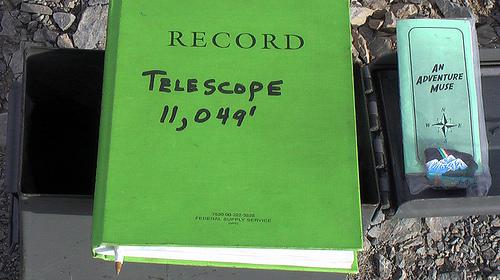
At the peak I found an impressive summit box. To the many souvenirs and prizes that had been contributed, I added a Summit Stone on behalf of artist DSD.
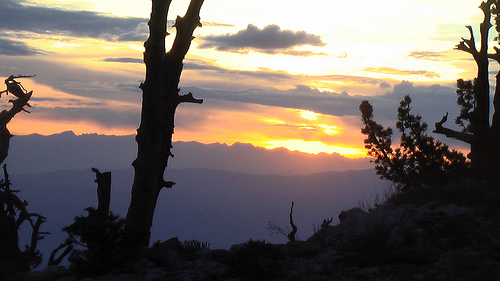
Here’s the sunset view from my campsite.
Mt Whitney and the Sierras
It’s normally snowed in between November and May. You can still hike, but bring crampons.
No hiking permit required. In fact, if driving in from Lone Pine, California in the Sierras, you won’t even be able to buy a Park Pass ($20 for 7-days) which is supposedly required to hike Telescope. This mountain is on the very edge of the Park.
Tom Harrison Maps are available. And several good guidebooks. But this hike is very straight forward. If you can find your way to the trailhead by personal vehicle, you won’t get lost on the trail.
=== Sound too easy? Consider this extreme alternative:
… An established, but more advanced, climbing route is from Shorty’s Well (elevation around -250′) to Telescope Peak. This provides a net gain of elevation of roughly 11,300 ft (3,400 m) The route follows Hanaupah Canyon for over 10 miles (16 km) until Hanaupah Springs is reached. This route can be done in one day by experienced hikers, and has one of the largest elevation gains that can be gained up a single summit. …
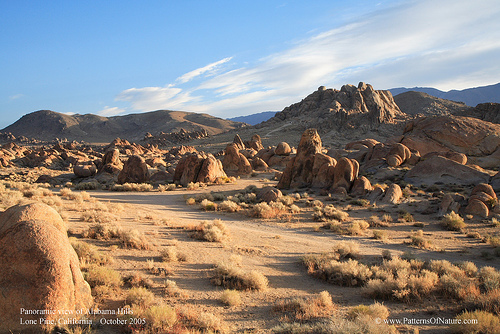
… The Alabama Hills are a popular location for television and movie productions (especially Westerns) set in an archetypical “rugged” environment. Since the early 1920s, 150 movies and about a dozen television shows have been filmed here … Gunga Din, Springfield Rifle, and How the West Was Won, as well as more recent productions such as Tremors and Joshua Tree…. In Gladiator, actor Russell Crowe rides a horse in front of the Alabamas, with Mount Whitney in the background, for a scene presumably set in Spain. Star Trek Generations was filmed here …. More recently, many parts of the film Ironman (film) were filmed here. …
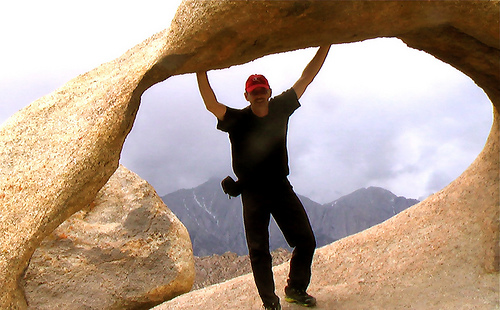
I went to scramble the boulders at dusk. Gorgeous.
… There are two main types of rock exposed at Alabama Hills. One is an orange, drab weathered metamorphosed volcanic rock that is 150-200 million years old. The other type of rock exposed here is 90 million year old granite which weathers to potato-shaped large boulders, many of which stand on end due to spheroidal weathering acting on many nearly vertical joints in the rock. …
Most hikers feel it is too hot in June to do valley hikes safely.
Actually, 100 degrees in the shade and zero humidity is not all that uncomfortable. I took plenty of water. And I love these slot canyons.
Fall Canyon is one of many colorful ravines in the hills surrounding Death Valley in California; shaped by occasional flash floods that flow from the higher mountains beyond, the canyon is remote and little-visited; deep and moderately narrow for many miles, with occasional shaded, cave-like passageways of great beauty. Some of these narrow, twisting sections are enclosed by smooth granitic walls with an unusual bluish tint. As with most other Southwest canyons, the rocks are layered, but quite differently to the orderly slot canyons of Utah – here the strata are multi-colored, buckled, twisted and eroded, the result of ancient geological forces. Fall Canyon is easily reached and offers a perfect wilderness experience, though it should be avoided during the summer months when the weather becomes too extreme.
The highlight comes 2.8mi in when you reach this 20ft wall.
Actually, you’d be crazy to scale this wall without ropes.
Instead look for cairns on the right hand side of the cliff. They lead up to a relatively easy path up and over the obstacle.
The next half mile is the best section.
Location: Fall Canyon is located in the Grapevine Mountains, towards the less-traveled north end of Death Valley National Park. It is close to Titus Canyon, another colorful ravine that is popular because of the rough one-way track that extends through it – this is a 4WD route …
It was cool and cloudy in the Eastern Sierra today.
Nice.
I did several short hikes in the mountains today as a warm-up for Death Valley.
Rick McCharles with Mt Whitney in the background
I’m staying tonight at the excellent new hostel in Lone Pine.
Early Sunday morning I’ll start Telescope Peak in Death Valley. (14mi return)
I’ll tent one night high up where it’s cooler.
Telescope Peak at 11,049 feet is the highest point in Death Valley National Park. The elevation gain from the valley floor to the summit is over 11,300 feet. This extreme elevation change is exceeded in the United States by Mt. Rainier at 11,600 feet, Mt. Fairweather in Glacier Bay National Park at 15,300 feet, and Mt. McKinley’s north slope at 17,000 feet.
Death Valley unfortunately lived up to its name earlier this week, when an Ohio hiker failed to return from a day trip in the park.
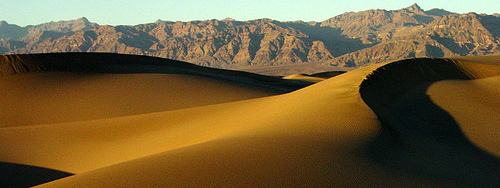
On Tuesday morning, May 19, employees at Death Valley National Park received a report of an overdue hiker in the Mesquite Flat Sand Dunes near Stove Pipe Wells Village. The dunes in that area rise nearly 100 feet above the surrounding desert. …
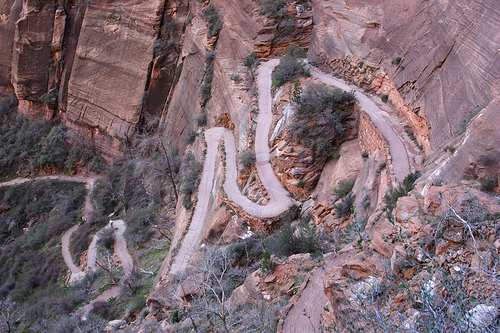
National Parks Traveler points us to an unique feature on the government website for Zion National Park in Utah.
Whether you want to relive a previous trip up Angels Landing, or you’ve never hiked there and want to get an idea of what it’s like, this virtual tour is the way to go. It offers a taste of the wonders of Zion—the sounds of birds calling and the soothing sound of the Virgin River, the sights of pink-hued sandstone cliffs at sunrise and the grand view from the summit.
You control your experience within our virtual tour with videos, pictures, and sounds. All these options come with a price, however—large file size. High-speed Internet access is recommended for viewing the full version of our virtual tour, which may take some time to download. You will also need to have a plug-in installed on your computer — Flash Player. We hope you enjoy your virtual visit to Zion National Park. …
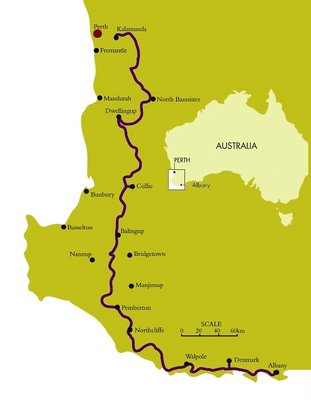
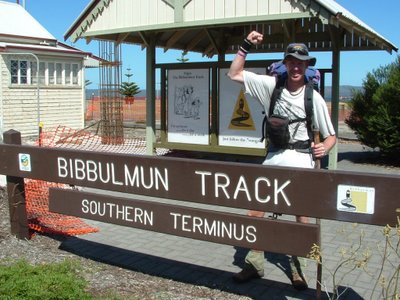
Only about 500 people have completed the Bibbulmun Track, nearly 1000kms (620mi) from Kalamunda in the Perth Hills to Albany on the south coast of Western Australia.
One of those is Dave Tomlinson who posted his 2007 trip report on Our Hiking Blog.
… When I reflect on the entire time I spent hiking the track, I think the first few days were the toughest of all. There is nothing quite like the challenge of carrying a heavy pack over difficult terrain in 40 degree heat. Although the track goes through eight towns, the first one is ten days from Perth. So, my pack was very heavy with supplies and I was stiff and sore during those initial stages. But as I progressed, my muscles began to get attuned to what was expected, my pack gradually lightened and things became easier. …
… Amazingly, I completed the whole distance without even a blister. Apart from some general soreness when I first started, I didn’t have any problems at all. There wasn’t a single day when I didn’t wake up and feel excited by what I was doing. Even on the most physically demanding days I embraced the challenge and never felt any doubt about reaching Albany in good health. The weather was generally very good and my Goretex jacket was often nothing more than my pillow at night. I only had rain on four days in the entire seven weeks. …
To learn more about this amazing tramp, here are the most important links:
– All of the distance from Beijing to Ürümqi has been completed solely on foot, straight good old walking. There are instances where you can see me in the video sitting on a plane or riding a boat, but those are during breaks I had to take from walking, either to sort out bureaucracy issues or to take care of some personal things. …
– The songs I used in the video are 1) Zhu Fengbo – “Olive Tree” and 2) The Kingpins – “L’aventurier” – visit the Kingpins website if you want to know more, they are very cool I think.
– This is not a strict “1 pic a day” video, because I wanted to make it a bit more alive by adding some additional movement. Sometimes during the film you would follow me turn around, or something would happen in the background. I tried to capture these moments to make the video more interesting.