
walking 4132mi down the Nile

Stretching for 4132 miles and crossing through ten countries, the Nile is the longest river on the planet.

… During the 19th century, the river inspired explorers to go in search of its headwaters. Numerous expeditions were mounted to map its length. But none of those explorers ever managed to walk the entire length of the Nile from source to sea.

That’s exactly what two British adventurers intend to do when they launch a 12-month long expedition later this year.

Levison Wood and Simon Clarke are in the final stages of planning for what they call the Walking the Nile expedition. The two men, who met and became friends while serving in the British military, say that they were inspired to undertake this epic trek by fellow countryman Ed Stafford. In 2010, Stafford famously completed a 4000+ mile long trek along the length of the Amazon. That journey helped Wood and Clarke come up with the idea of hiking along the world’s other great river – the Nile. …

British Adventurers Announce Plans to Walk the Length of the Nile

Nile

where’s Dead Burro Canyon?

… I really need to start hiking with a GPS. 😦

I set out into the Arizona desert with typically vague details I found online.

Dead Burro Canyon Trail is a loop hike for the adventurous around a mountain block through a deep scenic canyon in Havasu National Wildlife Refuge, a wilderness setting where very few trails exist. Look for wild burro and Bighorn sheep! …

As expected, I was quickly lost.

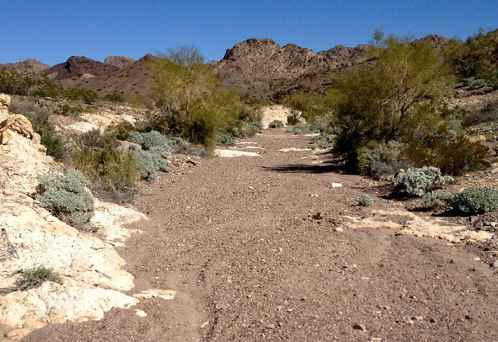
One wash looks much like the next.

wash

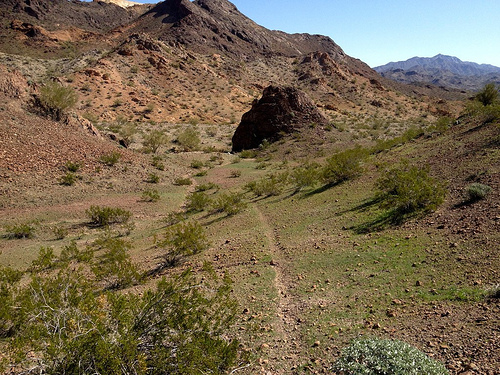
On the other hand, I enjoyed a solo morning off trail. It’s all good in the desert outside Lake Havesu, Arizona in February.

desert trail

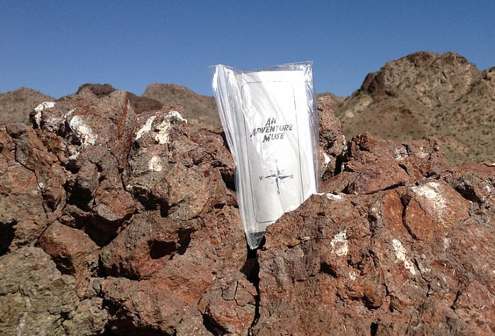
I dropped a Summit Stone atop one random stone mountain.

Summit Stone

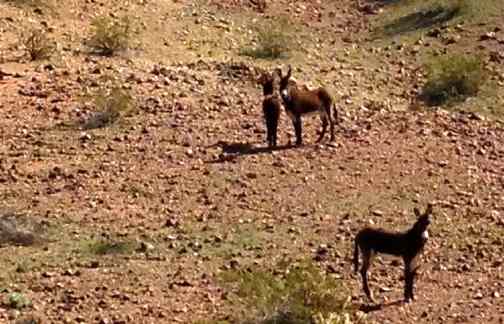
The highlight was finally spotting wild burros. LIVE ones.

burros

There were over 2000 of these beautiful animals running wild in Arizona as of 2010. They are regulated by the Wild and Free-Roaming Horses and Burros Act of 1971.

more photos

If you actually want to reach Dead Burro Canyon, my advice is to download the GPS track.

scrambling Piestewa Peak, Phoenix

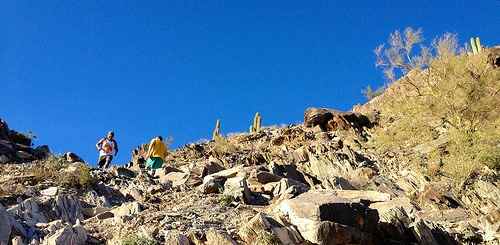
False summits discourage some non-hikers, but I loved the most acclaimed urban peak climb in Phoenix, Arizona.

false_summit

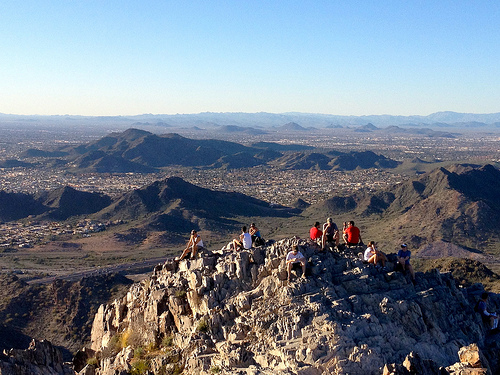
Vistas from the top are fantastic.

summit

… The Piestewa Peak (formerly Squaw Peak) Summit Trail (elevation gain = 1,190 feet in 1.2 miles) is climbed thousands of times per week by locals and visitors seeking a cardio-vascular workout, great views, or a family outing. However, quite a few hikers do not actually reach the top due to the fact that this trail is more difficult than it looks, especially in the summer when temperatures are well over 100 °F. No water is available on the trail and dehydration is a common and serious problem with hikers who come unprepared. …

The hike itself takes anywhere from 15 to 60 minutes depending on each hiker’s capabilities in fair weather (higher temperatures and sunny conditions may force the hiker to take twice as long). A beginning hiker should allow 60 minutes for a leisurely ascent and 30 for descent. The path is mostly well marked.

… There are a few sections that are technically difficult as they are steep and there are no guard rails.

There are approximately fifteen miles of interconnecting trails in the Preserve, ranging from easy to difficult.

Arizona is one of the best places to hike in North America. In February. 🙂

Rick Piestewa

Death Valley timelapse

Adventure Blog:

… some amazing footage from Death Valley, featuring the expected scenic landscapes, interesting light play and changing shadows. But about a minute and ten seconds into the short film the images start to change dramatically, giving us nighttime shots of those same landscapes while billions of stars dance by overhead. The sense of scale that these images generate is nothing short of awe inspiring and makes you realize just how tiny our little rock truly is.

Click PLAY or watch it on Vimeo.

The (almost) Ultimate Arches Loop

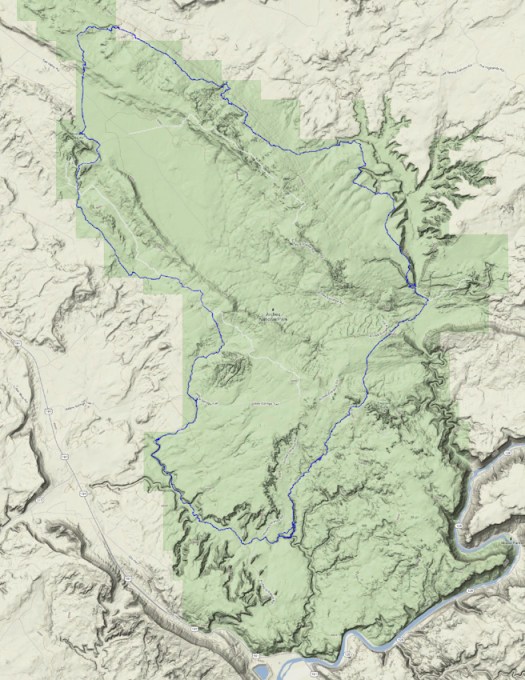
… Getting a back-country permit at Arches is strange. They come just shy of discouraging backpacking and it was apparent that they don’t have many people asking for permits. This is likely due to the small size of the park, lack of water, and lots of absolutely pristine soil crusts (they require that you have camp set up by dusk so you don’t risk walking on soils after dark).

I started the trip at Wolfe Ranch and headed north up Salt Creek. I knew generally what route I wanted to take but had zero beta so knew there would be some adjusting on the fly. The first route change happened pretty much immediately. I had planned on going up Salt Creek and doing some exploring in Lost Creek Canyon, but the canyon above Freshwater Spring looked pretty interesting from the bottom so I decided to head up that way. …

read more on Out. Living.

Fantastic photos.

I assume I saw that linked from Hiking in Finland. Where else?

bike, hike, raft – Cataract Canyon

3 days, 75mi+

Mike:

I had a funny idea a few months ago: Colorado and Utah are at the low (we hope) ebb of a 10-year drought cycle, meaning our trails are desiccated and our rivers low.

… it occurred to me that this would be an *ideal* time to use fatbikes to access Cataract Canyon, taking advantage of the low flows therein to float it with packrafts.

Big Wheel Building

Click PLAY or watch it on Vimeo.

Here’s another VIDEO edit from the same trip.

(via Hiking in Finland)

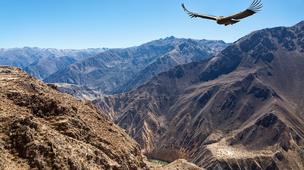
Colca Canyon, Peru

BBC and Lonely Planet posted an article on one of the best hikes in the world:

Most first-time visitors to Peru make a beeline for the ruins of Machu Picchu, without realizing that they are passing within a bus ride of the epic Colca Canyon.

Slicing through the High Andes like a giant fissure for more than 100km, Colca is the world’s second deepest canyon, approximately 3,400m at its deepest point — a shade shallower that the nearby Cotahuasi Canyon and nearly twice as deep as the US’ Grand Canyon. …

With a few days to spare and minimal planning, it is easy to shoehorn Colca Canyon into a wider Peruvian trip. The area is best accessed via Arequipa, Peru’s second largest city …

The Calera hot springs are an acclimatizing 3km walk up the valley to a scenic spot by the Colca River. Once there, recline in a simple alfresco pool as screaming zip-liners slide terrified across the canyon overhead. The zip-line stretches for 600mbetween the canyon walls simulating the flight path of an Andean Condor. …

read more – Exploring Peru’s epic Colca Canyon

Check our Colca Canyon information page.

Consider climbing 5822m (19,101ft) Misti Volcano on the same trip.

You need enough time for acclimatizing to altitude, of course.

Edward Abbey – “I Loved it…I Loved it All”

Ned Judge:

An eight minute film essay that I co-produced and directed with Ed Abbey in 1985. …

We met in Moab and went out to Arches National Park to shoot some practice sessions with a home video camera. We would review them at the motel in the evening. After a day or two, Ed was feeling pretty comfortable on camera so we scheduled the shoot. We were all happy with the way it went.

But then we ran head-on into network reality. Roger Mudd, the show’s host, was extremely negative about putting an “eco-terrorist” on the show. … So this Abbey essay was put on the shelf and never aired.

Abbey died 3 years later in March 1989.

Click PLAY or watch it on Vimeo.

Edward Paul Abbey (January 29, 1927 – March 14, 1989) was an American author and essayist noted for his advocacy of environmental issues, criticism of public land policies, and anarchist political views. His best-known works include the novel The Monkey Wrench Gang, which has been cited as an inspiration by radical environmental groups, and the non-fiction work Desert Solitaire. Writer Larry McMurtry referred to Abbey as the “Thoreau of the American West“. …

The story of his death and burial is … very Abbey.

Those two books are MUST READS for any serious outdoorsperson.

(via Rocky who calls Edward Abbey the Hunter Thompson of the environment)