researching Iceland hiking

Buzz sent me a link to Andrew Skurka‘s 2008 adventures.

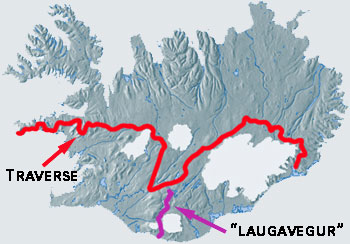
I’m no Skurka. My longest trip will be the 49-mile Laugavegur, in purple.

Preparing that itinerary, Skurka interviewed Jonathan Ley who did a huge trip in 2006.

From what I can see, it looks pretty easy to hike the established trails in June, the driest month. I’ll have a week in a rental car to reconnoiter and cache food, if necessary.

Leave a comment if you have any advice.

Mt Asgard, Baffin Island – the movie

More rugged and remote than the Himalayas.

The Asgard Project – OFFICIAL Climbing Teaser – Posing Productions

Click PLAY or watch the trailer on YouTube.

… objective to make the first free ascent of the west face of Mt Asgard on Baffin Island. Like that’s not an awesome enough feat in itself the journey there will be pretty special involving training trips to Riglos in Spain, Brento in Italy and Yosemite in California! …

Posing Productions

The film crew hiked in to this location in 5 days.

(via The Adventure Channel)

want to hike Torngat, Labrador?

It ain’t easy

Tourism Newfoundland and Labrador launched another ad in its already very successful ad campaign. This latest ad features Torngat Mountains National Park in northern Nunatsiavut. …

bluepeak.net – New Labrador ad

Click PLAY or watch it on YouTube.

… The park, 9,700 sq.km, is probably one of the most difficult parks in Canada to reach. Even the parks in Nunavut are easier to get to. It’s not only the remoteness, but especially the weather and ferocious winds that make getting here an adventure in itself.

If the weather is good, then the park is about 1 hours’ flying or up to two days by fishing boat north of Nain, Labrador’s northernmost community. There are no scheduled flights or boats to the park, and once you arrive, there are no facilities.

Safety is a real concern, as polar bears roam throughout the park. Since only Inuit are allowed to carry arms, visitors should always be accompanied by an Inuit guide. A good idea in any case, as the area is also infamous for its quickly changing weather and strong “ghost” winds that can appear out of nowhere. …

bluepeak

Fjällräven Classic – a hiking race

Fjällräven, a Swedish company specialising in outdoor clothing, sponsors an annual hiking race.

Hiking race?

I’ve never heard of this concept before. And 2000+ partipants attended this year!

The competition element is downplayed, however. It’s not in the same category as most other trail races. In this event, you must carry a pack. And sleep in a tent. Most people do it for FUN.

photographer: Kikki Brink

Under the RULES, it seems littering is the biggest breach – immediate disqualification! (I do like that.)

Participants walk from Nikkaluokta 110km to Abisko. (This is the first section of the famed Kungsleden trail. Of the 2000 racers, some no doubt continue to the end of that 440km (270mi) through hike.)

Medals are awarded: Gold if you finish in less than 72hrs, Silver less than 96hrs, Bronze under 120hrs.

Jörgen
Jörgen

Jörgen Johansson finished fastest in 2009, 13hrs 25min.

official website – fjallraven.com/classic

Johannes Huwe posted a report on his Trailblaze blog. He took home a gold.

Laugavegur Tour, Iceland

After many, many hours trying to find a good deal on airfare. And rent-a-car. I finally gave up on trying to hike the island nation this summer.

I’ll start months in advance next time. And travel off-season.

Here’s what I missed …

Landmannalaugar
Landmannalaugar

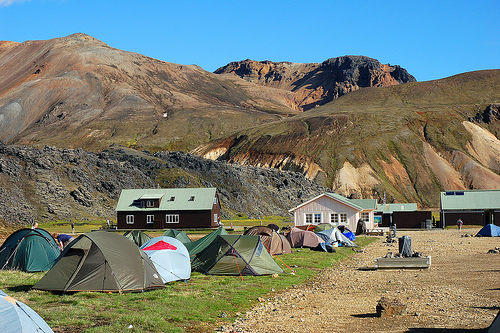
… Arguably the most famous hiking tour in Iceland is the Laugavegur Tour. Traditionally done north to south, the trek begins at a drop off point called Landmannalaugar. This tiny launch pad is a destination in its own right, in fact I would argue that it is the single most beautiful place I have ever been.

The area consists of one small hut (sleeps 80), a large campground for trekkers, a small building with sinks, toilets and showers, a covered eating area, an old school bus turned store, and the most coveted of all… a large natural hot spring that serves as swimming pool, meeting place, bath, warming room and of course bar. …

read the trip report on DolomiteSport – Iceland Laugavegur Tour (Aug. 2009)

Check out the PatitucciPhoto Iceland Trekking Photos for inspiration.

I’ve not found a good hiking guidebook for this trek, certainly one of the World’s best.

Canada, Russia new National Parks

The Great White Norths.

… the Russian government created a new Arctic park for endangered wildlife, banning all industrial activity on and around the northern tip of Novaya Zemlya, a long island that stretches north into the Arctic Circle, south of Franz Josef Land’s popular spring break beaches.

Outside Blog

Much better, me thinks, is the newly expanded Park in my homeland.

… the Canadian government finalized the expansion of the Nahanni National Park on the border of the Northwest Territories and the Yukon. …

After a 35-year effort from CPAWS, the seven-fold expansion adds the granite formation known as the Cirque of the Unclimbables, one of Canada’s best big wall climbing venues, to the National Park.

… read more – Outside Blog

Cirque of the Unclimbables - click for larger photo

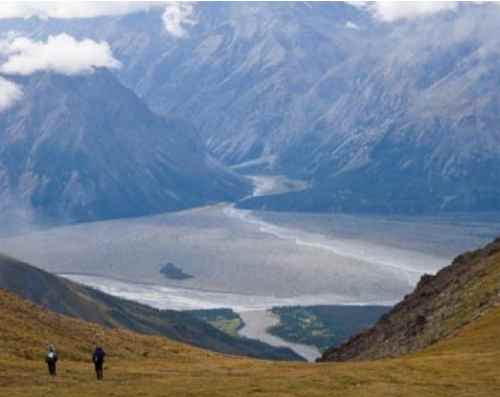
Donjek Route hike, Kluane, Yukon

Polly Evans posted a terrific trip report on Great Outdoors.

80mi, 9 days — this trip was epic.

… The Donjek Route, Parks Canada emphasizes, is not a trail. “Wilderness travel experience is essential, including excellent route finding skills, map and compass skills, and creek/river crossing skills,” the rangers insist in their literature. I had none of these estimable qualities. …

donjek1

read the entire article – Into the Yukon’s Kluane National Park

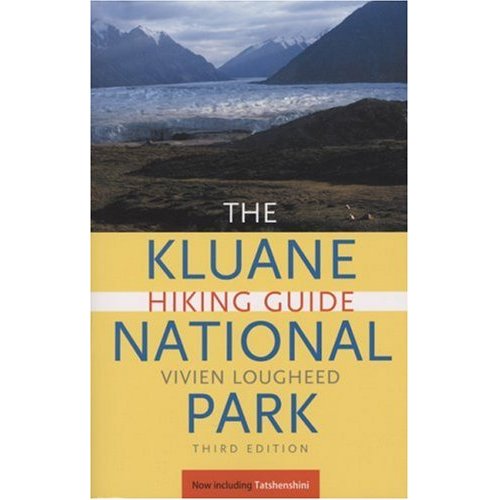
Polly recommends this guidebook:

kluane-hiking-guidebook

Kluane National Park Hiking Guide by Vivien Lougheed.

Polly Evans an award-winning travel journalist and author. Her latest book, Mad Dogs and an Englishwoman, tells the story of her attempts to learn to drive sled dogs in Canada’s Yukon Territory.

adventurer rewarded for stupidity?


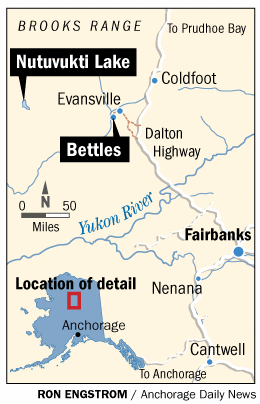
map-of-brooks-rangeDavid Roberts was air rescued in Alaska this past summer at a cost of over $90,000.

Though he had a lot of experience with arctic wilderness in Saskatchewan, the media is reporting that he was totally unprepared, and a “goofy guy”.

Roberts, a 54-year-old Australian, was trying to walk almost 100 miles across the Brooks Range wilderness when he set off a long-distance distress call on Friday. He’d been out there alone for two months.

He hauled a 140-pound sled full of supplies behind him, he said. A persistent stomach bug left him dehydrated while frequent, stabbing pains pierced his cold feet.

He traveled fewer than 40 miles in two months — far less than he’d expected.

Alaskans have little patience for seemingly ill-prepared adventurers, and news of the rescue prompted comparisons to another explorer who trekked into the wilderness 16 years ago — Chris McCandless. McCandless starved to death after trying to survive on his own for more than three months near Denali National Park.

Roberts didn’t know who would have to pay for his rescue when he made the decision to get help, he said. “I didn’t presume that somebody else was going to pick up the tab on that.” …

Anchorage Daily News – Adventurer’s wilderness trek ends with air rescue, free hotel

Roberts will not be billed for the rescue costs.

every McKinley hike a horror story

I visited Denali in Alaska last year.

But it was too miserably overcast to hike far.

Has anyone ever had a GOOD hike there?

This trip report by Hank Leukart on Without Baggage is typical of others I’ve read:

… the best place to cross a braided river like the McKinley is at its widest point, when the river’s water spreads across many channels (or braids). The individual channels are shallower and slower moving than at river’s narrowest point, where all of the braids are combined into a dangerous, freezing, fast-moving current. Using our topographical map and compass to guide us, we walked to the river’s widest point and began crossing.

Each braid was harder than the previous; at first the water only reached our shins, but in later braids it reached our knees, our waists, and eventually, about halfway through our crossing, it reached our chests. Silt made the water opaque, so we painstakingly searched for the best place to cross each braid by throwing rocks into the water to test depth as we slogged through a labyrinth of rock bars between braids. We used all of the crossing techniques we knew (facing upstream, walking sideways, using walking sticks, and stabilizing against each other), but the crossing became progressively more difficult as the river became deeper and we became colder and wetter (water at 36 degrees Fahrenheit without a dry suit is unbearable for any length of time).

Eventually, we became trapped on a small rock bar with very little space to move up or down stream. We knew (by throwing rocks) that the next braid was at least as deep as the last, but there wasn’t much we could do to change the situation without crossing braids in reverse and moving backward, so we decided to try crossing the next channel from our current position. As we stepped in, the water reached above our waist, but we knew it would be passable. Then, we took a second step and discovered that the river-bottom had a sheer drop-off.

In an instant, water was above our heads and we were floating downstream at 20 miles per hour in 36-degree water with 45-pound backpacks strapped to our backs.

As I looked into my brother’s eyes, I could see that he thought we were going to die, and I telepathically agreed. I thought to myself, “This is how those stupid people you read about in newspapers die in the wilderness.”

mckinley.jpg

Did they drown?

Or was it another Alaskan sufferfest? Off route? Running out of food?

Click through to find out – Accepting Wet Feet.

The photography is terrific.

bear2.jpg
link

related post: hiking in Alaska … disappointing
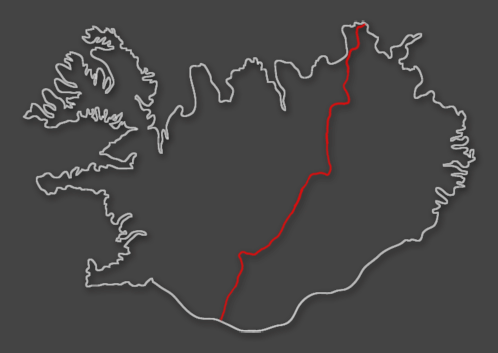
trekking across Iceland

Hardcore hiker Jonathan Ley has done the Continental Divide Trail and Pacific Crest Trail.

But I was most interested in his unique adventure in Iceland:

iceland-map.jpg
larger version

The photos are terrific:

iceland13.jpg

iceland17.jpg

iceland19.jpg

more photos

I really want to trek Iceland after seeing them!

Why Iceland?

When I was hiking the CDT, I had a lot of time to dream-up other hiking trips all over the world. One of those was a hike across Iceland… No particular reason, it sounded like it’d be interesting. When my friend Dave mentioned that he had the same idea, it seemed meant to be. The trip was a lot more enjoyable and safer with a traveling companion.

Iceland is a unique place. It is located along the Atlantic rift, where the earth’s crust is separating. As a result, there are a lot of geothermal features (volcanoes, hot springs, etc) all over the country. Iceland is quite far north – the Arctic circle was just offshore from our starting point – but, the climate is kept somewhat temperate by ocean currents. The land is one of stark beauty, shaped by ice, wind, and volcanoes.

How long was the route?

Even after completing the hike, I’m still not sure. Our best estimate was somewhere around 360-380 miles.

When did you hike?

We started on June 23, 2006, and finished on July 11, 2006.

Where / how did you resupply?

The population of Iceland is a sparse 300,000, and most of those live near Reykjavík. Virtually nobody lives in the interior. Still, we passed through a couple areas where we could resupply. There is a small town near the lake Mývatn in the north, and a summer “backpacking village” at Landmannalauger in the south. We sent packages to both places, but it’s possible to buy provisions “as you go”.

Has anyone else done this?

People have hiked across Iceland via a number of routes, but each trip has probably been somewhat unique, and the total number is likely small. Since returning from the trip, I’ve been contacted by at least one other American who completed a similar trip a number of years ago… I’m not sure if there are more. …

FAQs